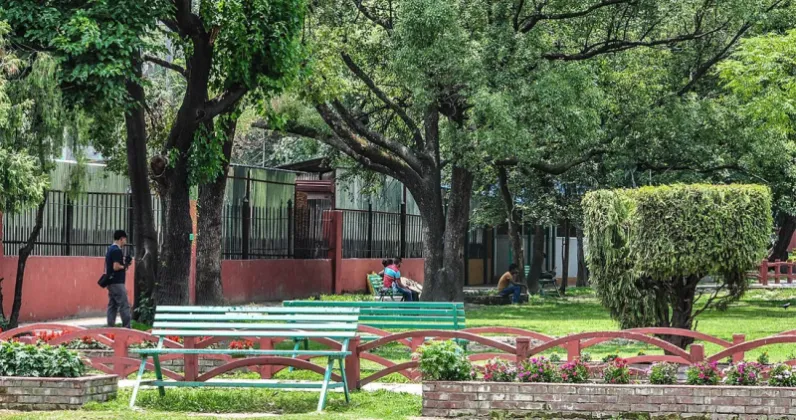
Nepal's park and garden culture is quietly changing. According to an explainer published by Ratopati in both Nepali and English, the country's long-standing tradition of coming together in open, shared spaces is shifting away from time-honoured venues such as the chautari and the home courtyard toward modern urban parks, hotel gardens, and party palaces. The report notes that these newer settings are now widely used for meetings, gatherings, discussions, and social events, a change that reflects how public life in Nepal is being reorganised around different kinds of green and leisure spaces.
From Chautari and Courtyard to the Urban Park
For generations, the rhythm of Nepali social life followed the contours of its traditional public spaces. The chautari, the raised resting platform familiar along trails and in village squares, and the courtyard of the family home served as the default venues where people met, rested, talked, and marked occasions together. These spaces were not designed as parks in the modern sense, yet they performed the same function: they gave communities a shared outdoor setting in which to gather.
The explainer describes a decisive movement away from that model. In its place, modern urban parks, hotel gardens, and party palaces are becoming the preferred backdrops for social interaction. The shift is not framed as the disappearance of tradition, but as a relocation of it: the gatherings that once took place in a chautari or a family courtyard are increasingly being hosted in purpose-built or commercially managed green spaces. The English-language explainer presents this as the defining feature of Nepal's changing park and garden culture.
New Venues for Meetings, Gatherings and Celebrations
What stands out in Ratopati's account is the range of activities that these modern venues now host. According to the explainer, urban parks, hotels, and party palaces are increasingly used for:
- Meetings and discussions, as people seek organised, comfortable settings for conversation
- Gatherings, where friends, families, and communities come together in shared green space
- Social events, for which hotels and party palaces in particular provide managed, ready-made settings
The movement of these functions into parks and gardens marks a change in what a Nepali public space is expected to do. Where the chautari or courtyard once served informal, organic gathering, the modern park or event venue offers a curated environment: landscaped, maintained, and equipped for organised use. The explainer presents this as the hallmark of the new culture, spaces that are planned and serviced rather than simply inherited. The old and the new coexist, but the balance of activity is visibly tilting toward the modern venue.
Framing the Trend: From Chautari to Eco-Tourism
The Nepali-language version of the report frames the same development in a distinctive way, describing it as a journey from the chautari toward eco-tourism. That phrasing links the everyday transformation of social space to a larger idea: Nepal's green spaces are being reimagined not only as places to meet, but as destinations in their own right, connected to leisure and the wider visitor economy.
Both versions of the article are presented as explainers rather than breaking news. They do not report a single incident, decision, or announcement. Instead, they step back to describe a pattern that has been unfolding over time, documenting how the venues of Nepali social life have migrated from the traditional to the modern. The explainer format suits the subject well: the shift in park and garden culture is gradual and cumulative, visible in daily life rather than in any one event.
A Culture in Transition
Taken together, the two reports sketch a society whose shared spaces are evolving alongside its urban development. The chautari and the home courtyard belong to a pattern of life in which public and private spheres overlapped in open, informal settings. The urban park, the hotel garden, and the party palace belong to a different pattern, one in which gathering is arranged, hosted, and often paid for.
Ratopati's explainer does not treat this as a loss or a gain, but as a shift in emphasis worth recording. The functions of the traditional space - rest, conversation, community - have not vanished; they have moved. What has changed is the setting, from the resting platform of the village to the landscaped grounds of the modern city, and, in the framing of the Nepali version, from the chautari toward eco-tourism.
For now, the explainer stands as a record of a culture adjusting to new surroundings. Nepal's park and garden culture, the reports suggest, has not abandoned its past so much as rehoused it, carrying the meeting, the gathering, and the celebration out of the chautari and the courtyard and into the parks, gardens, and party palaces of contemporary urban Nepal.