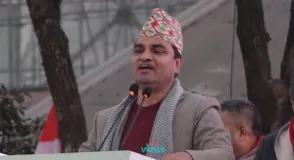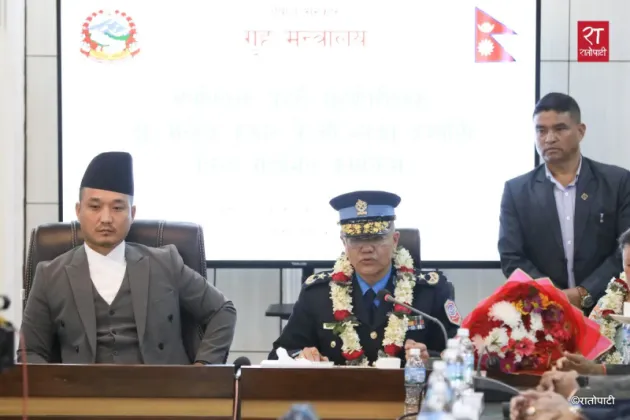
Kathmandu: Home Minister Sudhan Gurung on Wednesday conferred the insignia of rank on Dr. Manoj KC, the newly appointed Inspector General of Police, at a function held in Kathmandu. The ceremony formally marked the assumption of the top command of the Nepal Police organization by its new chief. Speaking on the occasion, Minister Gurung directed the police organization to work effectively in maintaining peace and security, controlling crime, managing disasters and delivering services to citizens, and stressed that the distance between the police and the public must be done away with.
A Formal Ceremony to Hand Over Command
The conferral of the insignia of rank is the formal ritual through which a newly appointed police chief receives the symbols of the office he is set to lead. That the Home Minister, the member of the cabinet responsible for the country's security administration, personally conferred the insignia on Dr. KC underlined the government's direct interest in how the police organization performs under its new leadership.
According to a report by RatoPati, the event took place in the capital on Wednesday, with the minister using the platform not merely to congratulate the incoming chief but to lay out his expectations from the entire organization. Such occasions are traditionally used by the government to signal its priorities to the security apparatus, and Gurung's address followed that pattern, combining the ceremonial handover of command with a clear set of instructions.
For the Nepal Police, the ceremony marks the beginning of a new leadership phase. The Inspector General of Police heads the organization and is responsible for steering its day-to-day operations as well as its long-term direction, which means the directives issued at Wednesday's function will be closely watched as a benchmark for the new chief's tenure.
A Four-Front Mandate for the Police
In his remarks, Minister Gurung identified the broad fronts on which he expects the organization to deliver. His instruction, as reported, was that the police work effectively in four areas: maintaining peace and security, controlling crime, managing disasters and delivering citizen services. Taken together, these form the core of the mandate the government has handed to the incoming leadership.
Peace, Security and Crime Control
Maintaining peace and security remains the foundational duty of the police, and Gurung placed it first in his list of priorities. Crime control, likewise, is the function through which citizens most directly judge the performance of the force in their daily lives. By naming these two areas explicitly at the very moment the new chief received his insignia, the Home Minister made clear that the government expects visible effectiveness on the ground, not merely administrative routine, from the organization under Dr. KC's command.
Disaster Management and Citizen Services
The minister also drew attention to responsibilities that go beyond conventional law and order. Disaster management is a field in which the police organization is regularly called upon to act, and Gurung's directive indicates that he expects the force to remain prepared and effective in that role. Equally significant was his emphasis on the delivery of citizen services, an area that shapes the everyday interaction between the state's security machinery and the people it serves. The message was that service delivery is not a secondary function but a measure of the organization's overall performance.
Closing the Gap Between the Police and the Public
The most striking element of the Home Minister's address was his remark on the relationship between the force and the people. He said the gap between citizens and the police must no longer remain. The statement effectively framed public trust and proximity, rather than authority alone, as the standard against which the organization should assess itself.
By raising the issue at the insignia conferral ceremony, Gurung tied the police leadership's formal assumption of office to a question of public confidence. His words suggested that the effectiveness he demanded in security, crime control, disaster management and service delivery is inseparable from how close the police stand to the citizens they serve. For the incoming chief, the remark sets a tone for the tenure that begins with this week's ceremony in Kathmandu.
The Road Ahead for the New Police Chief
Wednesday's function, in effect, handed Dr. KC both the insignia of his office and a clear statement of the government's expectations. The directives issued by Home Minister Gurung, covering peace and security, crime control, disaster management and citizen services, now constitute the agenda against which the new leadership of the police organization is likely to be judged.
The conferral of the insignia on the newly appointed Inspector General of Police in Kathmandu thus closed one chapter and opened another: a new chief has taken symbolic command of the force, and the government has publicly spelled out what it wants from him. How the organization responds to the instruction that the gap between the police and the citizens must no longer remain will now depend on the performance of the force under Dr. Manoj KC in the period ahead.