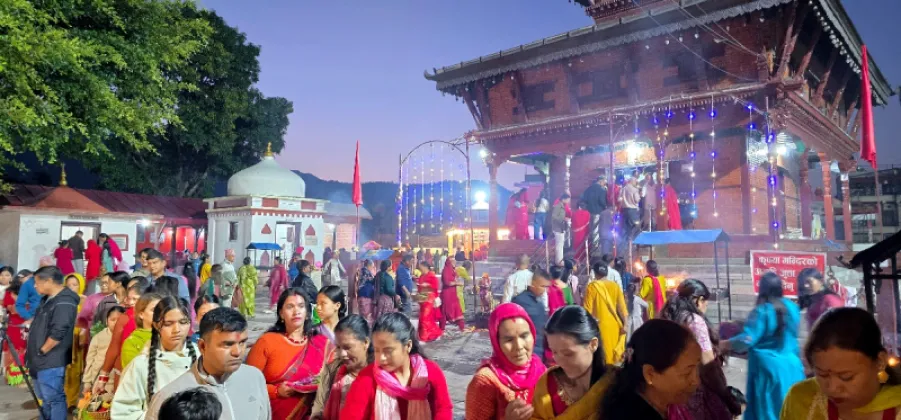
Devotees across Nepal observed Maha Ashtami, the eighth day of the Bada Dashain festival, with special worship of Goddess Durga Bhavani at Dashain Ghar, Kot and various Shakti Peeths across the country. Because this year's Ashtami tithi fell across two days, Ashtami worship and fasting were performed on both Sunday and Monday. The observance was followed by Maha Navami, marked on Ashwin Shukla Navami with special worship of Navadurga Bhagawati, as the nation moved through the most devotionally significant stretch of its biggest festival.
A rare two-day Ashtami
Maha Ashtami occupies a central place in the Dashain calendar, as devotees worship Durga Bhavani in her principal forms of Mahakali, Mahalakshmi and Mahasaraswati. This year, the Ashtami tithi, the eighth lunar day of the bright fortnight of Ashwin, extended over two days. As a result, temples and households conducted Ashtami rituals on both days, and devotees observed fasting and offered special worship on Sunday as well as Monday.
The three forms of the goddess worshipped on the occasion are traditionally understood as follows:
- Mahakali, revered as an embodiment of power and protection
- Mahalakshmi, honoured as the goddess associated with wealth and prosperity
- Mahasaraswati, worshipped as the goddess linked with knowledge and the arts
Worship at Dashain Ghar, Kot and Shakti Peeths
As reported by Nagarik News, special worship of Durga Bhavani was organised at Dashain Ghar, Kot and various Shakti Peeths across the country. Shakti Peeths, the shrines dedicated to the worship of the goddess, serve as the focal points of ritual activity during the festival, and the eighth day of Bada Dashain is among the most important for devotees seeking the blessings of Mahakali, Mahalakshmi and Mahasaraswati. The two-day observance this year gave worshippers an extended opportunity to complete their fasts and offerings in accordance with the lunar calendar.
Maha Navami and the offering of jamara
Following the extended Ashtami observance, the festival moved into Maha Navami, celebrated on Ashwin Shukla Navami, the ninth lunar day. The day was dedicated to the special worship of Navadurga Bhagawati, the nine forms of Goddess Durga. Khabarhub reported that special worship of Navadurga Bhagawati was carried out as part of the Navami observances, continuing the sequence of devotion that defines the middle days of Bada Dashain.
A distinctive feature of this year's Navami rituals was the offering of jamara at various Shakti Peeths. The jamara, which had been kept and nurtured since Ghatasthapana, was presented to the goddess as part of the ninth-day worship, formally linking the ceremonies of Navami back to the very beginning of the festival.
The journey of jamara from Ghatasthapana to Navami
The offering of jamara on Maha Navami underlines the continuity that runs through the Dashain rituals. Ghatasthapana marks the start of Bada Dashain, when the jamara is first kept for the festival, and its subsequent offering at Shakti Peeths on Navami completes a ritual cycle that devotees follow across the nine days of worship. By the time the jamara is offered to the goddess, it has been preserved since Ghatasthapana, making the Navami rituals a culmination of the worship that began on the festival's first day.
Ritual sacrifices and vegetarian alternatives
The eighth and ninth days of Dashain are traditionally the days when offerings to the goddess are at their most elaborate. Accordingly, sacrifices of goats, ducks, chickens and buffaloes were performed at Dashain Ghar, Kot and other temples across the country as part of the Ashtami and Navami rituals. These sacrifices form a central element of the worship for many devotees, who present the animals to the goddess during the most sacred days of the festival.
At the same time, the observances accommodate devotees who follow different practices:
- Devotees who take part in sacrificial worship offered goats, ducks, chickens and buffaloes at Dashain Ghar, Kot and other temples.
- Vegetarian devotees offered pumpkin and gourd in place of animals, presenting these produce items as their offerings to the goddess.
The practice of offering pumpkin and gourd allows those who do not offer animal sacrifice to participate fully in the same ritual framework, ensuring that the worship of Durga Bhavani during Ashtami and Navami can be observed in accordance with individual beliefs and customs.
The heart of the Dashain observances
With Maha Ashtami observed over two days and Maha Navami following immediately afterwards, Nepal has now passed through the core days of worship in the Bada Dashain festival. The special worship of Durga Bhavani and Navadurga Bhagawati at Dashain Ghar, Kot and Shakti Peeths across the country once again highlighted the festival's distinctive blend of fasting, offerings, sacrifice and age-old ritual practice. From the jamara kept since Ghatasthapana to the offerings made at Shakti Peeths on the ninth day, this year's observances reflected both the continuity of tradition and the flexibility that allows devotees across the country to mark the festival in their own way.