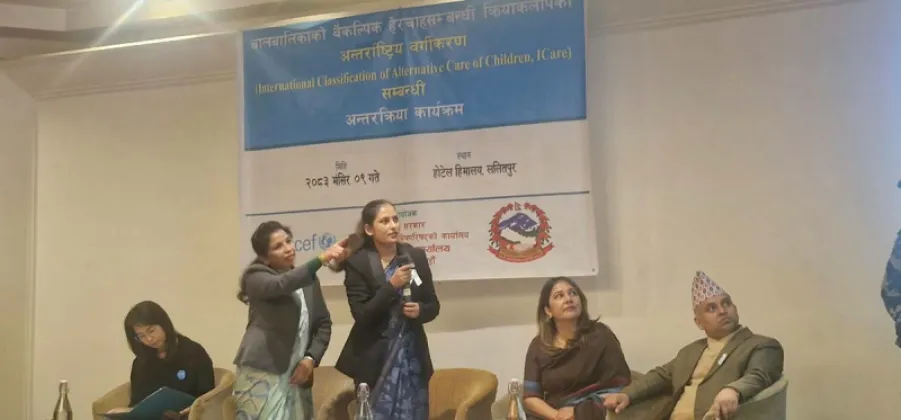
Nepal has begun a new initiative to identify the real situation of thousands of children who are without parents and remain outside the records of the state. Stakeholders speaking at an interaction in Lalitpur on Wednesday stressed that accurate data must be collected from the local level to determine the actual condition of these children and to make child safety and protection systems more effective.
The interaction, focused on the International Classification of Activities for Children and Alternative Care, was jointly organised by the National Statistics Office (NSO) and UNICEF. Participants agreed that the country currently lacks clear information about children who fall outside formal state care, making it difficult to design policies and programmes that address their needs.
Why a New Counting System Is Needed
According to the national census, around 350,000 children in Nepal are living in alternative care arrangements. However, stakeholders pointed out that the condition of these children remains unclear, as existing records do not capture details about where they are, who is looking after them, or whether their basic rights are being protected.
To address this gap, the data on such children is now to be coded in a new way under the international classification framework. The initiative aims to produce detailed, disaggregated information that can reveal the true picture of children outside parental care, including those living with extended family members, in institutions, or on the streets.
- The national census records approximately 350,000 children in alternative care.
- The circumstances of these children have not been clearly documented so far.
- A new coding system based on the International Classification of Activities for Children and Alternative Care will be applied to the data.
- Data collection will begin at the local level, where the actual situation of children is most visible.
Role of Local Levels
Speakers at the interaction emphasised that the federal, provincial and local governments all have a role to play, but the foundation of accurate data must be laid at the local level. Ward offices and local governments are in the best position to identify children who are without parents, are living in vulnerable conditions, or are invisible to official records.
Participants at the event also called for making child safety and protection mechanisms effective across the country. They argued that without reliable, up-to-date data on children outside state care, neither budget allocation nor service delivery can be properly targeted. The interaction highlighted that a systematic classification of children's living arrangements would help authorities identify which children need family-based care, which need institutional support, and which require immediate protection interventions.
Collaboration Between NSO and UNICEF
The partnership between the National Statistics Office and UNICEF reflects a broader effort to align Nepal's data systems with international standards on children and alternative care. By adopting the International Classification of Activities for Children and Alternative Care, Nepal intends to generate statistics that are comparable with global benchmarks while remaining relevant to the country's own federal structure.
The initiative is expected to support government agencies, child protection bodies and civil society organisations in planning evidence-based interventions. Stakeholders expressed hope that once the new coding and data collection process is implemented, the state will for the first time have a comprehensive picture of children who have until now remained outside its records, enabling more effective protection and care for the country's most vulnerable children.