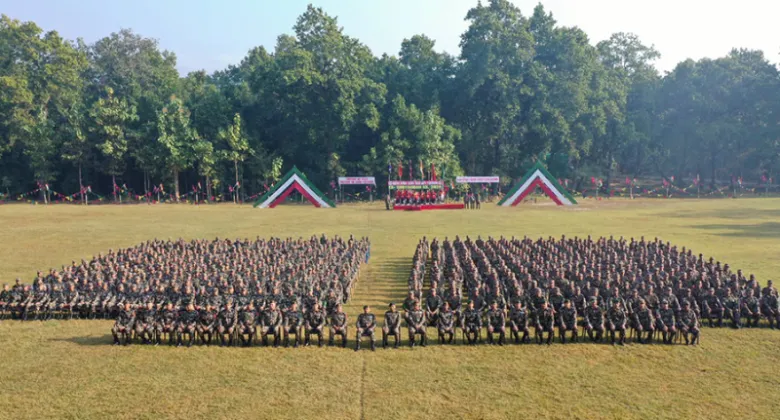
The 20th edition of Surya Kiran, the longstanding joint military exercise between the Nepali Army and the Indian Army, formally began on Wednesday at the Nepal Army Battle School in Saljhandi, Rupandehi. The drill was inaugurated by Major General Purna Bahadur Khatri, Divisional Commander at the Mid-Western Divisional Headquarters of the Nepali Army.
The exercise brings together elite units from both armies and is scheduled to run until December 8. Over this period, troops from the two neighbouring countries will train side by side with the goal of strengthening military cooperation and improving operational coordination between the two forces.
A recurring symbol of military ties
Surya Kiran is one of the most prominent and long-running bilateral exercises between Nepal and India, held alternately in the two countries. Its 20th edition taking place at Saljhandi underscores the depth of defence engagement between the two armies, which share a long tradition of cooperation, training exchanges and joint drills.
The Nepal Army Battle School in Saljhandi, located in Rupandehi district in Lumbini Province, serves as the venue for this edition. The school is known as a key training facility of the Nepali Army, providing a suitable setting for the kind of field-oriented, tactical training that the Surya Kiran series is designed around.
What the exercise aims to achieve
According to the organisers, the primary objectives of the exercise are to strengthen military cooperation and enhance operational coordination between the Nepali Army and the Indian Army. By training together, troops from both sides familiarise themselves with each other's procedures, tactics and working styles, which improves interoperability in real-world situations.
The involvement of elite units from both armies adds particular significance to this edition. Such participation allows the most capable formations of the two forces to test and refine their skills in a joint environment, covering aspects of soldiering that range from tactical manoeuvres to coordination in complex operations.
Continuity of a two-decade-old tradition
Reaching its 20th edition highlights how firmly established the Surya Kiran series has become in the defence relationship between Kathmandu and New Delhi. Each iteration builds on the experience of previous exercises, allowing the two armies to gradually deepen mutual understanding and trust at the working level.
The inauguration by a senior commander of the rank of Major General reflects the importance both armies attach to the drill. The presence of senior leadership at the opening ceremony of the exercise, which will continue in Saljhandi until December 8, signals institutional commitment to maintaining the momentum of bilateral military engagement.
Broader significance for Nepal-India relations
Defence cooperation has long been one of the pillars of Nepal-India relations, and joint exercises such as Surya Kiran are among its most visible expressions. Beyond the tactical training itself, such drills provide a platform for sustained people-to-people contact between soldiers of the two countries, fostering camaraderie that extends well beyond the duration of the exercise.
As troops settle in at the Nepal Army Battle School for nearly two weeks of joint training, the 20th Surya Kiran exercise in Saljhandi stands as another chapter in the continuing military partnership between Nepal and India, one that both sides describe as essential to strengthening cooperation and readiness.