Nepali business leaders have called on India and Nepal to transform their economic relationship from a traditional buyer-seller arrangement into a strategic, investment-based and production-oriented partnership.
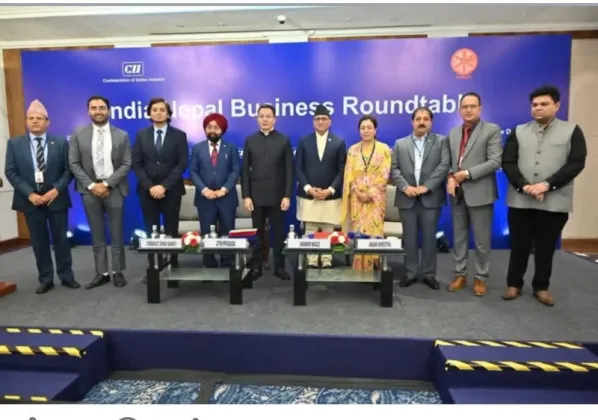
The call came at the India-Nepal Business Forum, held at Hotel Taj in New Delhi. Nepal Chamber of Commerce President Kamlesh Kumar Agrawal said bilateral economic ties must move beyond the traditional trade model, while former president of the Federation of Nepalese Chambers of Commerce and Industry (FNCCI) Bhawani Rana made a similar appeal, urging a shift toward cooperation in investment, production, entrepreneurship and innovation.
The forum took place in the context of Prime Minister Balendra Shah's two-day visit to India, giving the private sector's message particular weight as the two governments seek to deepen engagement.
From buyer-seller to production partnership
Addressing the forum, Bhawani Rana argued that the bilateral relationship should no longer be defined simply by the exchange of goods across the border. Instead, she said, Nepal and India should build cooperation in investment, production, entrepreneurship and innovation, so that the two economies become integrated through joint value creation rather than one-way trade.
Her remarks echoed the wider sentiment among Nepali private sector representatives who see the country's heavy reliance on imports, particularly from India, as a structural weakness. Framing the relationship as a production partnership, advocates argue, would help Nepal attract Indian investment into manufacturing and other productive sectors, creating jobs at home and reducing the trade imbalance that has long characterised the two countries' economic dealings.
Agrawal's call for a strategic relationship
Nepal Chamber of Commerce President Kamlesh Kumar Agrawal went a step further, describing the future of Nepal-India economic ties as a strategic, investment-based and production-oriented partnership. His comments positioned the business community as a key stakeholder in the broader diplomatic engagement underway during the prime minister's visit.
Agrawal's intervention reflects the position of Nepal's organised private sector, which has repeatedly sought a larger role in shaping bilateral economic policy. The Nepal Chamber of Commerce, one of the country's oldest and most prominent business bodies, has historically used such high-level forums to press for improved cross-border trade facilitation, investment promotion and energy cooperation with the southern neighbour.
Context of the prime minister's visit
The India-Nepal Business Forum was organised on the sidelines of Prime Minister Balendra Shah's two-day official visit to India. Business forums of this kind are a standard feature of high-level bilateral visits between the two countries, allowing chambers and entrepreneurs from both sides to interact directly with political leadership and outline their priorities.
By aligning their message with the visit, Nepali business leaders sought to ensure that private sector concerns remained prominent in the discussions between the two governments. The consistent emphasis from both Agrawal and Rana on investment and production suggests a coordinated push from Nepal's business community for a renewed economic agenda with India.
What the call means for bilateral ties
The joint message from Nepal's top business representatives highlights a growing consensus that the traditional trade-only framework has run its course. For decades, Nepal-India commerce has been dominated by Nepal's imports of Indian goods and comparatively limited exports, a pattern that has fuelled periodic debate in Kathmandu about the need to widen and rebalance the relationship.
Advocates of an investment-led model argue that Indian capital, technology and entrepreneurial networks could help Nepal build productive capacity in sectors such as manufacturing, energy and services. Such a shift would convert the bilateral relationship from a simple commercial exchange into a deeper economic partnership, in which companies from both countries jointly produce goods for domestic consumption and export.
Whether the appeals made at the New Delhi forum translate into concrete outcomes will depend on the follow-through from both governments. The statements by Agrawal and Rana, delivered during Prime Minister Shah's visit, add to the pressure on policymakers to give economic transformation a central place in the next phase of Nepal-India relations.
Related coverage: