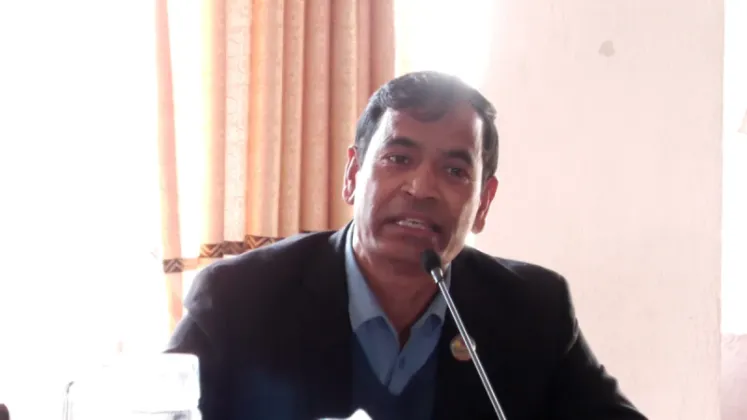
Nepali Communist Party lawmaker Mahendrabahadur Shahi said on Monday that the growing tendency to treat contract cancellation as an easy option has prevented multi-year and national pride projects from being completed on time. Speaking in Kathmandu, the MP argued that frequent cancellations, often carried out under the pretext of amending regulations, have directly affected the implementation of some of the country's most important infrastructure undertakings.
His remarks, reported by both Ratopati and Setopati, come amid a broader debate in Nepal over whether existing procurement rules allow authorities to terminate contracts too readily, leaving projects in limbo even after years of work and expenditure.
Contract cancellation used as an easy way out
Shahi questioned how justified it is to cancel a contract that spans multiple years simply by invoking the need to amend or update regulations. According to his comments, this practice has become routine enough that it now stands in the way of timely completion of large projects, particularly those the government itself has classified as national pride projects.
The MP's point was that once a contract is cancelled, the work that has already been done does not simply carry forward smoothly. Instead, projects stall while new processes begin, undermining the very deadlines and cost estimates the government had committed to. In his view, the option of cancellation is being exercised too easily, rather than being treated as a last resort.
He made the remarks while speaking in Kathmandu on Monday, framing the issue as one of governance and accountability rather than of any single project. His argument, as reported, was that the country cannot keep launching high-profile projects if the underlying contract regime allows them to be repeatedly disrupted.
Impact on multi-year and national pride projects
The core of Shahi's concern lies in the structure of multi-year contracts. Large infrastructure projects in Nepal are typically contracted for completion over several years. When the regulations under which such contracts operate are amended midway, the reporting on his remarks indicates, the contracts themselves become vulnerable to cancellation. This, he said, is being done under the pretext of updating rules, but the practical consequence is that the projects are the ones that suffer.
National pride projects are intended to be the flagship undertakings of the state, given special priority and funding. Shahi's remarks make clear that, in his assessment, these projects have been among those affected by the cancellation tendency. Instead of moving steadily toward completion, they have been caught up in cycles of termination and restart, which pushes back their timelines and erodes public confidence in the government's delivery capacity.
The MP did not frame the problem as one of contractors alone, but as a systemic issue in how the state manages its contractual obligations. His comments, as reported by Ratopati under a headline questioning how justified it is to cancel a multi-year contract under the pretext of amending regulations, suggest that the rules themselves are being applied in a way that prioritizes procedural cancellation over project completion.
A debate over procurement rules and accountability
Shahi's intervention highlights a tension at the heart of Nepal's public procurement system. On one side, regulations exist to ensure that contracts are awarded and executed according to the law, and amending rules is a legitimate legislative and administrative activity. On the other side, as Shahi's remarks point out, the very existence of a mechanism that allows contracts to be cancelled easily creates an incentive for authorities to use it repeatedly, with serious consequences for project delivery.
His statement raises questions about the balance between regulatory compliance and project continuity. If a multi-year contract can be invalidated whenever regulations change, the original timelines agreed upon lose their meaning, and the cost of delays is borne by the public in the form of unfinished infrastructure.
By singling out national pride projects, Shahi is drawing attention to the gap between the government's announcements and its execution record. These projects are meant to symbolize the country's development ambitions, and their repeated stalling, in his telling, is a direct result of administrative choices rather than inevitable obstacles.
What was said and what remains to be seen
The remarks were delivered on Monday in Kathmandu and covered by two major Nepali news outlets, Ratopati and Setopati, indicating that the issue of contract cancellations is drawing sustained attention in political circles. Shahi's position, as reported, is unambiguous: the tendency to treat contract cancellation as an easy option must be examined, because it has already affected multi-year and national pride projects.
Whether his comments will prompt a review of the procurement rules or a change in how cancellation powers are exercised remains to be seen. What the MP's statement establishes is that within the legislature itself, there is concern that the state's own procedures are standing in the way of completing the projects it has promised to the public.