The Ministry of Women, Children, Gender and Sexual Minorities and Social Security has urged all concerned parties not to engage in caste-based discrimination or untouchability during the Chhath festival, one of Nepal's most widely observed celebrations of devotion and family. In a statement issued on Thursday, the ministry also made a specific and pointed appeal: no separate Chhath ghats should be built, or caused to be built, for the Dalit community. The ministry's message, released as households across the country prepare for the festival, called for ensuring the equal participation of all communities in the celebrations.
The Ministry's Appeal
The statement was directed at all parties involved in the organisation and observance of Chhath, a formulation that appears to cover everyone from devotees and families to community committees and local bodies that often help manage festival arrangements. At its core, the ministry's message was simple: the festival must be celebrated together, without any form of caste-based discrimination or the practice of untouchability.
The most notable element of the appeal concerned the construction of ghats, the riverside and waterside venues where devotees gather to perform rituals during the festival. The ministry explicitly asked that no separate Chhath ghats be built or caused to be built for the Dalit community. The phrase is significant: it extends responsibility not only to those who might physically construct such segregated structures, but also to those who would order, authorise or enable their construction.
Alongside the prohibition on separate ghats, the ministry called for the equal participation of all communities in the festival. According to the statement, the emphasis was on ensuring that Chhath remains an occasion in which every community can take part fully and on an equal footing, rather than one in which social hierarchies are reproduced at the very sites where people gather to worship.
The Significance of Chhath
Chhath holds a place of deep cultural and religious importance, particularly among communities of the Terai and Madhesh, while also being celebrated with growing scale in urban centres including the Kathmandu Valley. The festival centres on devotion to the Sun God, with devotees observing rigorous fasts and offering prayers and arghya to the setting and rising sun across the days of the festival.
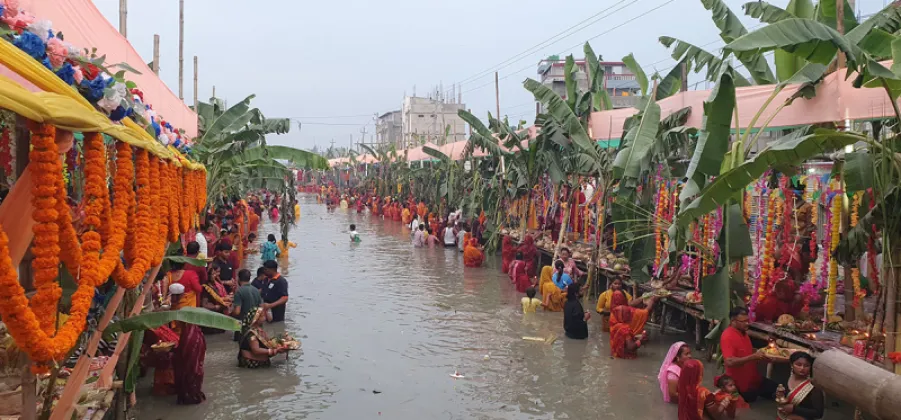
The rituals are intimately tied to water. Devotees, along with family members and entire neighbourhoods, gather at rivers, ponds and other water bodies, standing in the water at dawn and dusk to make offerings. These gatherings take place at ghats, which become crowded, vibrant centres of communal life during the festival. Because the observance depends so heavily on shared public spaces, access to ghats is not a secondary concern but lies at the heart of how the festival is experienced.
It is precisely because of this reliance on common spaces that questions of inclusion at the ghats carry such weight. A festival whose rituals unfold in public view, with thousands of devotees standing side by side in rivers and ponds, offers little room in principle for segregation, which is why the ministry's appeal foregrounded equal participation as a condition of the celebration itself.
Why the Ghats Matter
The ministry's statement comes against a long-standing backdrop in which caste-based exclusion from public spaces, including water sources, has remained a persistent problem in Nepal despite years of legal and social reform. Segregated access to water points and other shared facilities has historically been one of the most visible expressions of untouchability, and public gatherings can, without deliberate safeguards, mirror the inequalities of everyday life.
Against this backdrop, the prospect of separate ghats being established for the Dalit community during Chhath represents exactly the kind of practice the ministry's statement was designed to forestall. Rather than merely prohibiting discrimination in the abstract, the ministry named a concrete scenario, the construction of separate festival venues, and closed the door on it before the festival could unfold.
The appeal also carries legal weight beyond its moral force. Nepal's Constitution guarantees the right against untouchability and discrimination, and the Caste-Based Discrimination and Untouchability (Offence and Punishment) Act, 2011 criminalises practices that restrict or segregate access to public places, water sources and sites of religious or cultural significance. Building or designating separate ghats along caste lines would sit uneasily with both the constitutional guarantee and the statutory framework, giving the ministry's exhortation a firm foundation in law as well as in principle.
A Reminder for the Festival Season
By issuing the statement on Thursday, ahead of the festival celebrations, the ministry placed its appeal at the point where it could do the most good: before arrangements at ghats are finalised and before communities disperse to their chosen venues. The timing reflects an understanding that prevention, in matters of discrimination, is far more effective than response after the fact.
The ministry's message ultimately frames Chhath as a festival that belongs to all. Its call that no separate ghats be built or caused to be built, and that all communities be able to participate equally, ties the spiritual essence of the observance, devotion offered together, in open and shared spaces, to the social values of equality and dignity. As preparations continue and devotees gather at rivers and ponds across the country, the statement stands as a clear directive that the festival should be celebrated without discrimination, without untouchability, and as one shared occasion for every community that observes it.
For further details of the ministry's statement, see the original report in Nagarik News.