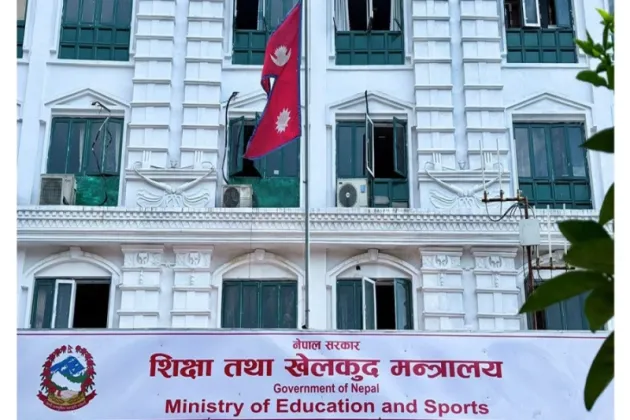
Kathmandu - The Ministry of Education, Science and Technology has launched an investigation into nearly 200,000 student records suspected to be fake or fraudulent in the Integrated Education Management Information System (IEMIS), the ministry's central database of school students. The ministry formed a five-member investigation and monitoring committee on Thursday through a ministerial-level decision, assigning it the task of establishing the facts behind the questionable entries and recommending action against those found responsible for the suspected fraud.
Five-member panel formed to probe suspect entries
The move follows the discovery that a large block of student entries in the IEMIS database cannot be treated as reliable. Close to 200,000 records are now under scrutiny, with the ministry suspecting that the entries are either entirely fake or have been manipulated in some form. By any measure, the figure represents a significant data integrity challenge for the country's education administration.
The committee was constituted through a ministerial decision, a step that places the probe at the highest decision-making level of the ministry rather than within a single department. Its mandate combines investigation with monitoring, meaning it is expected not only to examine the suspect records but also to keep the process itself under watch as it moves forward.
The panel's principal tasks, as set out in the decision, are:
- to investigate the nearly 200,000 questionable student records in the IEMIS database;
- to establish the facts surrounding the suspected fake or fraudulent entries;
- to monitor the overall investigation process; and
- to recommend action against those found responsible for the irregularities.
With the committee in place, the ministry has moved the matter from an internal query about data quality into a formal fact-finding exercise, the outcome of which will determine how the suspect records are handled and who is held accountable.
Why the IEMIS database matters
IEMIS is the integrated system through which the education ministry records and maintains student data drawn from schools across the country. Entries in the database form the official picture of Nepal's school student population, and that picture in turn feeds into planning, monitoring and decision-making within the education sector. When the data is sound, the ministry and related agencies can gauge the scale and distribution of the student population with reasonable confidence; when it is not, the entire planning chain built on top of the numbers comes into question.
It is against this backdrop that the suspected fraud has drawn attention. Nearly 200,000 entries is a substantial volume, and if the suspicion that they are fake or fraudulent is confirmed, the reliability of the statistics generated from IEMIS would be directly affected. Records of this kind, once inside a national database, can distort the understanding of how many students the school system actually serves, and where they are located.
The probe therefore carries weight beyond the immediate question of how the entries landed in the system. A credible investigation, followed by corrective measures, would be aimed at restoring the integrity of the database. Conversely, leaving the questioned records unexamined would leave open the possibility that decisions affecting schools and students are being made on the basis of unreliable figures.
Accountability and next steps
The clearest signal in the ministerial decision is the instruction that the committee recommend action against those responsible. This frames the probe not merely as a technical audit of data but as an accountability exercise aimed at identifying who inserted, approved or tolerated the questionable entries. The committee's recommendations, once submitted, are expected to shape whatever steps the ministry decides to take against the individuals involved.
At this stage, the formation of the five-member committee is the concrete outcome of Thursday's decision. The specifics of the committee's working procedure, its timeline and its eventual findings remain to be seen. What is established so far is the scale of the problem, nearly 200,000 questionable records, and the ministry's stated intent to establish the facts through an official investigation rather than treat the entries as routine data discrepancies.
The development has been reported by My Republica, which described the suspected fraud in 200,000 student entries, and by The Himalayan Times, which likewise reported that nearly 200,000 questionable student records triggered the education ministry's investigation. Both reports point to the same core facts: the suspected fake or fraudulent records in IEMIS, the five-member committee formed on Thursday through a ministerial decision, and its twin mandate of fact-finding and recommending action.
Until the committee reports back, the nearly 200,000 entries stand as suspect records in a system designed to hold authentic data on the country's students. The investigation's findings will determine both how the database is corrected and who is held responsible for the suspected fraud, making the committee's work the key development to watch in the weeks ahead.