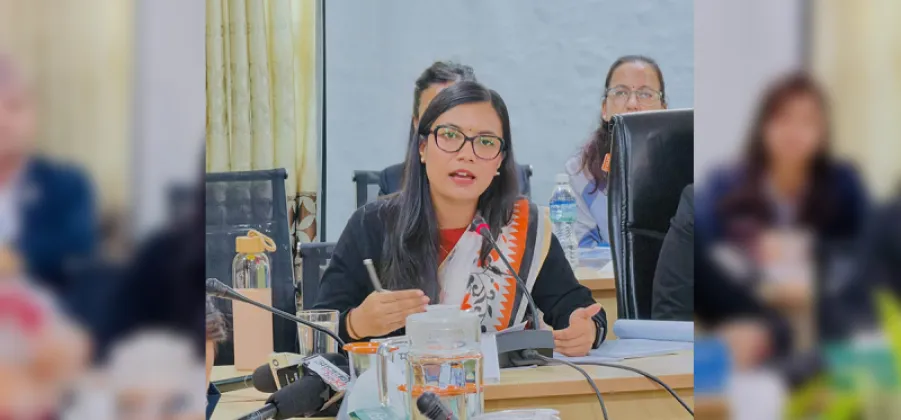
Law, Justice and Parliamentary Affairs Minister Sobita Gautam said on Thursday that justice cannot be reduced to the delivery of verdicts alone, arguing that resolving disputes in a fair manner is itself a form of justice. She made the remark while addressing a meeting of the Law, Justice and Human Rights Committee under the House of Representatives, held in Kathmandu, framing fairness in the handling of disputes as an essential measure of a working justice system. The comments, reported by Nagarik News and Ratopati, amount to a broad statement on how justice should be understood and evaluated, delivered by the minister who heads Nepal's justice portfolio.
"Resolving disputes in a fair manner is also justice"
Speaking before the parliamentary panel, Gautam told members that justice does not always mean only delivering verdicts in cases. In her framing, the fair resolution of a dispute carries the same weight as a formal judgment, because what matters most is that the conflict between the parties is brought to an end in a way that is fair. The formulation, echoed in the headline carried by Ratopati, presents justice as an outcome for the people involved in a dispute rather than merely a decision handed down by an adjudicating authority.
The distinction the minister drew is a meaningful one. A verdict marks the conclusion of a case, but it does not always capture whether the parties consider the matter genuinely settled or whether the underlying disagreement has been addressed. By placing fair resolution on the same footing as adjudication, Gautam's remark suggests that the success of a justice system should be judged by the fairness of the outcomes it produces, not solely by the number of judgments it delivers.
Remarks made before the House panel
The setting of the remarks underlined their significance. The Law, Justice and Human Rights Committee is one of the thematic committees of the House of Representatives, the lower house of Nepal's Federal Parliament. Such committees scrutinise the work of the ministries that fall under their remit, seek information from ministers and officials, and discuss policy matters connected to their subject areas. Appearances by ministers before these panels are a routine part of parliamentary oversight, and statements made there form part of the public record of how the government explains its priorities.
Gautam attended the committee meeting in Kathmandu on Thursday in her capacity as the minister responsible for law, justice and parliamentary affairs. The key points of her statement, as reported, were as follows:
- Justice does not always mean only the delivery of verdicts in cases.
- Resolving disputes in a fair manner is also justice.
- The remark was made at the meeting of the Law, Justice and Human Rights Committee under the House of Representatives, held in Kathmandu on Thursday.
Justice beyond the courtroom
The minister's comment speaks to a broader understanding of how disputes are resolved. Alongside formal adjudication, disputes can also be ended through mediation, negotiation and settlement, paths in which the parties themselves take part in shaping the outcome. In such processes, fairness depends on how the parties are treated and on whether any resulting agreement is reached freely and on an even footing. Where those conditions are met, a settled dispute can produce a resolution that the parties accept, which is precisely the sense in which Gautam described fair dispute resolution as justice.
For the people who bring disputes before the state, the difference between a verdict and a fair resolution can be practical as much as legal. A concluded case may end a dispute on paper, while a resolution perceived as fair by those involved can close the matter in fact. The minister's remark reflected that distinction, placing the fairness of the process, and not only the authority of the judgment, at the centre of what justice means.
A message from the head of the justice portfolio
Gautam leads the Ministry of Law, Justice and Parliamentary Affairs, the institution at the centre of Nepal's legal and justice administration and of the government's business with parliament. Remarks on the meaning of justice from the minister holding this portfolio carry particular weight, as they offer an indication of how the ministry's leadership conceptualises the goals of the justice sector it oversees.
Her appearance before the Law, Justice and Human Rights Committee placed that message before the very panel tasked with keeping law and justice matters under parliamentary review. In telling the committee that fair dispute resolution is also justice, she set out a standard against which the handling of disputes can be measured: not by whether a verdict was issued, but by whether the dispute was resolved fairly.
Further details of Thursday's committee discussion were not immediately available in the initial reports of her remarks.