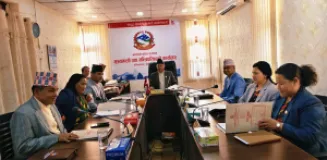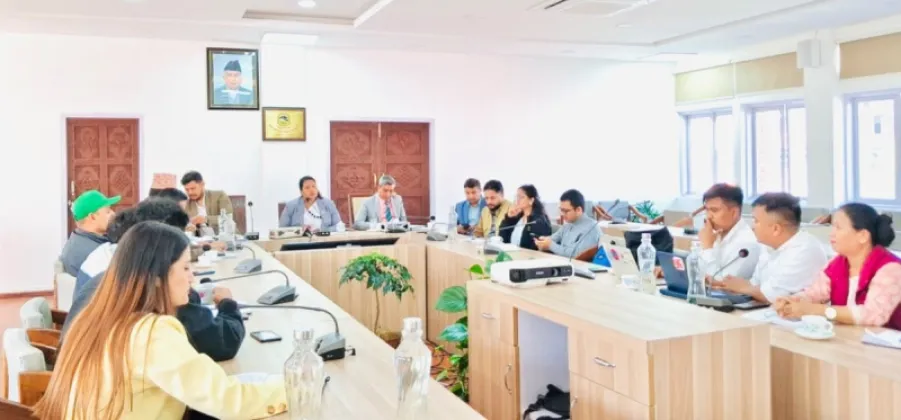
Agriculture, Forests and Environment Minister Geeta Chaudhary said in Kathmandu that the government will work to ensure equal and meaningful participation of youth, Gen Z, women, Indigenous nationalities and persons with disabilities at the 31st Conference of the Parties to the UN Framework Convention on Climate Change, or COP-31. Speaking during a discussion attended by civil society representatives, Chaudhary said the government was conscious of making the conference inclusive of all classes and communities.
Government signals an inclusive approach
Chaudhary’s pledge places participation by groups that can be overlooked in decision-making at the centre of Nepal’s preparations for COP-31. She named young people, including Gen Z, women, Indigenous nationalities and persons with disabilities as groups whose involvement should be ensured. Her remarks described the government’s intention as more than general attendance, emphasizing participation that is both equal and meaningful.
The minister also framed inclusion broadly, saying the government was conscious of making COP-31 inclusive of all classes and communities. That commitment indicates that representation is being treated as an issue for the conference as a whole, rather than one limited to a single group. However, the statement did not set out specific arrangements, targets or mechanisms for achieving that participation.
Civil society calls for equal representation
Civil society representatives who took part in the Kathmandu discussion also raised the need for inclusion. They suggested that the groups identified in the discussion be included on an equal basis at the conference. Their recommendation aligned with Chaudhary’s pledge and placed the question of who gets to participate alongside the government’s broader commitment to an inclusive COP-31.
The discussion brought together the minister’s stated intention and a call from civil society for equal inclusion. The two positions point to a shared concern: that youth, women, Indigenous nationalities and persons with disabilities should have a place at the conference, rather than be left outside its participation process. The groups named in the discussion represent a wide range of communities, making the pledge relevant to how the government approaches inclusion across COP-31.
What the pledge means for COP-31
Chaudhary’s remarks establish a public commitment, while the civil society representatives’ suggestion sets out a principle for how participation should be approached: on an equal basis. The emphasis on meaningful participation also signals that inclusion is not simply about being present. The minister’s statement points to a role for these groups in the conference, although the discussion, as reported, did not describe how that role would be put into practice.
The pledge therefore sets an expectation for the government’s COP-31 preparations. For the commitment to be reflected in practice, the government will need to address how the named groups can participate equally and meaningfully. No particular process or representation plan was announced in the remarks covered by the reports, but Chaudhary’s assurance and the civil society recommendation make inclusion a clear issue in the conversation around Nepal’s participation at COP-31.
The statement was made in Kathmandu during a discussion involving civil society representatives. Chaudhary said the government was alert to the need to include all classes and communities, while participants called for equal inclusion of youth, Gen Z, women, Indigenous nationalities and persons with disabilities. The pledge places those groups’ participation firmly on the agenda as the country looks toward the UN climate conference.