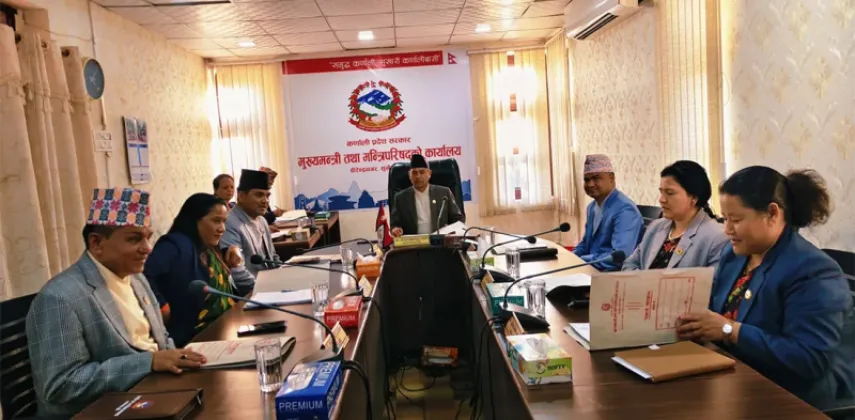
The Karnali provincial cabinet has approved a bill to establish and operate an apple development board in the province, clearing the proposal for introduction in the Karnali Provincial Assembly. The decision was taken at a cabinet meeting held on Friday evening, according to Finance Minister Tekraj Pachhai. With the cabinet's endorsement secured, the bill will now be tabled in the provincial legislature, where it will be debated and refined before lawmakers vote on whether to turn it into provincial law.
Cabinet clears the bill for the assembly
The approval came at a meeting of the provincial cabinet convened on Friday evening. Finance Minister Pachhai confirmed that the meeting endorsed the bill, which seeks to establish and operate an apple development board in Karnali, and decided to present it in the Provincial Assembly.
The decision places the proposal on the formal legislative track as a government bill. Under Nepal's provincial system, measures that originate in the cabinet are introduced in the assembly under a minister's sponsorship, distinguishing them from private bills brought forward by individual lawmakers. Cabinet approval is therefore a significant procedural milestone: it signals that the government of the day stands behind the bill and will shepherd it through the house.
The announcement was reported by RatoPati, which cited the finance minister's account of the meeting.
What the bill seeks to do
The bill's stated purpose is to create a standing institutional body - an apple development board - dedicated to the apple sector in Karnali. Although the announcement did not spell out the board's proposed structure, powers or budget, dedicated boards of this kind typically serve as focal institutions for planning, coordinating and delivering programmes for a particular sector or commodity.
The decision indicates that the provincial government wants apple development pursued through a dedicated mechanism rather than left dispersed across existing ministries and departments. If enacted, the board would operate as a provincial institution with a mandate tied specifically to the fruit, whose cultivation is among Karnali's best-known agricultural activities.
Key questions are expected to be answered once the full text of the bill is tabled and distributed to lawmakers. Among them:
- Composition and leadership: who will sit on the board, how its members will be appointed and who will head it
- Mandate and authority: the specific functions, planning role and promotional or regulatory powers the board will hold
- Financing: how the institution will be funded, including whether the province will allocate recurring or project-based budgets
- Coordination: how the board will work with provincial ministries, local governments and apple-growing communities
Until the bill is formally registered with the assembly, the provincial government has not publicly detailed these provisions.
The legislative road ahead
Under the procedures of the Karnali Provincial Assembly, a government bill generally passes through several stages before it can become law:
- Introduction and reading: the bill is tabled in the house by the responsible minister and read formally
- Committee scrutiny: the assembly may refer the bill to a committee for detailed review and feedback
- Clause-wise consideration: the full house debates the bill, considers amendments and votes on its passage
- Authentication and implementation: if passed by a majority, the bill is attested and takes effect as a provincial act
The pace of that process will depend on the assembly's calendar and the government's legislative priorities. The cabinet's announcement did not specify on which date the bill will be tabled, only that it will now be presented in the Provincial Assembly.
As finance minister, Pachhai is the cabinet member responsible for the province's budget, and his announcement of the decision underscores the government's collective backing for the proposal. Any financial commitments attached to the board would come into focus as the bill moves through the house and as subsequent budgetary decisions are made.
Apples and what happens next
Apples are among the most recognizable agricultural products of Karnali, a province whose high-hill terrain has long been associated with orchards and fruit farming. The push to establish a dedicated development board reflects the provincial government's decision to organize policy and resources around the crop through a permanent institution rather than ad hoc measures.
For the provincial government, the board represents a bid to give the apple sector a single institutional home. Advocates of such bodies argue that a dedicated board can concentrate expertise, planning and implementation under one roof, though the practical effect will depend on the powers, staffing and funding that the final law confers. The Provincial Assembly's deliberations will determine those details.
Attention now turns to the Provincial Assembly, where the bill is expected to be listed for tabling. Once it is formally introduced, lawmakers will examine its provisions, and any committee review will offer an early indication of the level of support for the proposal. If the assembly passes the bill, Karnali will have created, by law, an apple development board charged with operating for the province's apple sector, completing the process that the cabinet set in motion on Friday evening.