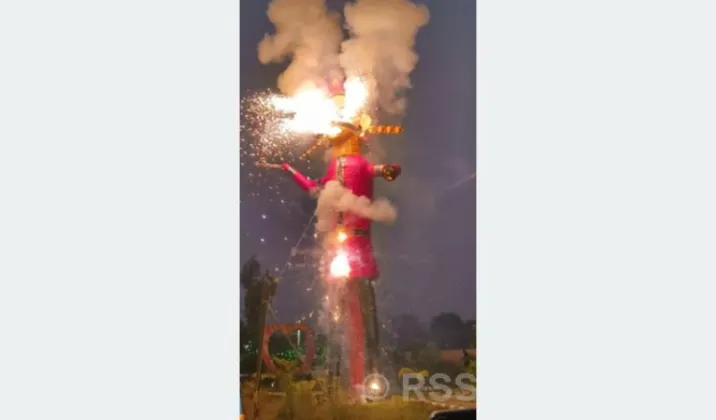
The centuries-old Maithil tradition of the Ravana Vadh festival was celebrated on Wednesday evening across several places in Mahottari district, including Matihani, as communities gathered to mark Vijaya Dashami, the most significant day of the Dashain festival. The festival commemorates the belief, central to Maithil cultural identity, that Lord Ram killed the demon king Ravana in battle on Ashwin Shukla Dashami during the Treta Yuga. Observed with religious fervour across the Mithila region, the celebration is one of the most distinctive expressions of Dashain in the southern plains of Nepal, where the epic events of the Ramayana are remembered not as a distant story but as part of the region's own heritage.
The Victory of Good Over Evil
Ravana Vadh, literally the slaying of Ravana, is observed on Vijaya Dashami, the tenth day of the bright fortnight of the Hindu month of Ashwin. According to the tradition, it was on this very day, in the Treta Yuga, that Lord Ram defeated Ravana, the king of Lanka who had abducted his wife Sita. The day is therefore celebrated as Vijaya Dashami, the festival of victory, symbolising the triumph of truth, righteousness and virtue over arrogance and evil.
Across Nepal, Dashain is observed as the country's biggest festival, with Vijaya Dashami marking its climax, when elders bless younger relatives with tika and good wishes. In Mithila, however, the day carries an additional layer of meaning, as households and communities observe the Ravana Vadh festival to relive the moment of Ram's decisive victory. As reported by RatoPati, the tradition concluded on Wednesday evening in Mahottari, with celebrations held at several sites across the district.
Sita, the Daughter of Mithila
What gives the Ravana Vadh celebration its special emotional significance in Mithila is the region's enduring bond with Sita. The Mithila tradition regards Sita, also revered as Maithili, as its own daughter. In the Ramayana, Sita is the daughter of King Janak of Mithila, and Janakpur, in present-day Nepal, is revered as her maternal home. Her abduction by Ravana and her eventual rescue, when Ram killed him in battle, are thus experienced in Mithila not as an outsider's tale but as the story of the region's own daughter.
For the Maithil people, the killing of Ravana therefore represents the restoration of their daughter's honour. This is why the Ravana Vadh festival holds a place of special importance in the region's Dashain observances, and why communities in Mahottari and across Mithila continue to uphold the celebration generation after generation. As Nagarik News noted in its coverage, the festival concluded this year with the observance of the centuries-old tradition in Mahottari.
Celebrations Across Mahottari
On Wednesday evening, the festival was observed at several places across Mahottari, with Matihani among the prominent sites of celebration. The key aspects of this year's observance were:
- Timing: The rituals were held on Wednesday evening, on the occasion of Vijaya Dashami.
- Spread: Celebrations took place across multiple locations in the district, reflecting the tradition's deep roots in the area.
- Significance: The observance honoured the belief that Ram killed Ravana on Ashwin Shukla Dashami in the Treta Yuga.
- Cultural identity: The festival reaffirmed Mithila's special connection to Sita, regarded as the region's own daughter.
The conclusion of the festival was also reported by Khabarhub, which highlighted the holding of the Maithil tradition across Mahottari on the Dashami evening. The celebration once again drew attention to the district's role as a custodian of one of the Ramayana tradition's most cherished regional observances.
A Living Heritage of Mithila
The continued observance of Ravana Vadh in Mahottari underscores how the cultural landscape of the Tarai-Madhesh remains deeply intertwined with the Ramayana. Mithila, stretching across the southern plains of Nepal and into neighbouring India, has for centuries nurtured a rich tradition of language, art and ritual centred on the figure of Sita and the court of King Janak.
In this context, the Ravana Vadh festival is more than a religious commemoration. It is an assertion of Maithil identity, a festival through which the community passes on its stories, values and sense of belonging to new generations. By celebrating the fall of Ravana on Vijaya Dashami, the people of Mahottari and the wider Mithila region reaffirm both their devotion and their pride in a daughter of Mithila whose story continues to define the region's culture.
With this year's observance concluded on Wednesday evening, the festival has once again affirmed its place at the heart of Dashain celebrations in Mahottari, keeping alive a tradition that binds faith, history and community across the Mithila region.