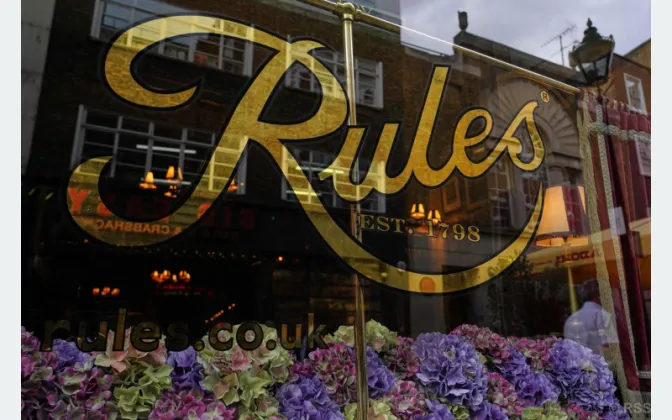
The historic building that houses Rules, London's oldest continuously operating restaurant, has been donated to the National Trust, Europe's largest conservation charity, in a move intended to safeguard one of the British capital's most enduring culinary landmarks. As reported by RatoPati and Khabarhub, the donation is expected to preserve the 228-year-old restaurant together with its original structure and atmosphere for future generations, securing the future of a business that carries more than two centuries of unbroken history.
Since Thomas Rule first opened its doors as an oyster bar in 1798, Rules has remained in continuous operation, a distinction that makes it the oldest restaurant of its kind in the city. Its founding coincided with one of the most turbulent periods in European history, when the aftershocks of the French Revolution were being felt across the continent. That the establishment has welcomed diners ever since, from the Georgian era through to the present day, is precisely what gives the building its singular place in London's story.
A Gift Meant to Keep History Alive
The donation transfers the building into the care of an organisation whose core mission is conservation. The National Trust, recognised as Europe's largest conservation charity, exists to protect places of historic significance so that they can be appreciated by generations to come. By accepting the Rules building, the Trust takes on responsibility for a property that is not a museum piece but a living, working restaurant, one whose value lies as much in its atmosphere and continuity as in its physical fabric.
The practical aim of the gift is clear: to ensure that the restaurant's original structure and character are not eroded over time. Historic interiors are often vulnerable to redevelopment, modernisation or simple neglect, and placing a property under conservation stewardship is intended to guard against exactly those pressures. Donations of significant buildings to conservation bodies are widely seen as among the most secure ways to guarantee long-term protection, since they remove the property from the uncertainties of the commercial market. For an establishment that has preserved its identity for more than two centuries, the donation offers a form of security that ordinary ownership cannot always provide.
Rules at a Glance
- Founded: 1798, by Thomas Rule, as an oyster bar
- Distinction: London's oldest continuously operating restaurant
- Age: 228 years
- New custodian: the National Trust, Europe's largest conservation charity
- Purpose of the donation: to preserve the building's original structure and atmosphere for future generations
From Oyster Bar to London Institution
Rules began life in 1798 as an oyster bar established by Thomas Rule, at a moment when Europe was still absorbing the shockwaves of the French Revolution. The late eighteenth century was a period of profound instability: the revolution had overturned the old order in France, and the upheaval it unleashed spread uncertainty far beyond its borders. It was into this restless world that Rule opened his establishment, one that would go on to serve customers 228 years later.
From those origins, the restaurant grew into an enduring institution of London dining. Continuous operation across such a span is exceptionally rare in an industry known for its turnover, and it means the restaurant has been an unbroken presence through every era of the city's modern history. For diners, an evening at Rules is not merely a meal but an encounter with living history, an experience the donation is designed to protect.
The survival of a restaurant over more than two centuries also reflects a changing city turning around a fixed point. London has been transformed many times over since 1798, yet the building has continued to serve the same essential purpose it did in Rule's day. That constancy is what gives places like this their value: they anchor the city's memory in physical space in a way little else can.
Why the National Trust's Role Matters
As Europe's largest conservation charity, the National Trust brings to the Rules building a level of expertise and long-term commitment that few private owners could match. Its involvement means the property's future will be guided by conservation principles, with the building's historic character treated as an asset to be defended rather than an obstacle to be modernised.
The donation also highlights a broader truth about heritage protection. Buildings of historic importance are often preserved not as grand monuments but as everyday places in continuous use, and a restaurant that has remained open for more than two centuries is itself a record of the capital's social history. Protecting it means protecting a chapter of London's past that no museum display could fully recreate.
Looking to the Future
With the building now in the hands of the National Trust, the intention is that Rules will carry on much as it has since 1798: as a working restaurant, housed in its original structure, preserving the atmosphere that has defined it for 228 years. For London, the donation secures a tangible link to the late eighteenth century. For the generations of diners still to come, it ensures that the door Thomas Rule first opened as an oyster bar will remain open long into the future.