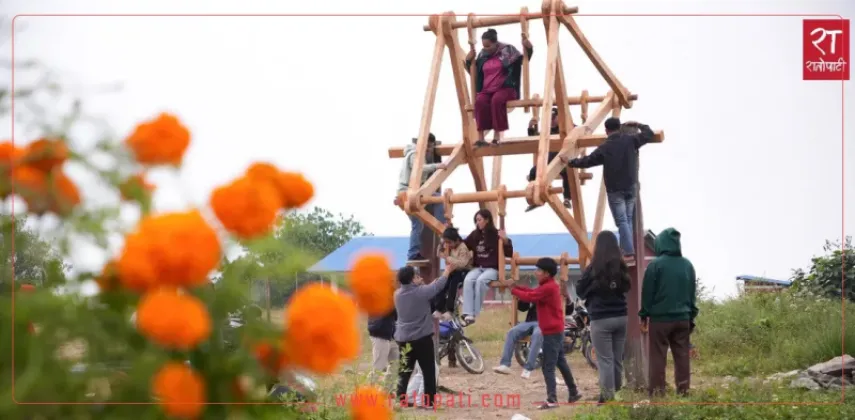
The hills of Sirandanda in Gorkha district are echoing with laughter this festive season as locals spin joyfully on a rote ping, the traditional rotating swing that remains one of Bada Dashain's most cherished amusements. Residents of Sirandanda in Ajirkot Rural Municipality came together to construct the swing ahead of the festival, continuing a practice handed down through generations. With family members returning to their villages from various places for the celebration, daily activity in the area has noticeably increased, and the newly built rote ping has quickly become the centre of attraction for children and adults alike.
A Swing Built by the Whole Village
What makes the rote ping in Sirandanda special this year is not just the fun it provides, but the way it came into being. Rather than being the project of a single household, the swing was built collectively by the residents, who pooled their labour and materials to keep the Dashain tradition alive. This spirit of shared effort is a defining feature of swing-making in Nepal's hilly settlements, where the whole community often lends a hand before the festival begins.
- The swing was constructed jointly by villagers as part of the Dashain tradition.
- It was erected specifically to provide entertainment for locals during the festival.
- The presence of the rote ping has added visible festive cheer to the area.
In villages like Sirandanda, erecting a swing before Dashain is treated almost as a ritual duty. Once the structure stands ready, it becomes a gathering point throughout the festival days. Children queue up for their turn, teenagers show off their spinning skills, and even elders join in or simply watch from the sidelines, recalling their own childhood memories of the swing.
Villages Come Alive as People Return Home
The festive mood in Sirandanda has been further lifted by the annual Dashain homecoming. As the summary and the accompanying photo feature by RatoPati note, people have been returning to their villages from various places to celebrate the festival with their families. This seasonal migration, where those working or studying in cities and elsewhere come back to their ancestral homes, brings a sharp rise in activity across the village.
Houses that stood quieter for much of the year fill up with returning members. Courtyards are swept and decorated, greetings of Dashain are exchanged, and the sounds of the festival, from music to the creak of the swing, replace the usual calm of the hills. For many migrant families, the trip home for Dashain is the most important journey of the year, and the presence of a communal swing gives the reunion a shared focal point.
The rote ping fits perfectly into this homecoming. A returning son or daughter, home after months away, can step straight onto the swing alongside cousins, neighbours and old friends, and in a few rotations the distance built up over the year seems to disappear. It is exactly this blend of reunion and recreation that villagers say makes Dashain in the hills feel different from celebrations elsewhere.
Rote Ping and the Spirit of Dashain
The rote ping is one of the distinctive traditional swings of Nepal, different from the taller four-poled linge ping that is also erected during Dashain. Where the linge ping swings back and forth, the rote ping rotates, spinning its riders around in circles, which is where it gets its name. Both types share a common purpose: they mark the festival season and give communities a shared source of joy.
Traditionally, such swings are made from locally available materials such as bamboo, wooden poles and strong rope, all lashed together by hand. Erecting one requires skill and coordination, which is why the task is usually undertaken as a group effort rather than by individuals. In Sirandanda, that cooperative approach remains intact, and the swing stands as a small monument to the village's ability to work together.
The cultural logic behind the tradition is straightforward. Dashain, the greatest festival of Nepali Hindus, celebrates the victory of good over evil and is a time when families reunite, blessings are received from elders, and communities come together. Swings like the rote ping have long been part of this celebration, particularly in rural and hilly areas where they remain among the most popular festival entertainments.
- Rote ping rotates its riders, offering a different thrill from ordinary swings.
- Swing-building during Dashain is a community tradition passed down over generations.
- The swings are typically enjoyed by all age groups, from small children to the elderly.
Festive Cheer in the Hills of Gorkha
For Sirandanda, the swing has done precisely what its builders intended. The photo feature published by RatoPati captures locals of different ages taking their turns, spinning and laughing as the festival unfolds around them. The images show a village visibly lifted by the season, with the rote ping serving as both entertainment and a symbol of togetherness.
In an era when festival celebrations increasingly shift toward cities, screens and commercial venues, scenes like the one in Sirandanda highlight the enduring pull of village traditions. A swing made by hand, raised by neighbours and set against the backdrop of the hills offers a form of celebration that depends not on money, but on participation.
As Dashain continues, the rote ping of Sirandanda is expected to keep spinning, carrying laughter through the village until the festival draws to a close. For the residents of Ajirkot Rural Municipality, it is a reminder that some of the best parts of the festival are also the oldest, and that a simple swing, built together, can hold an entire community's festive spirit aloft.