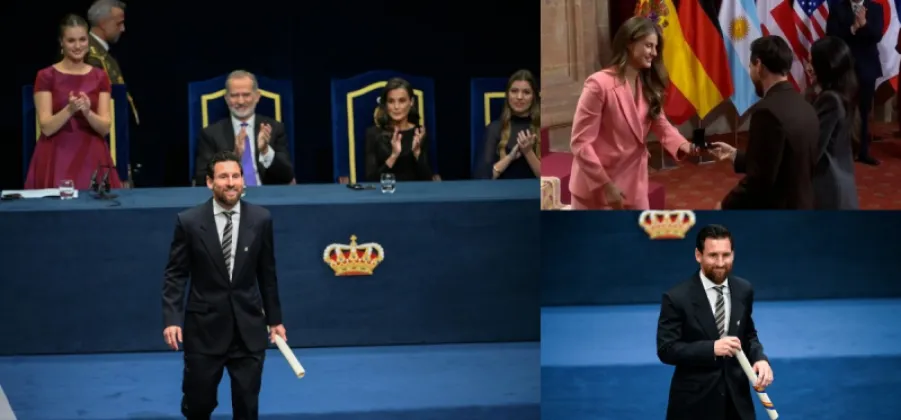
Argentina's Lionel Messi received Spain's prestigious Princess of Asturias Sports Award at a ceremony held on Friday at the Campoamor Theatre in Oviedo, in the north of Spain. Princess Leonor presented the honour to the 39-year-old forward, capping an evening in which the Argentine superstar was warmly applauded by the audience gathered in the historic theatre. The award recognises both his outstanding sporting career and his contributions to improving access to health and education for underprivileged children, adding yet another prestigious distinction to a name already synonymous with footballing excellence.
An ovation in Oviedo
The Campoamor Theatre in Oviedo, the capital of the Asturias region, is the traditional stage for the Princess of Asturias Awards, and on Friday it played host to one of the most celebrated figures in world sport. According to reports by Ratopati and Nagarik News, Messi was greeted with an ovation as he stepped up to receive the prize from Princess Leonor, the heir to the Spanish throne.
The presentation by the Princess gave the ceremony a distinctly royal character. The Princess of Asturias Awards have long been associated with the Spanish crown, and the annual gathering in Oviedo regularly brings together personalities from sport, culture, science and public life. For Messi, whose public appearances away from the football field are relatively rare, the evening in Oviedo offered a moment of recognition on a stage far removed from any stadium.
Honoured for more than what he has won
What sets this award apart is the breadth of what it celebrates. The Princess of Asturias Sports Award does not merely tally titles. It honours sporting careers that serve as an example and, in Messi's case, explicitly acknowledges his work beyond the pitch. The distinction cites two achievements:
- An outstanding sporting career at the highest level of world football.
- Contributions to improving access to health and education for underprivileged children.
The second point speaks to a significant dimension of Messi's public life. Away from the game, he has long supported causes related to child health and education, directing his profile and resources towards children in vulnerable situations. By placing this humanitarian record alongside his sporting achievements, the award framed Messi's legacy as something larger than the goals and trophies that made him famous.
Spain's most prestigious distinction
The Princess of Asturias Awards are considered among the most important honours conferred in Spain. Presented annually in Oviedo, they recognise individuals and institutions whose work across a wide range of fields contributes to universal values and the common good. The prizes are awarded in several categories, including:
- Arts
- Literature
- Communication and Humanities
- Technical and Scientific Research
- International Cooperation
- Concord
- Sports
Within this framework, the sports award is reserved for figures whose careers are judged to be an example of effort, talent and fair play. Past editions of the ceremony have honoured leading names from across the sporting world, and the presence of Messi at this year's edition underlined the global reach of the distinction. The Friday ceremony at the Campoamor Theatre stands as the high point of the awards programme in Oviedo, an occasion followed closely in Spain and well beyond its borders.
A career that keeps adding chapters
At 39, Messi remains an active and singular figure in the game. Widely regarded as one of the greatest footballers of all time, he has spent more than two decades at the top of the sport, winning league titles in Spain and France, a remarkable collection of individual honours and, most memorably for his country, the 2022 FIFA World Cup with Argentina. His move to Inter Miami in the United States extended both his career and his global influence, carrying his name to a new continent and a new audience.
Against that backdrop, the Princess of Asturias Sports Award occupies a special place. It comes not from a football federation or a media house, but from a foundation with close ties to the Spanish crown, and it rewards a career judged exemplary in the widest sense. For a player who has won practically everything the game can offer, the honour adds a different kind of recognition: one that measures influence rather than results.
For Oviedo, the evening added another memorable chapter to an institution that has, over the decades, hosted countless historic moments. For Messi, it was a night without opposition or scoreboard, in which the applause of the audience and the words of the citation did the talking. The 39-year-old left the Campoamor Theatre with a new title to his name, one that recognises not only the brilliance of his play, but the reach of his commitment to children for whom access to health and education remains a daily struggle.