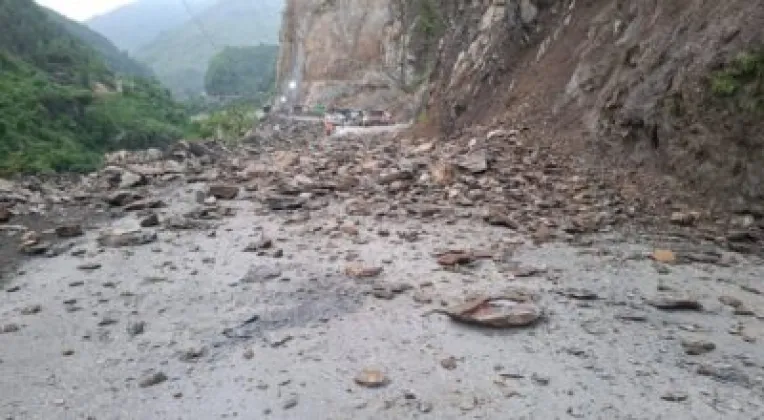
Vehicular movement has been disrupted across three hill districts after landslides and flooding blocked key roads in Myagdi and Gorkha districts of Gandaki Province and Surkhet district of Karnali Province, according to Nepal Police. The most significant disruption has come on the Beni-Jomsom road corridor in Myagdi, which is now operating under one-way traffic after a landslide damaged the road at Baisari in Raghuganga Rural Municipality-2 early on October 18. Police said the slope failure occurred at around 5:50 am, and officials have confirmed that multiple locations along the affected routes remain obstructed, forcing travelers to contend with delays on several key links.
Beni-Jomsom corridor runs on one-way traffic
The landslide at Baisari, in Raghuganga Rural Municipality-2 of Myagdi district, damaged a section of the Beni-Jomsom road, one of the most important transport arteries linking the hill and mountain districts of Gandaki Province. According to Nepal Police, the slide took place at 5:50 am on October 18, and traffic along the corridor has since been allowed to move in one direction at a time while the damaged stretch is managed.
The key points from the police information are as follows:
- The Beni-Jomsom road corridor remains operational, but only under one-way traffic.
- The damage occurred at Baisari in Raghuganga Rural Municipality-2 of Myagdi district.
- The landslide struck at approximately 5:50 am on October 18.
- Multiple locations along the affected routes remain obstructed.
The Beni-Jomsom road connects Beni, the headquarters of Myagdi district, with Jomsom, the administrative centre of neighbouring Mustang, and serves as a lifeline for communities, traders and travelers moving through the Kali Gandaki corridor. One-way operation of this kind typically allows vehicles to pass the affected section in alternation, but it also means slower journeys, longer waiting times and the risk of further hold-ups if the slope above the road remains unstable. Travelers using the corridor should therefore factor in additional time, as conditions on the ground can change quickly depending on weather and clearance work.
Obstructions reported in Gorkha and Surkhet
Beyond Myagdi, Nepal Police reported that landslides and flooding have also disrupted road movement in Gorkha district of Gandaki Province and Surkhet district of Karnali Province. Exact points of blockage in those two districts were not specified in the initial information shared by the force, but police confirmed that multiple locations along the affected routes remain obstructed, indicating that the disruptions are not confined to a single site on any one road.
The affected districts span two provinces and varied terrain:
- Myagdi (Gandaki Province): Home to the damaged Beni-Jomsom corridor, where one-way traffic is in force following the Baisari landslide.
- Gorkha (Gandaki Province): A hilly district where landslides have reportedly blocked road sections, according to Nepal Police.
- Surkhet (Karnali Province): A district in Karnali Province where flooding, along with landslides, is among the causes of road disruption.
The involvement of both landslides and flooding points to the dual nature of the hazard: sudden slope failures on roads cut into hillsides, and streams or rivers spilling over carriageways in lower sections. In districts such as Gorkha and Surkhet, where rural roads wind through fragile terrain and cross seasonal waterways, such blockages can isolate villages for hours or even days until machinery can reach the sites and clear the debris.
Why Nepal's hill roads remain vulnerable
Landslides and floods are a recurring feature on Nepal's road network, particularly in the mid-hills and mountain districts. Many of the country's highways and rural roads are carved into steep slopes with limited slope protection, leaving them prone to failure during and after the monsoon. Even after the rainy season ends, saturated slopes can continue to give way when struck by late-season or unseasonal rain, and the events of October 18 show that the risk does not end with the monsoon calendar.
The timing of the Baisari landslide, in the early morning hours, also fits a familiar pattern: slope failures frequently occur at night or before dawn, when debris triggered by overnight rain catches drivers by surprise. Advisories urging caution and avoidance of night travel along landslide-prone corridors are common in Nepal during the monsoon and the weeks that follow, and the latest disruptions underline why that caution persists well into autumn.
For a corridor like Beni-Jomsom, which serves residents of Mustang and Myagdi as well as travelers heading toward the trans-Himalayan region, any restriction carries consequences beyond simple inconvenience. One-way traffic reduces the number of vehicles that can pass in a day, and any renewed slide at or near Baisari could force a complete closure until the road is cleared. Reports from Khabarhub and My Republica cited the police in confirming the scale of the disruptions across the three districts.
What travelers should keep in mind
With three districts affected at once, the police update serves as a warning that road conditions across Gandaki and Karnali Provinces remain fragile. Travelers planning journeys on the Beni-Jomsom corridor, or on roads in Gorkha and Surkhet, should:
- Check the latest road status with local authorities or traffic police before setting out.
- Expect delays and possible queues at the one-way section near Baisari.
- Stay alert near landslide-prone slopes, stream crossings and stretches marked by fresh debris.
- Follow instructions from police and road crews on site who are managing the movement of vehicles past damaged sections.
Nepal Police has been the primary source of information on the disruptions, and updates on when full two-way movement resumes on the Beni-Jomsom road, and when the obstructed sections in Gorkha and Surkhet are cleared, will depend on the pace of clearance work and on weather conditions in the coming days. Until then, commuters and freight operators moving through the three districts should be prepared for continued disruption on multiple routes.