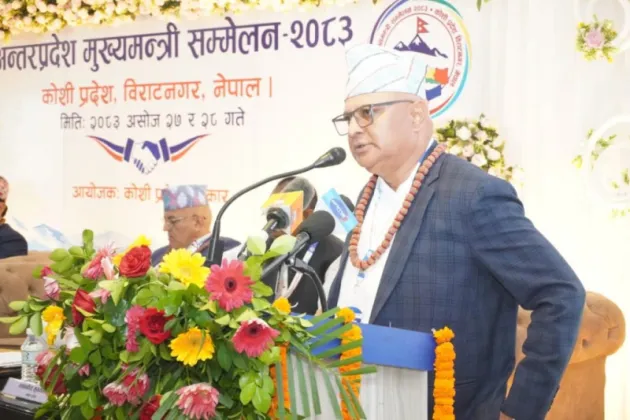
Koshi Province Chief Minister Hikmat Kumar Karki has said federalism in Nepal has become “colourblind,” arguing that provincial rights remain unclear under the division of powers among federal, provincial and local governments. Speaking at an inter-provincial chief ministers’ conference, Karki called for the constitutional responsibilities of the three levels to be made clearer and warned that provinces would continue to be dismissed as “white elephants” if they failed to work together.
Karki’s concern over provincial rights
Karki’s description of federalism as “colourblind” expressed concern that the system has not given provinces a sufficiently clear understanding of their rights. His remarks focused on the relationship between the constitutional distribution of powers and the ability of provincial governments to carry out their roles. He said the division of authority among the federal, provincial and local levels needs clarification.
The chief minister did not, in the remarks reflected in the report, identify a particular power or responsibility as the source of the uncertainty. Instead, he pointed to the broader question of how the constitution’s allocation of powers should be understood across the three levels of government. His call for clarity places the interpretation and practical boundaries of those constitutional responsibilities at the centre of the discussion.
Call for cooperation among provinces
Karki also linked the provinces’ standing to their ability to work together. He warned that without cooperation, provinces would be called “white elephants,” a phrase he used to underline the risk of provincial institutions being seen as ineffective or lacking a clear purpose. His warning made collective action among provinces part of his wider argument about the future of federalism.
The comments were made at an inter-provincial chief ministers’ conference, a forum bringing provincial leaders together. Karki’s appeal was therefore directed not only at the question of clarifying powers, but also at the need for provinces to act jointly. In his framing, clearer constitutional responsibilities and stronger coordination are related concerns: provinces need to understand their place in the system and demonstrate their capacity to work together.
The constitutional division of powers
Nepal’s federal structure divides powers among the federal, provincial and local levels. Karki’s remarks point to the importance of making that division clear enough for each level to understand its rights and responsibilities. He called for greater clarity in the constitutional arrangement, rather than presenting the issue as a concern limited to one province.
His comments put the role of provincial governments under scrutiny. If their rights remain unclear, Karki suggested, the provinces risk being regarded as institutions with little practical value. His “white elephant” warning tied that perception to a failure of cooperation, while his “colourblind” description highlighted the continuing uncertainty over provincial rights.
The chief minister’s intervention at the conference was a call for both clarity and collective effort. He said the division of powers among the three levels of government must be made clearer and urged provinces to work together so they are not reduced to the label he warned about. The remarks, reported by Nepal Press, frame the debate around two linked questions: whether provincial rights are adequately understood and whether the provinces can cooperate to establish their role within federalism.