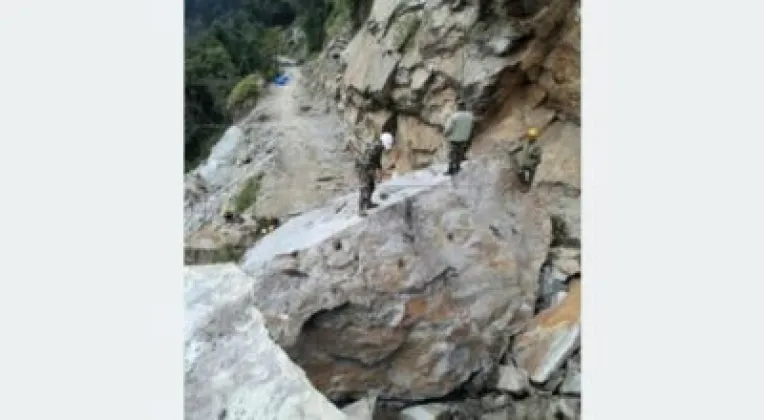
Vehicular movement on the Khandbari-Kimathanka road in Sankhuwasabha district has resumed after nearly three months, following the clearance of a massive landslide that had completely blocked the route in the Chhumsur area of Bhotkhola Rural Municipality-2. The restoration drive was led by the Nepali Army, with the North-South (Koshi) Highway Project also engaged in the effort, according to reports by Khabarhub and My Republica. The reopening restores the key road connection between Khandbari, the headquarters of Sankhuwasabha district, and Kimathanka, which lies on Nepal's northern border with China, ending a prolonged disruption on one of the most remote corridors in Koshi Province.
Three months cut off by the Chhumsur landslide
The disruption began when a large-scale landslide struck the Chhumsur section of the Khandbari-Kimathanka road in Bhotkhola Rural Municipality-2. Huge boulders and debris rolled onto the road and settled across the carriageway, bringing vehicular movement to a complete standstill. With the surface buried under rock and rubble and no alternative route available for vehicles, the road remained out of operation for a full three months.
The essentials of the closure can be summed up as follows:
- Location: Chhumsur area, Bhotkhola Rural Municipality-2, along the Khandbari-Kimathanka road in Sankhuwasabha
- Cause: A massive landslide deposited large boulders and debris across the route
- Impact: Vehicular movement was completely blocked on the corridor to the Nepal-China border
- Duration: The road remained closed for three months before restoration
The Khandbari-Kimathanka road is the main road artery linking Sankhuwasabha's district headquarters with the northern border belt. Kimathanka, at the top of the corridor, is a Nepal-China border point, which gives the route importance well beyond day-to-day local transport. When the Chhumsur landslide sealed the road, vehicles could no longer travel between Khandbari and the northern settlements of Bhotkhola, leaving the sections beyond the landslide site disconnected from the district headquarters by road.
For a corridor of this kind, a three-month closure carries consequences well beyond inconvenience. Roads in Nepal's high hill and mountain districts often serve as the principal mechanized transport link for the settlements they connect, and a blocked carriageway leaves passengers and goods dependent on long and arduous trails. The restoration of the route therefore marks the return of regular vehicular access for communities scattered along the northern belt of Sankhuwasabha.
Nepali Army leads the restoration
The task of reopening the road was led by the Nepali Army, which carried out the clearance and restoration of the damaged section at Chhumsur. The North-South (Koshi) Highway Project, the infrastructure agency associated with the corridor, was also involved in the drive. Their combined effort removed the boulders and debris that had buried the road and made the section passable again, allowing the route to resume operation after the long interruption.
Clearing a landslide of this scale in the terrain through which the road passes is a demanding undertaking. The Chhumsur section lies in the upper reaches of Sankhuwasabha, where the alignment climbs through rugged country toward the border. Landslides in such areas can leave enormous boulders mixed with loose debris strewn across the road, and crews and machinery must often work on steep slopes far from major supply centres. That reopening the blocked section took three months reflects both the scale of the obstruction and the difficulty of operating in the remote high-hill environment.
The Nepali Army has long served as a lead agency for road construction and reopening in Nepal's remotest areas, where its engineering capabilities are regularly deployed on routes that are difficult for other agencies to reach. Its front-line role in the Khandbari-Kimathanka restoration is consistent with that record, while the involvement of the North-South (Koshi) Highway Project brings in the body charged with developing the corridor itself.
A corridor of strategic weight
The reopening carries significance that extends past everyday mobility. As the road tying Khandbari to Kimathanka on the China border, the route forms part of Nepal's broader push for north-south connectivity in Koshi Province, an ambition reflected in the very name of the North-South (Koshi) Highway Project associated with it. Corridors of this kind are regarded as potential arteries for cross-border trade as they are developed further, and they are essential for reaching the northern border villages, which otherwise remain among the most isolated communities in the country.
Within Sankhuwasabha, the road serves settlements of Bhotkhola Rural Municipality and the wider northern belt, areas whose residents rely on the route for supplies, travel to the district headquarters, and access to markets and services. With the link restored, vehicles can once again move between the mid-hills and the border, easing the isolation that the Chhumsur landslide had imposed on the area for a full season.
Fragile terrain and the road ahead
The episode is also a reminder of how vulnerable mountain roads in Nepal remain to landslides. Steep slopes, fragile geology and intense seasonal rainfall make disruptions a recurring feature of hill roads across the country, and routes like Khandbari-Kimathanka, which traverse some of the most difficult terrain in Koshi Province, are particularly exposed. Even after a blocked section has been cleared, slopes above the alignment remain prone to failure, and keeping such corridors open over the long term requires sustained maintenance and monitoring.
For now, however, the immediate outcome is clear. After three months of blockage caused by the massive landslide at Chhumsur, the Khandbari-Kimathanka road is open and vehicles are once again travelling along the route to Nepal's northern border with China, thanks to an army-led clearance operation carried out with the support of the North-South (Koshi) Highway Project.