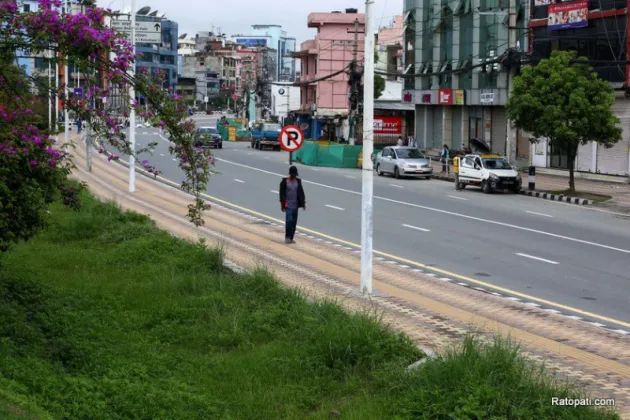
The roads of the Kathmandu Valley wore a rarely seen deserted look on the day of Maha Navami, one of the most important days of the Bada Dashain festival, as large numbers of residents had already travelled to their home districts to celebrate with their families. Adding to the stillness, many of those who remained in the capital observed the long-standing tradition of worshipping vehicles on Navami, leaving cars, motorcycles and other vehicles parked at home rather than on the move. According to the Kathmandu Valley Traffic Police Office, more than 576,000 people have left the Valley since Ghatasthapana, the day that marks the beginning of the festival. The near-empty streets, reported by Ratopati and News of Nepal, offered a striking contrast to the congestion that normally defines life in the capital.
A Valley Without Its Usual Rush
Roads across the Valley recorded very low vehicle traffic throughout the day, as the movement of private vehicles, commuters and public transport thinned out dramatically. Arterial routes that are typically packed with buses, motorcycles and office-goers saw only a scattering of vehicles, while the usual honking, weaving traffic and long queues at intersections were largely absent.
The quiet was not confined to a single neighbourhood. Roads in different parts of the Valley appeared similarly calm, reflecting how completely the annual Dashain migration empties the capital of its working population. With schools, offices and many businesses closed for the festival, there were far fewer reasons for residents to venture out, and those who did found the roads unusually easy to navigate.
For a Valley where traffic congestion is a daily headache and where rush hours can stretch for hours, the sight of wide, open carriageways on a major festival day underlined just how significant the exodus has been this season.
More Than 576,000 Have Left Since Ghatasthapana
The scale of the departure was quantified by the Kathmandu Valley Traffic Police Office, which stated that more than 576,000 people have left the Valley since Ghatasthapana. The figure captures the steady outflow of people that begins as soon as the festival opens and builds up in the days leading to Dashami, the day of receiving Tika and blessings from elders.
Key points from the traffic police assessment include:
- More than 576,000 people have departed the Kathmandu Valley since Ghatasthapana, the first day of Bada Dashain.
- The majority of those leaving are headed to their home districts across the country to celebrate the festival with family.
- Vehicle movement within the Valley remained very low on Maha Navami itself, as households stayed indoors for rituals and festivities.
The migration of people out of the capital ahead of Dashain is a familiar annual phenomenon, as Kathmandu draws hundreds of thousands of workers, students and professionals from across Nepal who return to their villages and towns for the festival. What the traffic police figures make clear this year is the sheer volume of that movement in a matter of days.
Vehicle Worship Kept Vehicles Off the Roads
Alongside the exodus, cultural tradition played its own part in the empty streets. Maha Navami is also the day on which the worship of vehicles is observed, a practice under which households across the country wash, decorate and perform rituals to their cars, motorcycles and other vehicles, seeking safety on the roads for the year ahead.
Because vehicles are the focus of the day's rituals, many families keep them parked at home until the worship is complete, and some refrain from using them altogether on Navami. The cumulative effect of thousands of households observing this tradition at the same time contributed directly to the low traffic recorded across the Valley, according to reports.
The combination of a reduced population, festival holidays and vehicle worship meant that even the Valley's busiest corridors remained light on vehicles for much of the day, a situation traffic authorities generally see only during the peak days of the Dashain break.
The Dashain Homecoming in Full Swing
Bada Dashain is the biggest festival in Nepal, and the days from Ghatasthapana through Maha Navami to Vijaya Dashami are marked by family reunions, religious rituals and the exchange of blessings. For the large population of the capital whose roots lie elsewhere, returning home for Dashain is a deeply held custom, and the period around Navami and Dashami represents the high point of that travel.
The departure of more than 576,000 people since Ghatasthapana reflects that pull. With the Valley's residents dispersed to their home districts, neighbourhoods in Kathmandu, Lalitpur and Bhaktapur have grown noticeably quieter, and the silence on the roads on Maha Navami served as the most visible sign of the season.
For now, the Valley's streets remain in their festival-mode calm, with the usual bustle expected to return only once celebrations wind down and families begin making their way back to the capital.