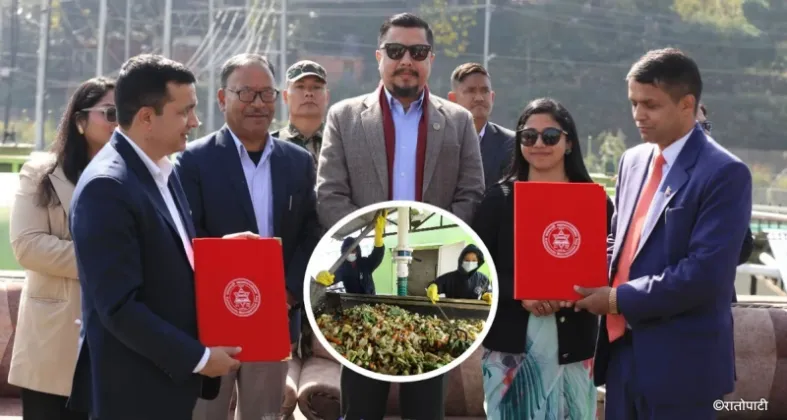
Kathmandu Metropolitan City has begun trial operations of its long-awaited waste-to-energy project at Teku, marking a significant step in the capital's efforts to manage the mounting biodegradable waste it generates every day. The trial of the rebuilt Teku bio-methanation plant commenced after a formal inauguration ceremony held at the Teku waste collection centre on Thursday.
The plant was jointly inaugurated by Minister for Energy, Water Resources and Irrigation Birajbhakta Shrestha and Acting Mayor of Kathmandu Metropolitan City Sunita Dangol. Their presence at the event underlined the joint interest of the federal energy apparatus and the local government in seeing the project succeed, as the capital continues to grapple with one of its most persistent urban challenges: what to do with the tonnes of organic waste it produces daily.
A Joint Effort for Waste Management and Clean Energy
The project has been developed with the support of the Alternative Energy Promotion Centre (AEPC), the government body tasked with promoting renewable energy technologies across the country. The partnership between the metropolis and the AEPC reflects an approach that treats household waste not merely as a disposal problem but as a resource that can be converted into something of value.
According to the project's stated aims, the plant is designed to manage biodegradable waste while simultaneously producing two useful outputs: renewable energy and organic fertiliser. This dual-benefit model is what distinguishes waste-to-energy initiatives from conventional landfilling, where waste is simply transported out of the city and dumped, often creating environmental problems elsewhere.
Bio-methanation, the technology employed at the Teku plant, relies on the decomposition of organic matter in an oxygen-free environment to generate biogas, which can then be used as an energy source. The process also leaves behind digested slurry that can be processed into organic fertiliser, offering farmers an alternative to chemical inputs.
Trial Phase and What Comes Next
With the inauguration complete, the plant has now entered its trial operations phase. During this period, technicians and officials will assess whether the facility can handle the volume of biodegradable waste fed into it and whether energy production can be sustained at a reliable level. The trial results are expected to determine how and when the plant moves toward regular, full-scale operation.
The Teku waste collection centre, where the plant is located, has long served as a key node in Kathmandu's waste management chain. Waste collected from across the metropolitan area passes through this site before being transported further. Situating the bio-methanation plant at Teku therefore allows the city to process organic waste close to where it is aggregated, reducing transport costs and emissions associated with hauling waste over long distances.
The rebuilding of the plant itself is notable. The Teku bio-methanation facility represents a renewed attempt to make waste-to-energy work in the Nepali capital, and Thursday's joint inauguration by the energy minister and the acting mayor signals the political weight now being placed behind the initiative.
Broader Context: Kathmandu's Waste Challenge
Kathmandu Metropolitan City, as the capital's largest local government, faces a continuous challenge in managing the waste generated by its residents. A large share of the city's municipal waste is biodegradable in nature, which makes technologies like bio-methanation particularly relevant. Diverting organic waste from the main waste stream could ease pressure on the city's existing disposal arrangements while recovering value in the form of energy and fertiliser.
The involvement of the Minister for Energy, Water Resources and Irrigation in the inauguration also situates the project within the federal government's broader interest in expanding renewable energy beyond large hydropower. Biogas and waste-to-energy projects, while smaller in scale than hydropower plants, contribute to energy diversification and can be deployed close to urban demand centres.
For the Alternative Energy Promotion Centre, the Teku plant offers a chance to demonstrate the viability of waste-to-energy technology in a dense urban setting. If the trial proves successful, the project could serve as a model for other municipalities across Nepal that face similar waste management pressures.
Acting Mayor Sunita Dangol's participation highlights that waste management remains a priority for the metropolis's executive leadership. The city government has repeatedly been called upon to find sustainable, in-city solutions to waste rather than relying entirely on distant disposal sites.
Looking Ahead
The coming weeks of trial operations will be closely watched by city officials and energy sector stakeholders alike. Key questions include how much biodegradable waste the plant can process daily, how consistent the energy output proves to be, and how effectively the organic fertiliser by-product can be collected, processed and put to use.
If the trials go well, the rebuilt Teku bio-methanation plant could become a cornerstone of Kathmandu's waste management strategy, converting a portion of the capital's daily refuse into renewable energy and organic fertiliser. For now, the metropolis and its partners have taken the first concrete step: the plant is running, and its performance during the trial phase will determine the path forward for waste-to-energy in Kathmandu.