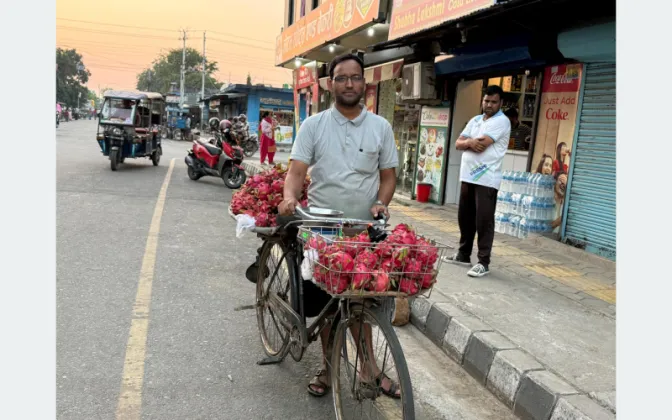
Ganeshdatta Pant, a 32-year-old resident of Maholiya in Bhimdatta Municipality-2, Kanchanpur, has spent the past four years selling dragon fruit from his bicycle in the Mahendranagar market, building a side business that now earns him up to Rs 60,000 a month. Pant is no ordinary vendor: he works as an office assistant at the District Treasury and Accounts Control Office and has completed 11 years in government service. Selling in the mornings and evenings, he makes a daily profit of around Rs 1,200 from the fruit he pedals into town. His dual life, reported by RatoPati and Nepal Press, has drawn public attention not only for the income he generates but for the message attached to it: that self-employment, begun on however small a scale, deserves respect and can meaningfully change a person's finances.
A Government Employee With an Early Start
Pant's day begins long before most of Mahendranagar's shopkeepers open their shutters. Loading his bicycle with dragon fruit, he heads into the market in the morning hours, serving early customers before his own office duties begin. When the working day at the District Treasury and Accounts Control Office ends, he returns to the market for the evening shift, repeating a routine he has maintained for four years.
His 11 years in government service might have been reason enough to remain within the comfort of a fixed salary. Instead, as Khabarhub reports, Pant chose to add a second occupation to his life, one that demands physical effort, daily commitment and direct contact with customers. The result is an enterprise that runs on two wheels but delivers returns that would satisfy many a full-time trader.
The discipline required to sustain this schedule is considerable. Balancing office attendance with two daily selling rounds leaves little idle time, yet Pant has kept the practice going since he first took his bicycle to the market four years ago. In doing so, he has become a recognizable figure in Mahendranagar, the main market town of Kanchanpur district, where regular customers now associate the sight of a fruit-laden bicycle with a familiar face.
The Economics of a Bicycle Business
The financial details of Pant's venture, modest on any single day, accumulate into a striking monthly figure. According to the reports, the key numbers behind his business are as follows:
- Daily profit: around Rs 1,200 from sales in the Mahendranagar market
- Monthly earnings: up to Rs 60,000
- Selling hours: mornings before office duty and evenings after it
- Duration: four years of continuous vending
- Product: dragon fruit, sold directly from his bicycle
For a government office assistant, an additional Rs 60,000 in a month represents a substantial boost to household income. The figure also illustrates how small-scale vending, often dismissed as informal or marginal work, can generate meaningful earnings when pursued with consistency. Pant's bicycle, in this sense, functions as a mobile shop with none of the overheads of a permanent stall, an arrangement that keeps his costs low and his margins intact.
Dragon fruit, his product of choice, is known for its distinctive appearance and its reputation as a healthy fruit, qualities that help it attract buyers in urban markets. By selling it personally to customers rather than leaving it to others, Pant keeps control of the entire chain from purchase to sale, a structure that supports the steady daily profit he reports.
Carrying a Message of Self-Employment
What distinguishes Pant from many other vendors, according to the coverage, is the message he promotes alongside his fruit. He presents his work as an example of self-employment, encouraging others to create income opportunities with their own initiative rather than waiting passively for formal job openings. The bicycle that carries his dragon fruit also carries this argument into the marketplace every morning and evening.
His example challenges two assumptions at once: that a permanent government post rules out other work, and that vending from a bicycle is somehow beneath a person holding an official position. By combining both, Pant demonstrates that dignity lies in the effort rather than the label of the job, and that an honest second occupation can sit comfortably alongside respected public service.
An Example for Others
Pant's story arrives amid ongoing public debate about employment and self-reliance in Nepal, where questions of job creation and income opportunities remain prominent. His own answer to those questions has been practical rather than theoretical: procure fruit, load the bicycle, and sell, day after day, in the market nearest to home.
Four years into the venture, he continues to pair his office work with morning and evening sales, maintaining the routine that now defines his public identity in Mahendranagar. Whether customers buy his dragon fruit for its taste, its health appeal or simply out of respect for the seller, they encounter a vendor who has turned a bicycle, a fruit and a strong work ethic into a monthly income of up to Rs 60,000, and into one of the most persuasive local cases for the power of self-employment.