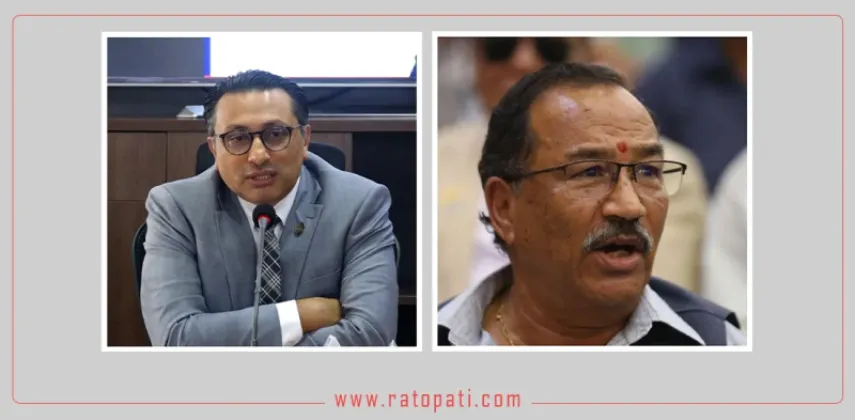
Former Rastriya Prajatantra Party (RPP) president Kamal Thapa has objected to Finance Minister Dr. Swarnim Wagle’s remarks on Nepal-India relations, calling the minister’s statement in New Delhi an undermining of Nepali nationalism and demanding that the government clarify its position. Thapa raised the issue in a Facebook post on Saturday, arguing that Nepal’s national identity is not based on hostility toward any particular country.
Thapa’s objection to the remarks
Thapa’s criticism focuses on how Wagle’s comments about Nepal-India ties relate to the country’s understanding of nationalism. He said the remarks made in New Delhi undermined Nepali nationalism, while also setting out his view that patriotism should not be defined by opposition to another country. His call for a government clarification places the issue before the government as a whole, rather than leaving it only as an exchange between the two politicians.
The available account identifies the location of Wagle’s remarks as New Delhi but does not provide their precise wording or further details about the occasion on which he made them. Thapa’s stated objection, however, is clear: he contests the implication he sees in the minister’s comments and says Nepal’s nationalism is not rooted in opposing a particular nation. His response asks the government to explain whether Wagle’s remarks reflect its position.
The distinction matters to Thapa’s argument. He is not describing nationalism as a stance against India or any other country; instead, he is rejecting the idea that national identity should depend on opposition to a foreign state. By asking the government to clarify its view, he is calling for an official explanation of how the remarks should be understood in relation to Nepal’s approach to its neighbour.
Demand for an official response
Thapa’s demand is directed at the government, with the central question being whether the finance minister’s comments represent the government’s position on Nepal-India relations. The statement does not, on its own, establish how the government has responded. It records Thapa’s request for clarification and his criticism of Wagle’s remarks, leaving the government’s position to be set out separately.
That demand also makes the issue broader than a personal disagreement. Wagle spoke as finance minister, while Thapa has challenged the meaning and implications of his comments in public. Thapa’s appeal for clarification asks the government to address the remarks institutionally and remove uncertainty over whether they should be read as an official position. His Facebook post on Saturday is the public forum through which he made that request.
Nepal-India ties and the nationalism debate
The dispute, as presented by Thapa, turns on how Nepal’s nationalism is described alongside relations with India. His position is that national pride does not require opposition to a particular country. He objected to Wagle’s statement because he believes it undermines that principle, and he wants the government to state clearly how it views the minister’s comments.
Thapa’s response does not provide further detail about the minister’s wording, nor does the available account include a government reply. The immediate development is therefore his objection and his demand for clarification. Any fuller assessment of the disagreement depends on the precise remarks and on whether the government sets out an official explanation.
For now, Thapa has framed the matter as one involving both Nepal’s national identity and the government’s responsibility to clarify a minister’s comments on relations with India. His central point is that Nepali nationalism should not be equated with opposition to another country. The government is being asked to say whether that understanding is consistent with its own position on Wagle’s remarks.