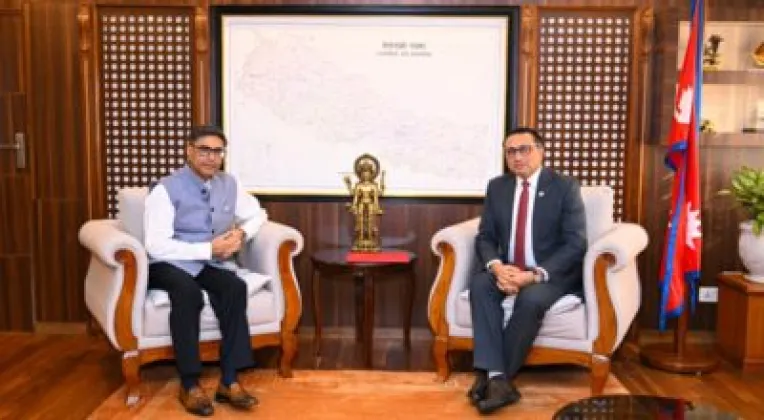
Indian Foreign Secretary Vikram Misri, currently on a visit to Nepal, held a courtesy meeting with Finance Minister Dr. Swarnim Wagle at the Finance Ministry in Kathmandu on Wednesday, with the two sides discussing various aspects of economic cooperation between the two neighbouring countries.
The meeting took place against the backdrop of the close and multifaceted relationship between Nepal and India, in which economic partnership has traditionally occupied a central place. According to details shared by Nepali officials, the discussion covered the breadth of economic cooperation between the two countries, although a detailed readout of the conversation was not immediately made public.
Finance Secretary Dr. Ghanshyam Upadhyay was present at the meeting, as were officials from the Ministry of Foreign Affairs and the Ministry of Finance. The presence of senior functionaries from both ministries underlined the weight the Nepali side attached to the engagement and reflected the institutional depth of Nepal-India dialogue at the official level.
A Courtesy Call with Clear Purpose
While characterised as a courtesy meeting, the engagement between Misri and Wagle carried evident significance. Courtesy calls by visiting foreign secretaries on senior ministers are a standard feature of diplomatic practice in Kathmandu, but they frequently provide an occasion for a candid exchange of views on the state of bilateral ties and on matters of mutual interest.
For Misri, who holds one of the most senior positions in India's diplomatic establishment, the meeting offered an opportunity to engage directly with the minister who oversees Nepal's economic policy and public finances. Economic issues have in recent years featured prominently in high-level conversations between the two countries, spanning trade, transit, energy, connectivity and development assistance.
Reports published by Khabarhub, Gorkhapatra Online and Nepal Lead confirmed that the discussion focused on various aspects of Nepal-India economic cooperation, without elaborating on specific projects or agreements.
Economic Cooperation: The Core of the Bilateral Agenda
Economic cooperation has long formed the backbone of relations between Kathmandu and New Delhi. India is one of Nepal's largest trading partners, and the two economies are closely interlinked through geography and longstanding commercial ties. Cooperation between the two countries traditionally spans a wide range of sectors, including:
- Trade and transit: As a landlocked country, Nepal depends heavily on transit routes through India for its overseas trade, making trade facilitation a persistent item on the bilateral agenda.
- Energy and hydropower: Nepal's hydropower potential and India's growing energy needs have made the power sector one of the most prominent areas of cooperation between the two neighbours.
- Connectivity and infrastructure: Road, rail and air links, along with cross-border infrastructure, remain central to efforts to deepen economic integration.
- Development partnership: India has supported a broad portfolio of development projects in Nepal, covering sectors ranging from education and health to roads and border infrastructure.
Against this backdrop, a meeting between India's foreign secretary and Nepal's finance minister naturally centres on the economic dimension of the relationship. While Wednesday's discussion was described in general terms, it comes at a time when both governments continue to pursue deeper cooperation in areas of shared interest.
High-Level Engagement Continues
Misri's meeting with Wagle forms part of a broader pattern of regular high-level engagement between Nepal and India, two countries bound by geography, history, culture and extensive people-to-people ties. Visits by India's foreign secretary to Kathmandu are closely followed, as they offer an indication of the state of the relationship and of the priorities both capitals are placing on bilateral dialogue.
The composition of the Nepali side at Wednesday's meeting, drawing officials from both the Finance Ministry and the Foreign Ministry, also illustrated how economic diplomacy has become inseparable from traditional political diplomacy in the Nepal-India context. Ministers and secretaries from economic ministries are routinely drawn into conversations with visiting Indian dignitaries, reflecting the practical, day-to-day nature of the cooperation between the two countries.
For Nepal, engagements of this kind provide a channel to convey its economic priorities directly to India's top diplomatic leadership. For India, they offer an opportunity to reaffirm the importance it attaches to its relationship with Nepal, which New Delhi has long treated as a key partner in its neighbourhood diplomacy.
As Misri's visit continues, the discussion at the Finance Ministry stands as the latest instance of the steady rhythm of exchanges between Kathmandu and New Delhi. While no specific outcomes of Wednesday's meeting were announced, the conversation between Misri and Wagle underscored the shared recognition that the economic partnership between Nepal and India remains central to the broader health of their bilateral relationship.