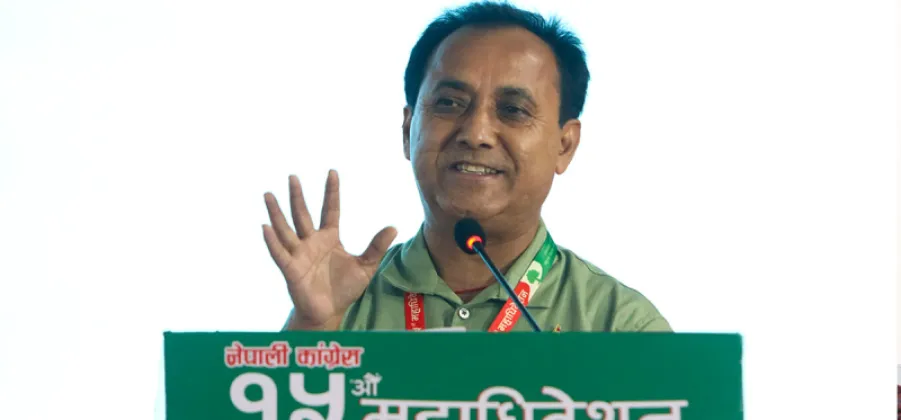
Senior vice-president of the Nepali Congress Vishwaprakash Sharma has come out firmly in defence of the party's special convention, declaring that it was held in accordance with the party statute and branding attempts to question its legitimacy as planned propaganda. In the same statements, reported by Nepali media on November 4, 2026, Sharma also served notice that the party will keep sharp vigilance over the government's wrongdoings and will continue to demand the rule of law, transparency and accountability. His remarks, carried by Nagarik News and Rajdhani Daily, show the senior leader speaking on two fronts at once: defending the party's internal processes while positioning the organisation as a watchdog over the government's conduct.
Convention held 'in accordance with the party statute'
At the heart of Sharma's intervention was a firm assertion about the special convention's validity. According to the senior vice-president, the gathering was convened and conducted through the procedures laid down in the party's own statute, and its decisions therefore carry full organisational authority. Any suggestion to the contrary, he argued, should be seen not as an honest difference of opinion but as a deliberate effort to delegitimise a properly constituted party exercise.
The distinction he drew is significant. A special convention is an extraordinary assembly, held between regular party congresses, and it is typically used to settle questions of organisation, policy or political direction when the ordinary party calendar does not allow for it. Because such a gathering speaks in the name of the entire party, its legitimacy is never a mere technicality. Resolutions, mandates and organisational decisions that flow from it depend on members accepting that it was properly convened. By insisting that every step followed the statute, Sharma sought to cut off that line of attack at its root.
'Planned propaganda': Sharma's reply to the critics
Sharma went beyond a simple rebuttal. In his assessment, the questioning of the convention's legitimacy amounted to planned propaganda, a characterisation that frames the criticism not as a spontaneous grievance but as an organised campaign. By choosing that language, the senior vice-president signalled that he does not regard the objections as good-faith internal debate; he presented them as a coordinated attempt to cast doubt on a valid party process.
His statement leaves little ambiguity about where one of the party's most senior office-bearers stands. For Sharma, the matter of the special convention is settled: the statute was followed, the convention is legitimate, and the effort to portray it otherwise should be recognised for what he says it is, planned propaganda.
Sharp vigilance over the government's wrongdoings
The second strand of Sharma's remarks turned outward, toward the government. He said the Nepali Congress will maintain sharp vigilance over the government's wrongdoings, a formulation that casts the party in the role of a constant monitor of those in power rather than a passive bystander. Alongside that pledge, he articulated the standards against which he said the government should be measured:
- Rule of law, meaning that governance must operate within the framework of the constitution and the law rather than through arbitrariness;
- Transparency, meaning that decisions and the use of public resources should remain open to public scrutiny; and
- Accountability, meaning that those who exercise authority must answer for their actions and for the results they produce.
Taken together, the three demands form the yardstick that Sharma says his party will apply to the government's conduct. The pledge of vigilance implies sustained public attention: watching for wrongdoing as it emerges, speaking out against it, and pressing for lawful, open and answerable governance.
A message on two fronts
Read together, the two halves of Sharma's statement form a coherent political message. Internally, he wants the debate over the special convention closed: the process was valid, the statute was followed, and the attempt to portray it otherwise is planned propaganda. Externally, he wants the party's oversight role underlined: the government's wrongdoings will be watched closely, and the rule of law, transparency and accountability will be demanded without pause.
The dual emphasis reflects the position of a senior office-bearer at a time when the party must manage its own organisational affairs while also engaging in public scrutiny of governance. As senior vice-president, Sharma occupies one of the leading positions in the Nepali Congress, one of Nepal's principal political parties, and his words carry organisational weight. Framing the convention's legitimacy as settled serves both to reassure party ranks and to discourage further challenge.
The remarks were reported in Nepal's mainstream press on November 4, 2026, with Nagarik News highlighting the pledge to keep a close watch on the government and Rajdhani Daily carrying the senior leader's statements. As of that reporting, Sharma's position stands as the party's clearest recent public answer on both counts: the special convention is legitimate, and the government remains under the Nepali Congress's watch.