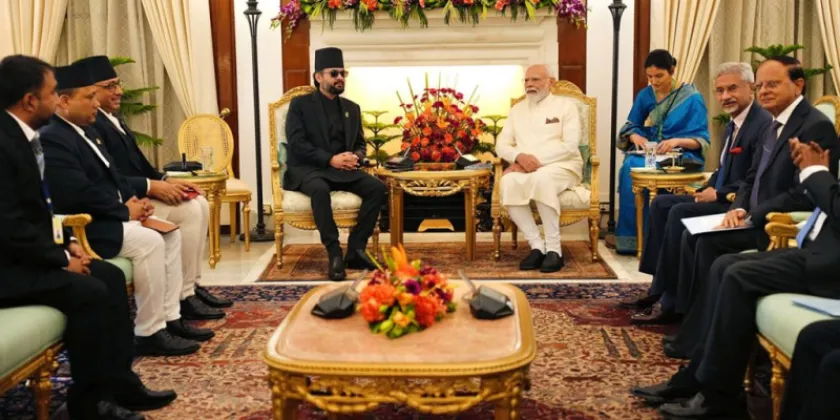
Indian Foreign Secretary Vikram Misri has confirmed that the Lipulekh issue was not raised during the bilateral talks held between the two prime ministers following Prime Minister Balen Shah's visit to India. The statement comes despite the fact that the Kalapani-Lipulekh border dispute had been publicly raised by Prime Minister Balen Shah himself in the run-up to and during the engagement with the southern neighbour.
Foreign Secretaries Tasked With Resolving the Dispute
According to details published by Nepal Press, the responsibility for resolving the long-running border dispute has now been formally assigned to the foreign secretaries of the two countries. This means that while the issue did not feature in the prime ministerial-level conversations, it has not been dropped from the bilateral agenda altogether. Instead, it has been delegated to the senior-most diplomats of Nepal and India, who are expected to handle the technical and political complexities of the dispute at the bureaucratic level.
The decision to route the matter through the foreign secretaries is significant. It suggests that both governments preferred to keep the sensitive territorial question away from the high-profile optics of a prime ministerial summit, while still keeping a channel open for its eventual resolution. Misri's remarks, however, underline the silence at the top level: the Kalapani-Lipulekh issue, which Balen Shah had publicly flagged, was simply not taken up during the talks between the two leaders.
Balen Shah's Public Position on Kalapani-Lipulekh
Prime Minister Balen Shah had made the Kalapani-Lipulekh border dispute a visible part of his public messaging, raising it openly in connection with Nepal's relationship with India. The dispute centres on territory at the trijunction of Nepal, India and China, an area that has been a persistent source of friction between Kathmandu and New Delhi for decades. Lipulekh, in particular, gained renewed attention after India developed infrastructure in the area, which Kathmandu has objected to as encroachment on Nepali territory.
By raising the issue publicly, the prime minister had signalled that the border question would be a priority in his government's dealings with India. The revelation that the matter did not come up in the bilateral talks between the two prime ministers therefore marks a notable gap between the public positioning of the Nepali leadership and the actual content of the diplomatic engagement.
What Misri's Remarks Signal
Foreign Secretary Misri's statement that the issue was not raised in the prime ministerial talks has been read as an indication of how the two sides managed the boundary question during the visit. Rather than confronting the dispute at the highest political level, the two governments appear to have chosen a quieter track, entrusting the foreign secretaries with the task of finding a way forward.
This approach carries both risks and opportunities for Kathmandu. On one hand, keeping the dispute off the summit agenda avoids public friction that could overshadow other areas of cooperation between the two neighbours. On the other, it raises questions among observers in Nepal about whether the country's top leadership is pressing hard enough on an issue that the prime minister himself has identified as important. The fact that the matter has been handed to the foreign secretaries will now be watched closely to see whether that channel produces tangible progress on the ground.
The Road Ahead for the Border Talks
With the foreign secretaries now carrying the mandate, the next phase of the Kalapani-Lipulekh dispute will unfold at the diplomatic working level. The assignment of the issue to the two foreign secretaries formalises a mechanism through which Nepal and India can continue discussing the boundary question without the pressure and visibility of a leaders' summit.
For Prime Minister Balen Shah's government, the challenge will be to ensure that the delegated process delivers results that match the expectations created by his public statements on the dispute. For India, Misri's confirmation that the issue was left out of the prime ministerial talks reflects New Delhi's preference for handling the matter through established diplomatic channels rather than in the spotlight of bilateral summits.
As the foreign secretaries take up their mandate, attention in Nepal will focus on whether this quieter track can succeed where higher-level engagements have so far remained silent on the issue that Balen Shah had placed firmly on the public agenda.