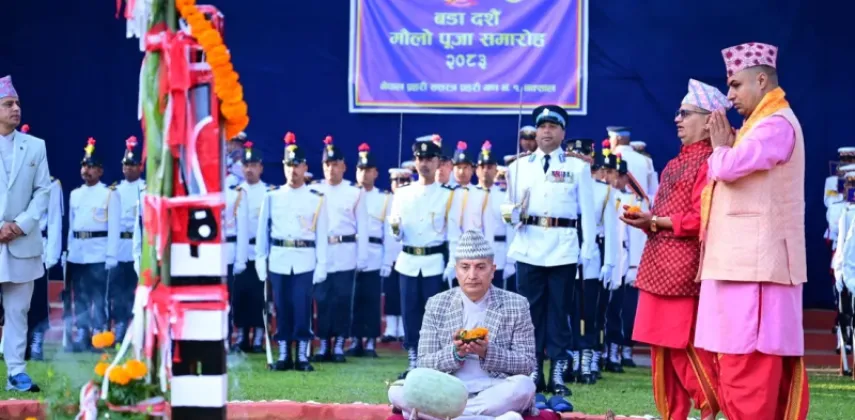
Inspector General of Police Dan Bahadur Karki performed the traditional Maulo Puja and Sankalpa Puja at the Maulo of the Nepal Police Armed Police Battalion No. 1 in Naxal, Kathmandu, on Tuesday, on the occasion of Bada Dashain. During the worship, the police chief offered animal sacrifice, a customary element of the ritual, and applied panja chhap to the Nishan, the ceremonial flag of the Nepal Police. The ceremony, held at one of the most significant Dashain venues for the force in the capital, also included felicitations for police personnel, with two havildars honoured on the occasion.
Traditional worship at the Naxal Maulo
The Maulo Puja and Sankalpa Puja were carried out at the Maulo maintained by the Nepal Police Armed Police Battalion No. 1, which serves as the sacred centre of Dashain rituals for the unit. The Maulo, a consecrated spot preserved within police formations, is worshipped during the festival as a symbol of protection and power for the force and the personnel who serve under it.
As the principal officiant of the ceremony, IGP Karki conducted the rituals in keeping with the established tradition of the Nepal Police. The offering of animal sacrifice formed part of the worship, while the application of panja chhap to the Nishan marked one of the central moments of the event. The Sankalpa Puja, the ritual of vow performed before the deity, is traditionally undertaken to seek strength and success in the responsibilities shouldered by the force in the period ahead.
News of the ceremony was reported by RatoPati, Nagarik News and News of Nepal.
Havildars honoured with cash prize and pagari
Alongside the religious rituals, the occasion was used to recognise members of the force. The key honours announced at the ceremony were as follows:
- Police Havildar Ram Kumar Karki was awarded a cash prize along with a pagari, the traditional turban presented during Dashain ceremonies as a mark of respect.
- Police Havildar Poshan Raj was also honoured on the occasion.
The presentation of the pagari and the cash award forms a customary part of the Maulo Puja programme, through which the Nepal Police felicitates personnel for their service. The honours were conferred in the presence of the police chief and assembled members of the battalion, underscoring the ceremonial importance the institution attaches to the festival and to the recognition of its staff during it.
A long-standing Dashain ritual of the Nepal Police
The Maulo Puja is among the best-known traditional rituals of the Nepal Police, observed every year during Bada Dashain. Similar ceremonies are traditionally held at police units and barracks across the country during the festival, with the Nishan worshipped, panja chhap applied and personnel felicitated with pagaris and awards. The panja chhap imprinted on the Nishan is regarded within the tradition as a mark of blessing and victory for the force, linking the modern security institution with cultural practices handed down over generations.
The Sankalpa Puja performed on the occasion carries particular significance for the force. Performed as a solemn vow, it is traditionally understood as a renewed commitment by the police to the security and service of the public, sought at the start of the festival period.
Bada Dashain and the festival context
Bada Dashain is the largest festival in Nepal, celebrated by Hindus across the country over fifteen days with rituals that include Phulpati, animal sacrifices, the giving of tika and jamara, and family gatherings. Government offices and public institutions mark the festival with traditional programmes, and the Maulo Puja stands among the most prominent of these observances within the Nepal Police, alongside the honours and rewards presented to personnel each year.
Tuesday's ceremony at Naxal brought together the religious and institutional dimensions of the festival in a single event. Under IGP Karki, the rituals at the battalion's Maulo reaffirmed the traditions of the force, while the felicitation of Havildars Ram Kumar Karki and Poshan Raj highlighted the individual service that the institution chose to recognise during this year's Bada Dashain celebrations.