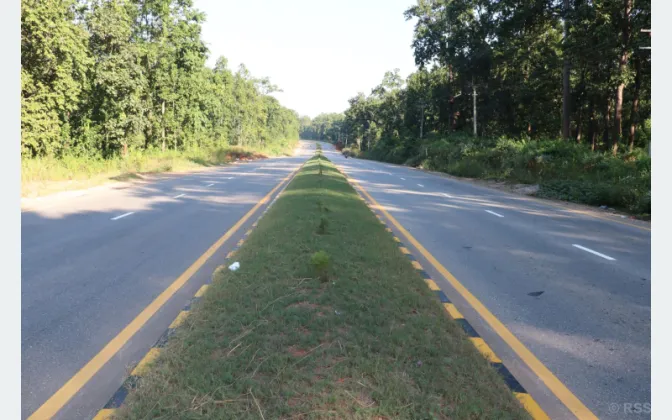
Grass planting is underway along the median divider of the expanded Narayanghat–Butwal road, with workers placing dubo grass on the three-metre-wide strip that runs between the four lanes of the roughly 113-kilometre highway. The greening work is being carried out at multiple locations along the route, including Gaindakot, Devchuli and Kawasoti, and is reported to be progressing rapidly.
According to Engineer Shiva Khanal, information officer of the eastern section of the Narayanghat–Butwal Road Expansion Project, the planting of dubo grass on the divider is part of the ongoing work to complete and beautify the expanded highway. The project has widened the road to four lanes, and the median strip separating the two directions of traffic is now being covered with grass as part of the finishing touches.
Planting Underway at Multiple Locations
The grass-planting campaign has reached several sections of the highway simultaneously. Work is underway at Gaindakot, which lies near the western end of the road section across from Narayanghat, as well as at Devchuli and Kawasoti, two major municipalities along the route through Nawalparasi and Chitwan.
By distributing the work across these locations rather than moving sequentially from one end of the road to the other, the project team has been able to move quickly. Engineer Khanal confirmed that the work is advancing at a rapid pace, with grass being laid on the divider at various points along the expanded highway.
The dubo grass being used is a hardy, fast-spreading variety commonly planted along roadsides and embankments in Nepal. Once established on the median, it is expected to give the divider a green appearance and help stabilise the soil on the strip.
A Four-Lane Highway Taking Final Shape
The Narayanghat–Butwal road section stretches roughly 113 kilometres and has been expanded from two lanes to four lanes under the road expansion project. The corridor is one of the busiest in the country, forming part of the main east-west route through the Terai plains and serving as a key link between Chitwan and Lumbini Province.
With the widening work largely in place, attention has shifted to the finishing elements of the project. The three-metre-wide median divider that separates traffic moving in opposite directions is one such element, and covering it with dubo grass is intended to complete the look of the modernised highway.
What Comes Next
Engineer Khanal, who shared details of the planting work in his capacity as information officer for the eastern section of the project, indicated that the greening of the divider is an active and ongoing component of the project's current phase. No timeline for the completion of the grass planting was specified.
The planting at Gaindakot, Devchuli and Kawasoti suggests that the work is being spread across the eastern and central stretches of the corridor. As the work progresses, more sections of the divider are expected to be brought under grass cover, gradually extending the green strip along the length of the expanded highway.
Significance for Travellers and Residents
For the thousands of people who travel the Narayanghat–Butwal road daily, the addition of a grassed median marks a visible change to one of the country's most heavily used highways. A green divider not only improves the appearance of the road but also plays a practical role in separating opposing traffic flows on a high-speed four-lane corridor.
For residents of municipalities along the route, including Gaindakot, Devchuli and Kawasoti, the greening work signals that the long-running expansion project is moving toward its final stages. Once the grass takes root along the divider, the expanded highway is expected to present a considerably improved picture compared with the congested two-lane road it replaced.
The Narayanghat–Butwal Road Expansion Project continues its work on the corridor, with the rapid pace of the divider planting indicating steady momentum on the road's finishing works. Further updates on the progress of the grass planting and other remaining components of the project are expected as the work advances along the 113-kilometre stretch.