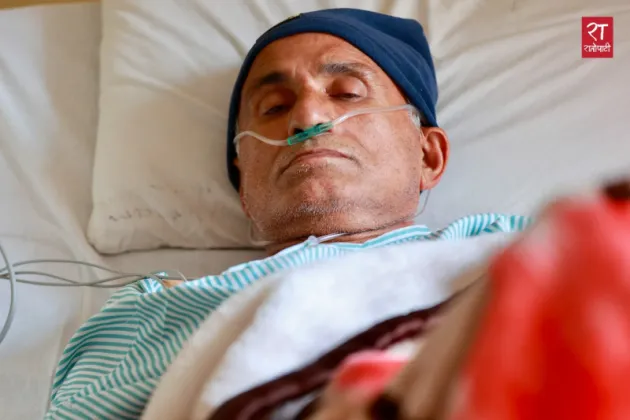
Kathmandu - The government has formed a four-member committee to hold talks with medical education reform activist Prof Dr Govinda KC, converting what had so far been an informal channel of communication into a formal negotiating mechanism. The panel will be coordinated by Jayaram Adhikari, a joint secretary at the Ministry of Education, and the decision to constitute it was taken on Wednesday, a day after it was reported that the Ministry of Education and Sports had opened informal discussions with Dr KC over his demands without yet putting a negotiation committee in place.
Alongside Adhikari, the committee includes joint secretaries from the Ministry of Health and Food Hygiene as well as the member secretary of the Medical Education Commission, according to a report by RatoPati. The team will now sit across the table from Dr KC, whose demands are the stated subject of the talks and whose campaign for reform in medical education is the reason the government has moved to engage him directly.
Three Arms of the State at the Table
The most distinctive feature of the new committee is its composition, which draws officials from three separate parts of the state structure rather than from a single ministry. Based on the information made public, the panel comprises:
- Jayaram Adhikari, joint secretary at the Ministry of Education, who will coordinate the four-member team.
- Joint secretaries from the Ministry of Health and Food Hygiene, representing the health side of the government in the negotiations.
- The member secretary of the Medical Education Commission, bringing the state body concerned with medical education directly into the process.
The spread of portfolios is significant because the questions at the heart of a medical education reform agenda rarely fall within the remit of a single institution: policy sits with the education ministry, while the health administration and the Medical Education Commission are the other state bodies most directly connected to how medical education is run. By staffing the committee with representatives of all three, the government has assembled a team that can, in principle, engage with the full breadth of the activist's demands rather than with fragments of them.
The choice of a joint secretary as coordinator is also notable. It places the negotiations at the level of senior officialdom from the outset, with the talks to be conducted by career administrators of joint secretary rank drawn from the ministries and the commission concerned.
From Informal Discussions to a Formal Talks Committee
The formation of the panel caps a rapid sequence of developments. The Ministry of Education and Sports had begun informal discussions with Dr KC over his demands, but as of Tuesday no negotiation committee had been formed, leaving that early engagement without a formal structure or an identified government side to negotiate with. That gap was filled on Wednesday, when the government decided to constitute the four-member committee under Adhikari's coordination.
The move from informal contact to a constituted committee is more than a procedural adjustment. A formally mandated team gives the negotiation a defined counterpart, a fixed membership and a clear point of contact within the bureaucracy through which any follow-up can be channelled. For the reform demands at the centre of the dispute, the existence of an official committee whose explicit purpose is to hold talks marks the first institutional step in a negotiation process that until this week existed only as preliminary contact.
The Mandate: Talks Over His Demands
The committee's stated purpose is straightforward: to hold talks with Prof Dr Govinda KC over his demands. The information released so far does not enumerate the specific agenda items the two sides will discuss, nor does it detail what the government is prepared to place on the table. What the decision does establish is that the demands of the medical education reform activist will now be processed through an official channel rather than through ad hoc engagement.
Several practical questions, meanwhile, remain open. The schedule for the first round of formal talks, the venue and the frequency of meetings were not part of the initial information made public, and it is not yet known how quickly the newly formed panel will convene with Dr KC after Wednesday's decision.
Any movement at the negotiating table is likely to be followed closely within the medical education sector, where reform remains a live and contested issue. For now, the government has done what it had not done as of Tuesday: it has put a named, structured team in place to negotiate with Dr KC, and the focus now shifts to the talks themselves and to whether the committee's formation proves to be the beginning of a substantive settlement of his demands.