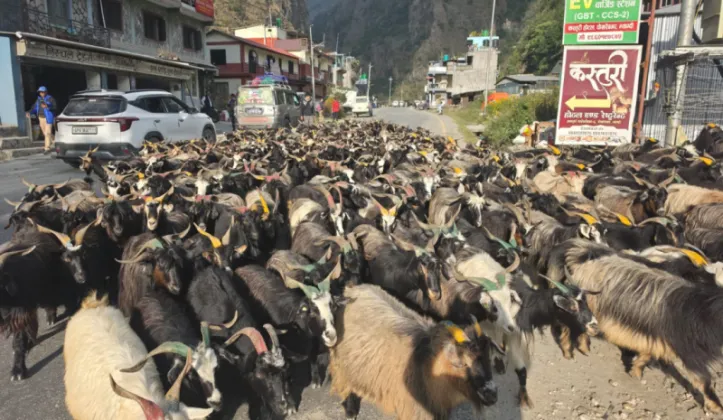
With the Tihar festival approaching, more than 1,500 sheep and goats brought down from Mustang have already been sold for the festival season, and traders have moved additional animals into Myagdi district for sale. Traders active in the market say each goat is currently priced at Rs 40,000 to Rs 45,000, a level that underscores the strength of demand during the festive period. The brisk Tihar trade follows an equally busy Dashain, during which some 14,000 sheep and goats were sold.
Strong Demand Ahead of Tihar
Demand for sheep and goats climbs steadily in the run-up to Tihar, when households across Nepal prepare feasts and rituals in which meat occupies a central place. According to traders, sales of animals from Mustang have already crossed the 1,500 mark for this festival alone, and business remains under way as the celebrations draw closer. The figures point to the continuing role of Mustang's flocks in meeting the festive demand that peaks twice a year, first around Dashain and then again during Tihar.
Festivals drive the busiest weeks of the year for the sheep and goat trade, and the current figures show that pattern holding again this season. The animals sold so far have moved as buyers prepare for the celebrations, with traders bringing more livestock from Mustang into Myagdi to keep pace with demand.
The price band quoted by traders, Rs 40,000 to Rs 45,000 per goat, reflects what buyers are prepared to spend at this time of year. For many households, the purchase of a goat is among the largest single expenses of the festival season, and the animals arriving in the market are being priced accordingly. Traders describe the current rates as the going price for goats in the run-up to the festival, with sales continuing as more animals reach the market.
Mustang Livestock Brought to Myagdi
The animals reaching the market come from Mustang, the trans-Himalayan district where sheep and goat herding remains an established livelihood, and they are being brought to Myagdi for sale ahead of the festival. Traders move the flocks down from the highlands as Tihar nears, giving buyers in the hilly district access to animals reared in Mustang's pastures. The arrangement links the two districts each festival season, with Mustang supplying the livestock and Myagdi serving as the marketplace where the transactions take place.
The seasonal movement of livestock is a significant feature of the festival economy. The more than 1,500 sheep and goats already sold for Tihar represent fresh income for the herding households of Mustang, while buyers in Myagdi secure animals for their own celebrations. With further animals having been brought to Myagdi for sale, trade between the two districts is continuing in the days leading up to the festival.
Dashain Sales Set a High Benchmark
The Tihar figures come against the backdrop of an exceptionally busy Dashain season. During Dashain, 14,000 sheep and goats were sold, a volume that dwarfs the current Tihar tally of more than 1,500 animals. The comparison highlights the sheer scale of demand during the autumn festivals, when the purchase of sheep and goats becomes one of the most visible markers of the festive season in markets across the country.
While Tihar sales have so far reached a fraction of the Dashain total, the festival is still approaching and animals continue to arrive in Myagdi for sale. Traders say each goat is fetching Rs 40,000 to Rs 45,000, rates that keep the trade attractive for sellers even as buyers weigh their budgets. Taken together, the trade in Mustang's sheep and goats this season has already involved more than 15,000 animals across the two festivals.
The Season at a Glance
- More than 1,500 sheep and goats from Mustang have been sold for the Tihar festival so far
- Additional animals have been brought to Myagdi district for sale as the festival approaches
- Traders are quoting Rs 40,000 to Rs 45,000 per goat
- Around 14,000 sheep and goats were sold during the Dashain festival
According to a report published by Gorkhapatra Online, the trade underlines the enduring pull of the festival market, where Mustang's herders and Myagdi's buyers meet each Dashain and Tihar. With the festival still to come and animals continuing to arrive for sale, the movement of sheep and goats from the high pastures of Mustang to the markets of Myagdi stands out as one of the clearest illustrations of how deeply the festival season shapes the livestock trade in western Nepal.