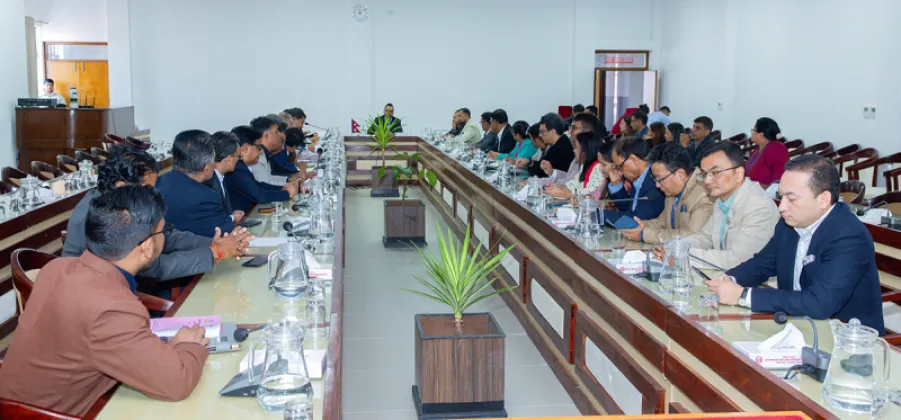
Kathmandu - The Office of the Prime Minister and Council of Ministers on Friday, November 6, held discussions with the country's top private sector leadership on a draft bill seeking to amend existing Nepal Acts related to investment and infrastructure. The meeting, convened at the Prime Minister's office at Singha Durbar in Kathmandu, was attended by the heads of major business organizations, including the Federation of Nepalese Chambers of Commerce and Industry (FNCCI), the Confederation of Nepalese Industries (CNI) and the Nepal Chamber of Commerce, along with other industrialists and businesspeople, according to Nagarik News. The consultation comes as the government readies legal changes ahead of a major infrastructure conference scheduled for the last week of the Nepali month of Mangsir.
Private sector leadership at the Singha Durbar table
The discussion was held at the Office of the Prime Minister and Council of Ministers at Singha Durbar, the seat of Nepal's federal government. Asim Shah, political adviser to the Prime Minister, was present at the meeting, which centered on the draft of a bill prepared to amend certain Nepal Acts concerning investment and infrastructure. The venue and the guest list together pointed to the priority the government has attached to the exercise: rather than circulating the draft through routine channels, it brought the leadership of the business community directly into the room where policy is made.
The participation of the country's three leading chambers at a single sitting gave the consultation particular weight. As Nepal Press reported, the attendees included the heads of the major private sector organizations as well as other industrialists and businesspeople, offering the government a broad cross-section of views from manufacturing, trade and industry.
Who took part in the consultation
- Federation of Nepalese Chambers of Commerce and Industry (FNCCI), the largest umbrella body of Nepal's private sector
- Confederation of Nepalese Industries (CNI), a leading representative of the country's industrial enterprises
- Nepal Chamber of Commerce, a longstanding voice of the trading community
- Other industrialists and businesspeople invited alongside the chamber heads
Convening such a wide representation of the private sector at Singha Durbar signals a consultative approach to lawmaking at an early stage of the process, before the draft bill advances toward formal endorsement.
59 laws set for amendment ahead of the Mangsir conference
According to business portal Bizmandu, as many as 59 laws are being amended ahead of an infrastructure conference scheduled for the last week of Mangsir. Mangsir, the eighth month of the Nepali calendar, runs from roughly mid-November to mid-December, which places the conference in the middle of December on the Gregorian calendar.
A bundled legislative exercise
The draft discussed on Friday is framed as a bill to amend certain Nepal Acts, a formulation commonly used in Nepal for omnibus legislation that updates a large number of existing statutes through a single piece of law. Rather than amending each act separately, such bills allow the government to introduce coordinated changes across multiple laws at once, an approach generally regarded as faster when a wide body of legislation must be brought into line with a new policy priority.
In this case, the stated priority is investment and infrastructure. By linking the amendment drive to the infrastructure conference planned for the final week of Mangsir, the government has effectively set a deadline for itself: the legal groundwork is expected to be in place by the time the conference convenes. Neither Nagarik News nor Nepal Press, however, detailed which of the 59 laws pertain specifically to investment and infrastructure or the exact changes envisaged in the draft.
Why the legal framework for investment is in focus
Laws governing investment and infrastructure shape how development projects are approved, financed and executed, and how private capital is able to participate in them. Amending these provisions is the kind of step governments take to clear outdated or inconsistent rules and make the legal environment more predictable for investors. For the business leaders seated at Friday's meeting, the wording of such amendments has a direct bearing on the cost, timeline and risk of doing business in Nepal.
From consultation to legislation
The Friday meeting represents an early stage in a longer legislative journey. Once feedback from stakeholders such as the chambers is gathered, a bill typically requires the endorsement of the Council of Ministers before it is tabled in the Federal Parliament, where it must pass both houses to become law. The reports of the meeting did not disclose the specific feedback offered by the business community, but the timing of the consultation, weeks before the Mangsir conference, suggests the government is keen to move the bill forward without delay.
With the infrastructure conference approaching and 59 laws on the amendment list according to Bizmandu, attention will now turn to how quickly the draft bill advances through the formal process, and how far the concerns raised at Singha Durbar shape its final form.