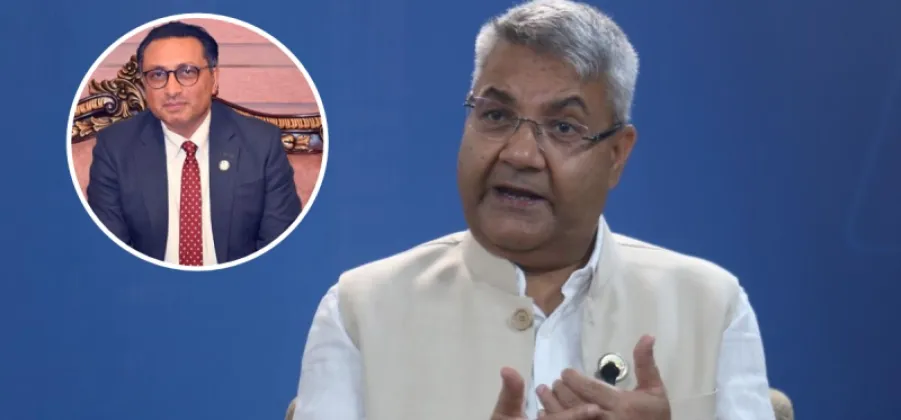
CPN (UML) leader Gokul Baskota sharply criticised Finance Minister Dr. Swarnim Wagle on October 24, 2026, over remarks Wagle made about Nepali nationalism and Nepal-India relations during a visit to India. Baskota accused the minister of speaking against Nepal once he reaches the neighbouring country, according to reports published by multiple Nepali news outlets.
Baskota’s criticism
Baskota’s central allegation was that Wagle’s comments in India were contrary to Nepal’s interests. He framed the remarks as a matter of national identity and Nepal’s relationship with India, arguing that the finance minister spoke against the country after arriving there. The criticism placed Wagle’s statements, made during an overseas visit, at the centre of a political dispute over how Nepal’s interests and national identity are represented.
The available account identifies the subjects of Wagle’s remarks as Nepali nationalism and Nepal-India relations, but does not provide their full wording. It also does not set out the specific points in Wagle’s comments that prompted Baskota’s accusation. Without that detail, the reported dispute is chiefly defined by Baskota’s characterisation of what the minister said, rather than by a complete account of the remarks themselves.
The reports describe Baskota’s response as sharp and directed at Wagle in his capacity as finance minister. His criticism went beyond disagreement over the substance of a statement: he accused the minister of speaking against Nepal when in India. That accusation makes the exchange a public challenge to how Wagle’s comments should be understood and whether they accurately represented Nepal’s position.
Focus on nationalism and bilateral ties
The controversy brings two closely connected subjects into the same debate: Nepali nationalism and relations with India. The reports indicate that Wagle addressed both during his visit, while Baskota’s response questioned the national significance and framing of those remarks. The criticism therefore concerns not only what was said about bilateral relations, but also how comments made abroad can be interpreted in Nepal’s domestic political debate.
Baskota’s allegation is a political assessment of Wagle’s remarks, not an independently established finding that the minister intended to speak against Nepal. The distinction matters because the account of the exchange, as reported, includes Baskota’s charge but does not provide Wagle’s full comments or a detailed explanation of his position. The precise basis for the disagreement cannot be fully assessed from the reported summary alone.
The reports also do not specify the exact setting or date of Wagle’s remarks in India, beyond linking them to his visit, or provide further details about the visit itself. They focus on Baskota’s criticism and the themes of nationalism and Nepal-India relations. No additional response from Wagle is included in the information available for this report.
Political dispute remains centred on the remarks
Baskota’s comments ensure that Wagle’s statements are being debated in Nepal as well as in the context in which they were made in India. The disagreement, as reported on October 24, is centred on Baskota’s claim that the finance minister’s comments amounted to speaking against the country. The wording and context of Wagle’s remarks remain important to understanding the dispute, but are not provided in full in the available accounts.
For now, the reported exchange is a public criticism by a CPN (UML) leader of a sitting finance minister over comments on national identity and ties with India. Baskota has made his accusation clear, while the supplied reports do not offer enough detail to establish the full content of Wagle’s remarks or how he would answer the charge.