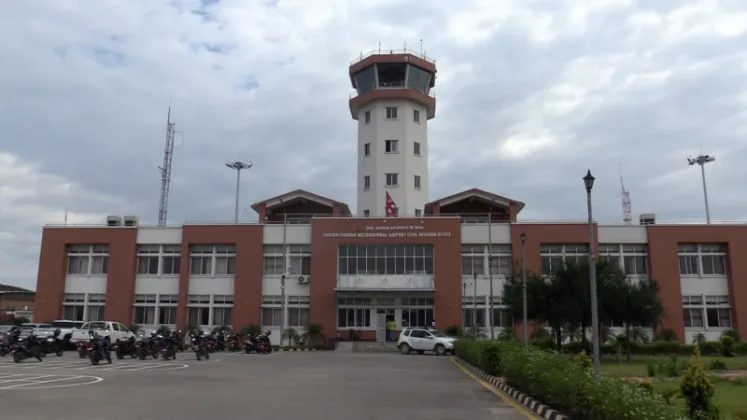
Hoteliers in Nepal's Lumbini tourism belt are facing the prospect of losing investments worth billions of rupees as Gautam Buddha International Airport continues to sit without regular flight operations. Two Nepali news reports have highlighted the growing financial strain on hotel businesses in and around Bhairahawa, in Rupandehi district, where entrepreneurs poured capital into hotels and hospitality ventures on the expectation that the international airport would bring a steady stream of tourists to the region. With the airport failing to operate regularly, those investments now stand exposed, the reports warn, leaving a business community that bet on connectivity carrying costs on assets that are not producing the returns they were built for.
Billions Invested on the Promise of Flights
The reports, published by Nepal Views and Nepal Samaya, describe a familiar pattern in the story of the region's hospitality boom: the arrival of an international airport was treated as the signal that tourism to Lumbini, the birthplace of Gautama Buddha, was finally set to take off. Hoteliers responded by expanding existing properties, building new hotels, restaurants and event venues, and committing savings and borrowed capital to position themselves for the anticipated surge in visitor numbers.
According to the reports, that surge has not materialized the way the business community expected, because the airport itself has not been brought into regular operation. Without international flights landing and departing consistently, the volume of travelers the hotels were built to serve has remained out of reach. The result, the reports say, is that billions of rupees in investment are now at risk.
What "Investment at Risk" Means on the Ground
For hospitality businesses, the exposure described in the reports is not a paper loss that can simply be waited out. The practical consequences of a stalled airport include:
- Unsold room inventory: hotels built or expanded for high occupancy are running far below the levels their business plans assumed.
- Continuing loan obligations: much of the investment in the sector is financed through credit, and repayment schedules do not pause when guests fail to arrive.
- Fixed operating costs: staff salaries, maintenance, utilities and marketing expenses continue regardless of how many rooms are sold.
- Stranded capacity: new properties and facilities built specifically to capture airport-driven arrivals now risk becoming assets without a market.
The reports emphasize that this combination leaves hoteliers carrying costs on investments that are generating little or no return, which is precisely what puts billions of rupees of capital in jeopardy.
An International Gateway Yet to Operate Consistently
Gautam Buddha International Airport at Bhairahawa was developed to serve as Nepal's second international gateway, complementing Tribhuvan International Airport in Kathmandu and placing an international-standard airport within reach of Lumbini, one of the country's premier cultural and religious destinations. Its name and location reflect its purpose: to connect travelers, including Buddhist pilgrims from around the world, directly to the birthplace of the Buddha.
The reports underline the gap between that vision and the current reality. The airport's continued non-operation has meant that the tourism economy it was meant to anchor has been left waiting. For hoteliers who timed their investments to the airport's arrival, the inactivity has turned a planned catalyst for growth into the central source of their financial risk.
Why the Airport Matters So Much to Lumbini Tourism
Lumbini occupies a distinctive position in Nepal's tourism landscape. As the birthplace of Gautama Buddha and a UNESCO World Heritage Site, it draws pilgrims and heritage travelers whose journeys depend heavily on convenient air access. An international airport in close proximity was expected to reshape visitor flows to the area, cutting out the need to route through Kathmandu and making short pilgrimages and heritage trips far easier to arrange.
That expectation is exactly what underpinned the hoteliers' investment decisions described in the reports. When the airport operates, the argument ran, arrivals rise, occupancy follows, and hospitality investments pay off. With the facility not operational on a regular basis, the logic that justified the spending has been interrupted, and the businesses are left exposed to the full weight of their fixed commitments.
What Is at Stake Beyond the Hotels
The financial exposure detailed in the reports is concentrated in the hotel sector, but the implications extend further. A hospitality market built around billions of rupees in investment supports employment, suppliers, transport operators and a wide range of local services. When the anchor infrastructure that justifies that investment does not operate, the risk is not contained to individual balance sheets; it weakens the broader economic case for tourism-led development in the region.
The reports also point to a reputational dimension. An international airport that is not operational sends a signal to potential travelers, airlines and investors that the destination's infrastructure cannot yet be relied upon. For hoteliers who have already committed their capital, that signal compounds the difficulty of attracting the guests their businesses were designed to host, deepening the gap between what was promised and what the market is currently delivering.
Where to Read the Reports
The original coverage can be found here: