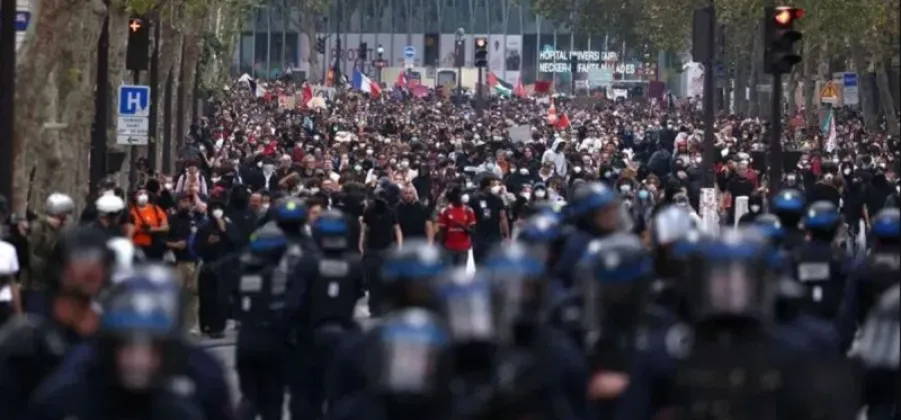
France was rocked by a weekend of violent protests against inflation, fuel price hikes, the rising cost of living and deteriorating public services, with nationwide demonstrations on Saturday descending into clashes with police, arson and looting in Paris and several other cities. As the unrest carried on into Sunday, President Emmanuel Macron issued an appeal for calm from the Élysée Palace, calling on citizens to maintain peace and order and warning protesters against any step that would worsen the situation. The violence has also ignited a bitter exchange of accusations between political parties over the government's failure to control the protests, a confrontation unfolding just months ahead of presidential elections scheduled in two rounds next April and May.
From Protest to Chaos on the Streets
What began as a nationwide expression of economic frustration quickly slipped beyond the authorities' control. Demonstrators took to the streets across France on Saturday in protests aimed squarely at the government over an economic squeeze that households say has become unbearable, with the capital and other cities emerging as flashpoints, as reported by Nagarik News.
The movement's grievances were broad, but they were bound together by a single thread: the mounting pressure on ordinary family budgets. The issues pushing people into the streets included:
- Runaway inflation, which has steadily eroded household purchasing power
- Fuel price hikes, driving up the cost of transport and daily commutes
- A rising cost of living that has made everyday essentials increasingly hard to afford
- Deteriorating public services, which protesters say are delivering less even as expenses climb
A Second Day of Fires and Looting
Rather than remaining peaceful, the demonstrations turned confrontational. Police clashed with protesters in Paris and other cities, while arson and looting were reported as the disorder spread through urban centers. Scenes of burning property and ransacked shops marked some of the most serious episodes of the weekend.
Crucially, the chaos did not end with nightfall. The violence continued into Sunday, extending the crisis into a second day and deepening the impression of a government struggling to restore order, according to Rato Pati.
Macron Urges Calm from the Élysée Palace
With French cities still unsettled, President Macron stepped forward with a direct public appeal. Speaking from the Élysée Palace, the head of state called on citizens to maintain peace and order, and issued a pointed warning to protesters against taking any action that would worsen the situation.
The intervention underscored the gravity with which the presidency is treating the unrest. An appeal delivered from the seat of executive power, while violence was still flaring, was aimed squarely at pulling the country back from further confrontation. It also carried a political dimension: with arson and looting dominating the picture of the protests, the president moved to shift the emphasis toward restoring order.
For the demonstrators, however, the message from the palace offered little immediate answer to the complaint that brought them there. The protests were fueled by economic pain that has been building across the country, and by a conviction that public services are deteriorating even as prices rise. How the government translates Macron's call for calm into relief for squeezed households remains an open question.
Political Recriminations with the Election in Sight
The unrest has rapidly become a political battleground. Political parties traded accusations over the government's failure to control the protests, each side seeking to assign blame both for the economic conditions that fueled the anger and for the security failures that allowed it to spiral.
The timing gives the confrontation added edge. Presidential elections are scheduled in two rounds next April and May, and the cost of living has now been thrust to the center of the national debate. For the government, the twin challenge of calming the streets and answering the economic grievances behind them will weigh heavily on the period ahead. For opposition parties, the disorder presents an opportunity to argue that the country's leadership has lost its grip on both prices and public order.
The Same Anger Beyond France's Borders
Nor is the fury confined to France. Protests over similar economic grievances were reported in Albania, Italy, Portugal, Spain and Greece, according to Khabarhub, a sign that inflation and rising prices are straining household finances across a wide swath of the continent. The breadth of the unrest points to a shared malaise, with governments across southern Europe confronting populations squeezed between climbing costs and mounting frustration over public services.
For now, the immediate question is whether the calm Macron has demanded can hold. Another day of violence would deepen the human and political cost of the crisis, while a return to peace would leave the underlying economic grievances unresolved. With the first round of the presidential vote now only months away, the government's response to the anger that filled France's streets this weekend may prove as consequential as its ability to police them.