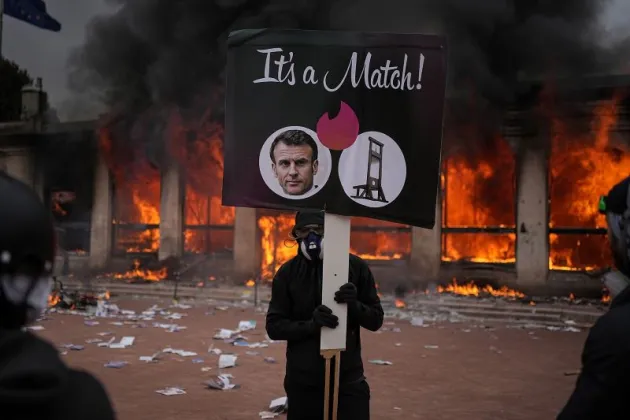
The French government has imposed a partial curfew in an effort to halt the riots and looting that have been unfolding across parts of the country, moving to reclaim control of the streets as public disorder continues. Officials said the restriction was introduced as an emergency measure to contain the violence, and issued a stark warning that the state is prepared to go further and declare a full state of emergency if the situation fails to improve. The development, reported by Thaha Khabar, underscores the gravity of the unrest and the mounting pressure on authorities to restore calm.
A Curfew to Reclaim the Streets
The measure is described as a partial curfew, meaning that restrictions on movement apply during certain hours or within designated areas rather than amounting to a blanket lockdown across the entire country. Such measures are typically deployed when authorities believe that large-scale violence is being driven, or at least worsened, by crowds gathering after dark. By clearing people from the streets during the most volatile hours, a curfew gives police a legal basis to prevent precisely the kind of nighttime disorder that fuels riots and enables looting.
According to the government, the curfew is explicitly intended as a measure to control the unrest. Officials have framed it as a proportionate first step: firm enough to disrupt the momentum of the violence, but stopping short of the extraordinary powers that a state of emergency would confer. In practice, curfews of this kind are generally enforced through visible police patrols, with people found on the streets in violation of the restrictions liable to be stopped, questioned and penalized.
Why governments reach for curfews
Curfews are among the most common tools available to governments facing civil unrest, because they serve several purposes at once:
- Breaking the rhythm of unrest: Riots often build after nightfall, when crowds can assemble and scatter quickly. A curfew removes that window of opportunity.
- Protecting businesses: Looting tends to concentrate on shops and commercial streets, and keeping people indoors makes such theft far harder to carry out.
- Simplifying enforcement: With the streets largely empty, police can treat anyone moving about during restricted hours as a potential offender, rather than trying to separate bystanders from rioters in a volatile crowd.
A State of Emergency Held in Reserve
The government has made clear that it is prepared to declare a state of emergency if necessary, a statement that functions both as a warning and as an assertion of resolve. A state of emergency is a far more powerful legal instrument than a curfew. In the French context, such a declaration grants authorities significantly expanded powers, including the ability to:
- restrict or prohibit the movement of people and vehicles in defined zones
- ban public gatherings considered a threat to public order
- carry out administrative searches without prior judicial approval
- place individuals deemed a danger to security under tight control, including house arrest
France has previously invoked emergency powers during grave crises, and the government's willingness to do so again signals serious concern that the current wave of riots and looting could grow beyond what ordinary policing can contain. By announcing in advance that the option is on the table, officials are also applying direct pressure on those involved in the violence, making it clear that continued lawlessness will be met with progressively harsher measures.
Declaring a state of emergency is not, however, a step taken lightly. It curtails civil liberties and concentrates power in the hands of the executive, which is why governments generally treat it as a last resort, to be used only when lesser tools such as curfews and large-scale deployments have failed. The French government's stated position, ready if needed but not yet pulling the trigger, suggests it is testing whether the partial curfew can do the job on its own.
The Toll of Continued Unrest
For residents caught in the middle of the violence, the combination of riots and looting represents the most immediate danger. Rioting endangers lives and property, disrupts transport and daily routines, and spreads fear through neighborhoods that may have little to do with the underlying grievances. Looting, meanwhile, hits local businesses hard, stripping shopkeepers of stock and, in many cases, inflicting damage that can take months or years to repair.
The curfew itself carries costs for ordinary citizens as well, since it restricts the freedom of movement of everyone, not only those participating in the violence. That trade-off between civil liberties and public safety sits at the heart of nearly every debate over emergency measures, and it is likely to become only more charged if the government proceeds to a full state of emergency.
What Comes Next
Attention now turns to whether the partial curfew achieves its central objective of quelling the riots and looting. If the streets fall quiet in the coming days, the government will be able to argue that it restored order without resorting to exceptional powers. If the violence continues despite the restrictions, the promised state of emergency would follow, reshaping daily life in France far more dramatically.
In the meantime, the authorities' message to the public is straightforward: comply with the curfew, stay off the streets during restricted hours, and allow security forces the room they need to work. The situation remains fluid, and further details, including the precise scope of the curfew and whether the state of emergency is ultimately invoked, are expected to become clear as events develop, according to reporting by Thaha Khabar.