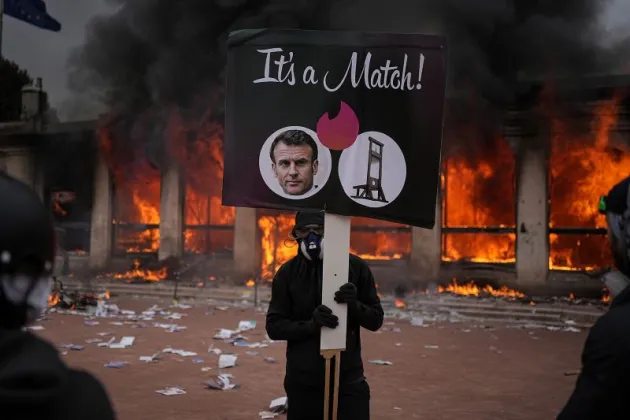
France has imposed a partial curfew in an effort to halt riots and looting that have posed a mounting challenge to public order, according to reports. The measure restricts movement during designated hours in the areas affected by the unrest and is intended to deprive the disturbances of the momentum that has sustained them. Announcing the move, the French government also made clear that it is prepared to go further if required, saying it stands ready to declare a state of emergency should the situation deteriorate beyond what ordinary policing can contain.
The decision to curtail movement comes amid ongoing riots and looting that have tested the capacity of security forces and unsettled businesses and residents. According to a report by the Nepali news portal Thaha Khabar, the curfew is being imposed specifically as a measure to control the unrest, with the government framing it as a necessary step to stop the violence from spreading further.
Details of the curfew's exact scope were not spelled out in initial reporting, but the description of the restriction as partial indicates that it applies to particular areas and hours rather than to the entire country around the clock. Even so, the imposition of any curfew in a country where public movement is normally unrestricted represents a significant escalation in the state's response to civil disorder.
A Partial Curfew to Reclaim the Streets
Curfews of this kind are typically designed to achieve several objectives at once. By clearing the streets during the hours when unrest tends to peak, authorities aim to remove the crowds in which rioting thrives, cut off the cover that emboldens looters, and give police and security forces the space to deploy more effectively. The measure announced in France is understood to be directed at precisely those goals.
The immediate aims of the curfew are understood to include:
- Breaking the momentum of the riots by keeping potential participants off the streets during critical hours
- Deterring looting, which has accompanied the unrest and which the government has singled out as a key target of the measure
- Allowing security forces to regain control of affected neighbourhoods without confronting large crowds
- Reassuring residents and shopkeepers that the state is acting to protect lives, homes and property
Looting is a particular concern for any government confronting riots of this kind. Beyond the immediate losses suffered by shop owners, the sight of businesses being ransacked erodes public confidence and can encourage copycat acts elsewhere. By restricting movement, the curfew is intended to deny would-be looters both the opportunity and the anonymity of the crowd that such acts depend on.
The effectiveness of the measure will depend heavily on how it is enforced. A curfew that is widely ignored can deepen the impression of a state losing its grip, while one enforced too aggressively risks provoking confrontations of its own. Authorities will therefore be seeking a balance between firmness and restraint as the restriction takes effect.
State of Emergency Held in Reserve
Perhaps the most significant signal in the government's announcement is its explicit readiness to declare a state of emergency if necessary. Such a step would represent a substantial escalation. In practical terms, emergency powers typically allow a government to restrict movement and public assembly far more aggressively, to widen the search and detention powers available to security forces, and to impose blanket prohibitions that ordinary police measures cannot match.
By flagging the option publicly, the government is accomplishing two things at once. First, it is warning those taking part in the riots and looting that the current restrictions may be only the beginning, and that harsher instruments remain available if the disorder continues. Second, it is reassuring a public that has watched the unrest unfold that the state retains considerable capacity to act if the partial curfew proves insufficient.
Governments facing riots often hold emergency powers in reserve precisely for this dual purpose. Declaring a state of emergency carries costs, including restrictions on the civil liberties of ordinary citizens and heightened political scrutiny, which is why it is usually treated as a last resort. The French government's formulation, that it is prepared to take the step if necessary, leaves the threshold deliberately unstated while preserving the deterrent effect.
The Days Ahead
Much now depends on whether the partial curfew achieves its central purpose of quelling the riots and halting the looting. If the streets quieten and order is restored, the government will be able to present the measure as proportionate and effective, and the question of a state of emergency will recede. If the violence persists, the pressure to invoke emergency powers will grow correspondingly.
Key questions remain unanswered in the initial reporting. The precise areas and hours covered by the curfew, the length of time it will remain in force, and the specific conditions under which a state of emergency would be declared have not been detailed. These particulars will shape both the daily reality for those living in the affected areas and the wider political debate over the government's handling of the crisis.
For now, the partial curfew stands as the government's principal instrument for re-establishing order, with the state of emergency positioned firmly as a measure of last resort. As the reporting indicates, the curfew is being imposed as the authorities' chosen response to the riots and looting, and the coming days will reveal whether it succeeds in calming the unrest or whether France decides that more drastic powers are needed.