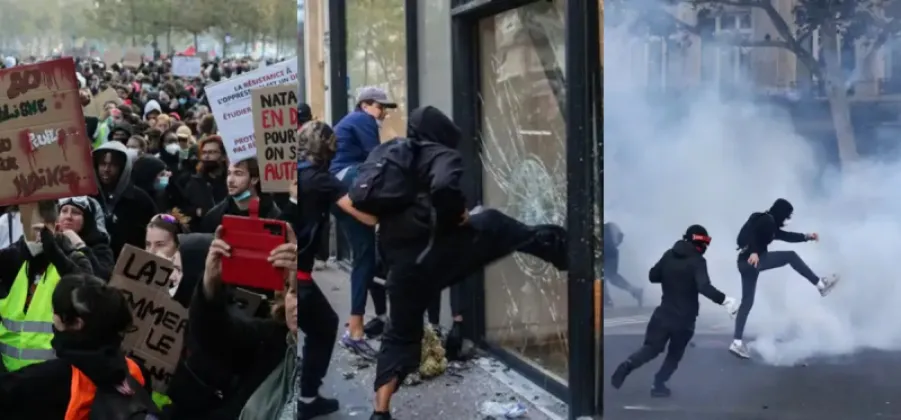
France has launched one of its largest security mobilizations in recent years, deploying around 70,000 security personnel across the country this weekend to head off a fresh wave of unrest as nationwide protests against rising prices are expected to begin today. The extraordinary deployment follows last week's demonstrations, which saw the most severe urban violence the country has experienced in years, and which also affected the school environment and education. According to reports published by Nagarik News and Rato Pati, the operation is designed to control possible protests and prevent a repeat of the clashes that accompanied the previous round of demonstrations.
A Nationwide Security Operation
The scale of the deployment signals how seriously French authorities are treating the threat of renewed violence. Around 70,000 security personnel are being spread across the country, mirroring the nationwide reach of the protest call. The stated aim is preventive: to control possible protests and clashes before they can escalate into the kind of destruction and confrontation that marked last week's events.
The key elements of the security operation are as follows:
- Scale: Around 70,000 security personnel are being deployed across France this weekend.
- Purpose: The operation is intended to control possible protests and prevent clashes between demonstrators and security forces.
- Timing: The deployment comes as fresh nationwide protests against rising prices are expected today.
- Backdrop: It follows last week's demonstrations, which saw the most severe urban violence in years.
Reports in the Nepali press, including Rato Pati's English service, framed the move as an effort to prevent violence rather than merely respond to it, suggesting that authorities hope a highly visible security presence will deter those intent on confrontation. With protests scheduled to continue today, the task facing the security forces will be to allow grievances to be expressed while keeping the situation from sliding back into the disorder of the previous weekend.
Last Week's Violence and Its Toll
Last week's demonstrations are the immediate trigger for this weekend's security buildup. According to the reports, the protests produced the most severe urban violence in years, and it is that level of unrest that authorities are now working to ensure is not repeated. The description points to an intensity of violence that went well beyond ordinary protest activity, and it explains why the government has responded with a deployment of this magnitude.
Crucially, the fallout did not remain confined to the streets. The reports note that last week's unrest also affected the school environment and education, an indication that the disruption reached into institutions and routines far removed from the front lines of the demonstrations. For families, students and teachers, the violence was not something happening only on television screens or in distant city centers; it intruded directly into daily life and learning.
That reality presents the authorities with a double challenge. The protests are driven by genuine economic grievance, yet the violence that has accompanied them has imposed costs on ordinary people, including in the education sector, that extend well beyond the demonstrators themselves. Preventing a repetition of that toll is as much a part of this weekend's operation as protecting property and public order.
Rising Prices at the Heart of the Protest Wave
The grievance fueling the movement is economic. The fresh protests expected today are directed against rising prices, a cost-of-living complaint that resonates across households. When prices climb and the pressure on family budgets intensifies, discontent tends to spill into the streets, and France's current unrest follows that pattern: a broad, nationwide expression of anger built around the everyday squeeze that people say they are feeling.
The protests expected today are nationwide in scope rather than confined to a single city, and it is that character which has shaped the government's response. Security personnel have been deployed across the country in large numbers, in step with the breadth of the protest call.
What to Watch Today
Attention now turns to how today's protests unfold. Fresh nationwide demonstrations against rising prices are expected, and the roughly 70,000 security personnel deployed over the weekend will be tasked with keeping them peaceful. The central question, based on the reporting, is whether the sheer size of the security presence can prevent the clashes that turned last week's demonstrations into the most violent urban unrest France has seen in years.
For the authorities, success would mean protests that express anger over rising prices without a repetition of the urban violence, and without further damage to the school environment and education. For the protesters, the test is whether their message about the cost of living can be heard without being overshadowed by disorder.
With demonstrations continuing today and tens of thousands of security personnel deployed across the country, France faces a decisive moment in managing a wave of unrest born of economic frustration. The coming hours will show whether this weekend's massive deployment has restored calm, or whether the country is in for another round of the violence that has already left deep marks on its cities and its schools.