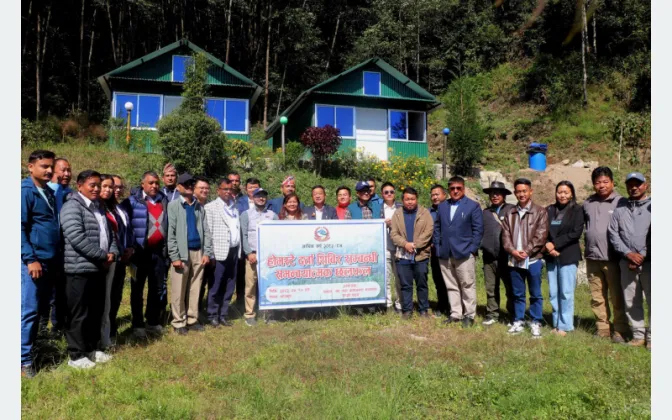
Local elected representatives in Bhojpur have said that forest-related legal provisions are obstructing the construction of homestays and other infrastructure needed for tourist stays along the Mundum Trail, the trekking route winding through the hills of Koshi Province. The concern was raised at an event held on Tuesday in Bhojpur and organised by the Koshi Province Ministry of Tourism, Forest and Environment, where speakers pointed out that most of the trail area falls inside forest land, making it difficult to build the structures required to provide food and lodging to visitors.
Most of the Trail Lies in Forest Land
The problem presented at the event is, at its core, a matter of geography colliding with law. The Mundum Trail passes predominantly through forest, which means nearly every stretch where a guesthouse, dining space or other tourist facility might be built falls under legal provisions that govern forest land.
According to the local representatives, those provisions have become a direct obstacle to construction. Homestays and other infrastructure essential for accommodating tourists are difficult to build on the forest land that dominates the route, leaving the trail short of the basic facilities visitors need to eat and sleep.
That shortage matters for any trekking route. Tourists on multi-day walks need somewhere to stay each night and somewhere to eat, and routes that cannot offer those services struggle to attract or hold visitors. The representatives' argument was that the trail's biggest bottleneck is not demand or interest, but the legal status of the ground it crosses.
Why Homestays Matter on Routes Like Mundum
Homestays have become the backbone of village tourism in Nepal's hills. They allow local families to earn income directly from visitors, spread tourism spending into rural areas, and give trekkers an experience of local life that large lodges cannot match. On shorter and newer trekking routes, homestays and small eateries are usually the first facilities to be developed, because they are modest in scale and can be opened by individual households or small community groups.
On the Mundum Trail, however, the issue raised in Bhojpur is not about converting existing homes into guest rooms. It is about the construction of new structures for tourist food and lodging, much of which would have to take place on land that is legally forest. It is precisely that construction, the representatives said, that the forest-related legal provisions obstruct.
Concerns Raised at a Province-Level Forum
The complaint was aired at a Tuesday event in Bhojpur organised by the Koshi Province Ministry of Tourism, Forest and Environment. The ministry's mandate is notable here: it holds responsibility for both tourism and forest matters within the province, making it the one body where the two sides of the Mundum Trail problem meet.
Local elected representatives used the forum to state plainly that forest-related legal provisions are holding back homestay construction and other infrastructure along the trail. Their remarks frame the route's development as a case where the legal protection of forest land and the push to build a tourist destination are working against each other.
The key points raised at the event:
- Forest coverage: Most of the Mundum Trail area falls inside forest land.
- Legal obstacle: Forest-related legal provisions are obstructing homestay and infrastructure construction, according to local elected representatives.
- Visitor facilities: The restrictions make it difficult to build the structures needed for tourist food and lodging.
- Forum: The issue was raised at a Tuesday event in Bhojpur organised by the Koshi Province Ministry of Tourism, Forest and Environment.
What the Deadlock Means for Tourism
Tourism authorities in Nepal have in recent years looked to develop new trekking routes beyond the country's established hubs, and the involvement of the province's tourism ministry in convening the Bhojpur event signals interest in the Mundum Trail's potential. For routes like this to deliver economic returns, however, they need accommodation. A trail that visitors can only walk through, without places to eat or sleep, offers limited benefit to the villages along it.
The representatives' complaint in Bhojpur suggests that until the legal questions around forest land are resolved, the construction of homestays and supporting infrastructure along the trail will remain stalled.
A Familiar Tension in Nepal's Hills
The situation along the Mundum Trail reflects a broader tension in Nepal between forest conservation and local development. Large parts of the country's mid-hill terrain are classified as forest, and forest-related law tightly restricts building, land conversion and tree cutting within those boundaries. Those rules exist to protect trees, watersheds and biodiversity, but they can put projects ranging from roads to tourist facilities through lengthy and uncertain approval processes.
Balancing the two objectives is not simple. Conservation rules protect environmentally sensitive land, while tourism development is often the main hope for income in hill communities. The Mundum Trail case shows how directly the two can collide: a route promoted for tourism cannot develop the homestays and food facilities it needs because the land it crosses is, in legal terms, forest.
As of the Tuesday event, local elected representatives made clear that the legal provisions remain an obstacle, and that homestay and infrastructure construction along the Mundum Trail is being held back as a result. The discussion was reported by RatoPati and Khabarhub.