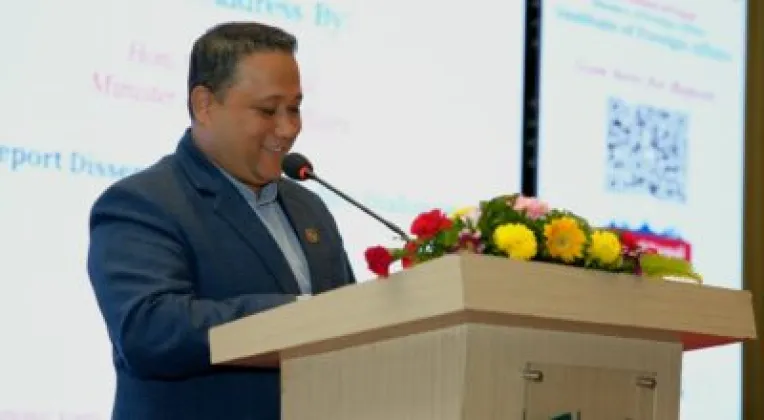
Foreign Minister Shishir Khanal has said the government is committed to further establishing Nepal's distinct national identity, cultural diversity, natural heritage and contemporary achievements before the world, framing the projection of the country's image as an active priority of its diplomacy. Khanal made the remarks as chief guest at a programme held in Kathmandu on 19 Kartik, organised by the Institute of Foreign Affairs (IFA). The gathering also marked the release of a project report titled 'Brand Nepal: National Asset, Global Narratives and Strategic Opportunities' and featured a policy dialogue on how Nepal can tell its own story more effectively on the global stage, as reported by Khabarhub.
Government Pledges to Take Nepal's Story to the World
Speaking at the Kathmandu event, Khanal placed the government squarely behind the effort to present Nepal to international audiences in its full breadth. His statement identified four strands that the government intends to carry forward together as it seeks to raise the country's profile abroad:
- Distinct national identity - a conscious effort to define and communicate what makes Nepal recognisably its own, rather than allowing outside perceptions to set the terms.
- Cultural diversity - the wide range of communities, traditions and living heritage that together form the social fabric the government says deserves a place in how the country is presented internationally.
- Natural heritage - the landscapes and natural endowments for which Nepal is known worldwide, which the minister grouped alongside culture as a core national asset.
- Contemporary achievements - progress and accomplishments of the present day, which the government wants to bring into the picture alongside the country's celebrated heritage.
The phrasing of the foreign minister's commitment, with its emphasis on presenting these qualities "before the world," pointed to an outward-facing exercise in communication as much as an inward one of self-definition. By placing the remarks at a foreign affairs platform, Khanal signalled that the government views the country's image as a matter that belongs within the domain of diplomacy, not merely of domestic celebration.
'Brand Nepal' Report Unveiled at IFA Programme
The formal centrepiece of the programme was the release of the project report 'Brand Nepal: National Asset, Global Narratives and Strategic Opportunities', prepared under the aegis of the Institute of Foreign Affairs. The title itself outlines a three-part logic that frames the discussion around nation branding. It begins with national assets, the raw material of what Nepal possesses and can draw upon. It then turns to global narratives, the stories told about the country and how they circulate internationally. Finally, it points to strategic opportunities, the diplomatic, economic and cultural returns that a deliberate branding effort can generate.
That sequencing matters. It suggests the report approaches Nepal's image not as a slogan to be coined but as a structured exercise: take stock of what the country has, understand how it is currently narrated abroad, and identify where a sharper strategy can make a difference. The choice of the Institute of Foreign Affairs as the venue for the release reinforced this framing, indicating that nation branding is being treated as an instrument of foreign policy rather than as tourism promotion alone.
Policy Dialogue Weighs Nepal's Place in the World
Alongside the report launch, the programme featured a policy dialogue, giving participants a platform to discuss the ideas set out in the document and the broader question of Nepal's global image. Such dialogues serve as a bridge between research and practice, allowing the findings of a project report to be tested against the perspectives of those engaged in policy and public life.
The discussion took place against a backdrop in which nation branding has become an established concern for states of every size. Countries increasingly invest in shaping how they are perceived, recognising that reputation influences tourism, trade, investment and diplomatic standing. For Nepal, global recognition has long rested on a handful of powerful images: the Himalayas crowned by Mount Everest, Lumbini as the birthplace of Lord Buddha, and a living culture of festivals, crafts and traditions. What a branding initiative of the kind unveiled at the IFA programme points toward is a deliberate attempt to broaden that picture, bringing contemporary achievements into the frame alongside the heritage the country is already famous for.
Khanal's remarks at the event aligned squarely with that ambition. By naming identity, culture, nature and present-day accomplishments together, the foreign minister sketched the range of material a national brand would have to draw upon.
With the report now released and the government's commitment voiced from the podium, attention will naturally turn to how the ideas move from paper to practice. For now, the Kathmandu programme has made clear the direction the government wishes the conversation to take: toward a Nepal that narrates itself confidently, in its own words, before the world.