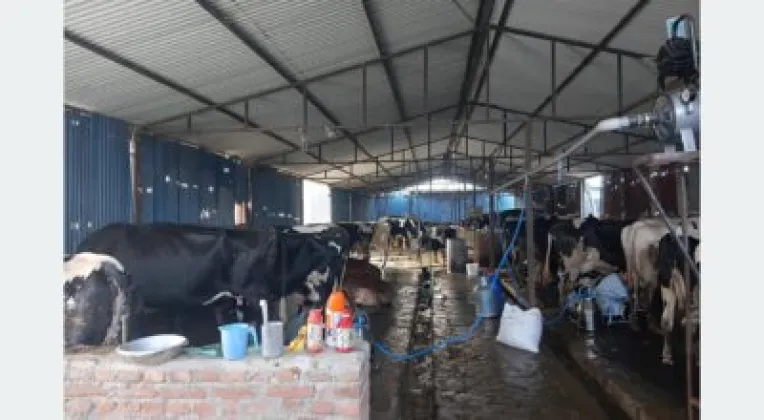
Kumar Lamichhane, a civil engineer from Gorkha, has turned cattle farming into a remarkably profitable side business, earning a monthly profit of Rs 1.5 million from a venture he manages alongside his engineering career. His farm, Kshitij Integrated Agriculture Farm Pvt. Ltd., operates at Ramkot, Dandapauwa, in Nagarjun municipality on the western edge of the Kathmandu valley. According to a report by Khabarhub, Lamichhane's success has made him a role model for entrepreneurial farming in his community, offering a rare example of a trained professional building a thriving agribusiness on the outskirts of the capital.
An Engineer's Leap into Commercial Farming
Lamichhane hails from Gorkha, a hill district in Gandaki Province where, as across much of rural Nepal, many working-age people have long looked to the cities, to service professions and to foreign employment for their livelihoods. Rather than following that path alone, he chose to keep a foot in two worlds: practising as a civil engineer while building a cattle enterprise that now delivers returns few salaried jobs in the country can match.
The venture is formally registered as Kshitij Integrated Agriculture Farm Pvt. Ltd., a private limited company, a structure that signals the operation is run as a business rather than a casual household activity. The word "integrated" in the farm's name reflects an approach in which different agricultural activities are combined under a single operation, a model increasingly favoured by commercial farmers seeking to make the most of land, labour and livestock.
Siting the farm at Ramkot, Dandapauwa places it within Nagarjun municipality, an area that has grown quickly in recent years as the Kathmandu valley expands westward. That location keeps the farm close to one of the country's largest urban markets while retaining the space and environment that cattle raising requires.
Key Facts at a Glance
- Promoter: Kumar Lamichhane, civil engineer from Gorkha
- Enterprise: Kshitij Integrated Agriculture Farm Pvt. Ltd.
- Location: Ramkot, Dandapauwa, Nagarjun municipality
- Sector: Cattle farming, run as a side business
- Monthly profit: Rs 1.5 million
Strong Returns from a Side Venture
The headline figure of Rs 1.5 million in profit every month sets the farm apart from the subsistence and smallholder farming that dominates much of the Nepali countryside. Sustained across a year, that level of profit amounts to roughly Rs 18 million. That the farm delivers these returns while remaining a side business for Lamichhane makes the numbers all the more striking, and it illustrates the logic of income diversification: an engineering career provides professional stability, while the farm adds a substantial and growing stream of profit.
The result also challenges a long-standing perception that agriculture in Nepal is a low-return occupation. Lamichhane's experience suggests that when farming is planned, financed and managed like any other enterprise, with a registered company, a considered location and a professional outlook, it can compete with, and in some cases outperform, the earnings of urban white-collar work.
A Role Model in His Community
Perhaps the most significant impact of the farm so far lies in how it has changed the way people around Lamichhane view agriculture. According to the Khabarhub report, his success has made him a role model for entrepreneurial farming in his community. In a country where young people frequently look to the Gulf, Malaysia, Korea and Europe for work, or to the service sector for salaried positions, the sight of a local engineer earning a seven-figure monthly profit from cattle carries considerable persuasive power.
Role models matter in farming because agricultural decisions are so often copied from neighbours rather than learned from textbooks. When a respected professional demonstrates that livestock can be a serious business, it becomes easier for other educated, investment-ready Nepalis to consider the sector, whether in dairy, poultry, vegetable production or allied trades. Lamichhane's farm offers a visible template: choose a viable location, register the enterprise properly, manage animals and accounts with equal seriousness, and let the results speak for themselves.
What His Success Signals for Nepali Agriculture
The story lands at a time when Nepal's agriculture sector is under pressure to modernise. Farming remains the backbone of the national economy, employing a large share of the population, yet the country continues to rely on imported food and livestock products that could be produced at home. Commercial ventures such as Kshitij Integrated Agriculture Farm speak directly to that gap, showing how private initiative and professional management can raise output in areas where demand is strong and dependable.
Nagarjun's position on the valley's western fringe illustrates the wider opportunity. As the capital's population grows, so does its appetite for fresh milk and other livestock products, and farms within reach of that market enjoy transport and freshness advantages that more distant producers cannot easily match. Entrepreneurs who pair that proximity with disciplined farm management are well placed to capture a growing share of urban demand.
For Lamichhane personally, the farm offers a second kind of reward alongside its profits: proof that the skills of an engineer, applied to one of the oldest of professions, can build something both commercially successful and locally admired. From Gorkha to Ramkot, his journey is a reminder that Nepali farmland, worked with discipline and ambition, can still be the ground on which a prosperous future is built.