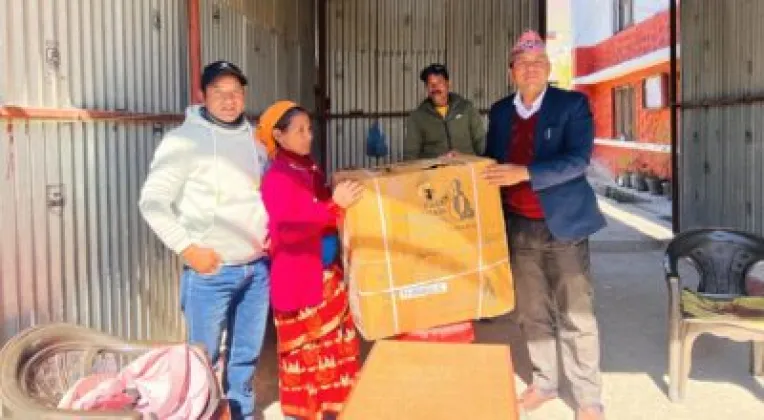
Eight-year-old Prakash Rawat, a boy living with a complete physical disability in Rara village of Tila Rural Municipality-1 in Jumla district, has received a wheelchair from the Social Development Office, Jumla, bringing long-awaited relief to a family that had been caring for him without any form of mobility support. Office chief Top Bahadur Budha formally handed over the wheelchair, valued at Rs 50,000, to Rawat's mother, Jyoti Rawat. The handover was reported by Khabarhub and Gorkhapatra Online.
A Daily Struggle Without Mobility Support
For Rawat, the absence of a wheelchair had turned the most ordinary routines of childhood into serious obstacles. Described in the reports as a fully physically disabled child, he could not walk or move independently, and his family had to lift and carry him for even the smallest movements around the home. As Khabarhub notes, Rawat had been facing severe difficulties in his daily life precisely because he had no wheelchair to rely on.
In mountain villages such as Rara, where homes are scattered across steep terrain and basic services can be far from the doorstep, a disability of this nature affects nearly every hour of a child's day. Moving from one room to another, stepping into the courtyard, or travelling to a health facility all require another person's physical strength. That responsibility falls squarely on the family, and in Rawat's case much of it has rested on his mother, Jyoti Rawat.
The hardship is not only physical. For caregivers in remote settlements, the constant demands of carrying a growing child limit the time and energy left for household work, farming and other livelihood activities. The provision of even a single assistive device can therefore ease pressure on an entire household, not just on the child who receives it.
The Handover and the Office Behind It
The wheelchair was handed over by Top Bahadur Budha in his capacity as chief of the Social Development Office, Jumla. Valued at Rs 50,000, the device was received by Jyoti Rawat on behalf of her son. According to Gorkhapatra Online, the Social Development Office provided the wheelchair to the eight-year-old boy from Tila Rural Municipality-1.
For a family in a remote village, the market value of such a device represents a cost that would be difficult to bear alone, which is what makes direct government provision of assistive equipment so significant. Social Development Offices function as district-level bodies for provincial social welfare programmes, working on issues concerning persons with disabilities, children, women and senior citizens. In districts like Jumla, such offices are often the first point of government contact for families seeking identification or assistance for members with disabilities, and the provision of a wheelchair to Rawat reflects that mandate in practice.
Why This Matters in Remote Karnali
Jumla, in Karnali Province, is among Nepal's more remote and geographically demanding districts. Settlements are spread across high hills, transport and services remain limited, and families of children with disabilities often face long journeys to reach even basic health or rehabilitation support. In such conditions, assistive devices are not mere conveniences; they can determine whether a child remains confined indoors or is able to move, interact and take part in family and community life.
Wheelchairs and similar devices are widely recognised as doing far more than restoring movement. Their practical benefits include:
- Independent or assisted movement around the home and village
- Reduced physical strain on parents and caregivers
- Easier access to health posts, schools and community spaces
- Greater dignity, confidence and social participation for the user
For an eight-year-old like Rawat, whose school-age years are passing quickly, timely support of this kind carries particular weight, as early access to mobility can shape a child's development and inclusion for years ahead.
Relief and New Possibilities for the Rawat Family
For Jyoti Rawat and her son, the wheelchair is expected to bring immediate and practical change. Everyday care becomes easier, and Rawat can now be moved around the home and village with far less strain on his mother and other family members. The device also opens possibilities that were previously out of reach, including simpler travel to health facilities and, in time, the chance to attend school or join community activities.
The handover also carries a wider significance. It underlines both the scale of unmet need among persons with disabilities in remote districts and the difference that targeted government support can make when it reaches the right family at the right time. For now, the most important outcome is a simple one: a young boy in Rara village no longer has to face each day without the wheelchair he needed.