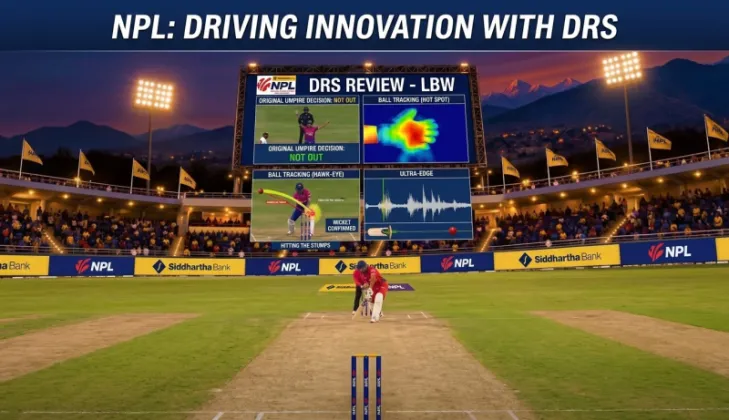
The Nepal Premier League will use the Decision Review System for the first time, marking a significant technological milestone for Nepal's flagship franchise T20 competition. Reports published on October 20, 2026, and carried by Nepal Lead, Thaha Khabar and Nepal Views, confirmed that the review system, under which umpires' on-field decisions can be challenged, will feature in the league. The reports, however, stopped short of specifying which matches or venues would be covered by the technology or how extensively it would be deployed, leaving several operational details to be clarified as the tournament approaches.
A First for Nepal's T20 League
Until now, the NPL has not had a formal mechanism for challenging umpiring decisions, meaning rulings made on the field stood regardless of whether replays suggested otherwise. The adoption of the Decision Review System changes that, creating a structured process through which disputed calls can be examined by the third umpire before a final verdict is reached.
The move aligns the league with standard practice in modern cricket, where technology-assisted officiating has become the norm rather than the exception. In a short format such as T20, where matches can be decided by fine margins, a single marginal call, whether a caught-behind appeal or a run-out at the striker's end, can swing the result. A review mechanism reduces the risk of a game turning on a human error that technology could have corrected.
The reports did not quote league officials, name a technology provider or indicate when the system would first come into use. Nor did they clarify whether the Decision Review System will apply across all fixtures or be limited to particular matches or venues, details that teams and fans will be watching for.
How the Decision Review System Works
Under the Decision Review System, a batting or fielding side that is dissatisfied with an on-field umpire's decision can request a review. The on-field call is then examined by the third umpire using available technological aids, who either upholds or overturns the original decision. Teams are normally allowed only a limited number of unsuccessful reviews per innings, a rule designed to discourage frivolous challenges.
First introduced in international cricket in 2008, the system has since become a fixture of ICC events and of the major franchise T20 leagues that dominate the global calendar. Its arrival in the NPL brings Nepali domestic cricket into line with that wider landscape and with the standards that players and viewers have grown accustomed to in international matches.
The Tools Typically Involved
While the reports on the NPL did not specify the exact technological package to be used, DRS implementations elsewhere in cricket typically combine several aids:
- Ball-tracking technology, which projects the predicted path of the ball and is central to deciding lbw appeals
- Edge-detection audio systems, which capture the faintest sounds as the ball passes the bat or pad
- High-speed replays from multiple camera angles, used to assess catches, run-outs and stumpings
The scope of the NPL's setup, including which of these tools will be available and at which grounds, has not yet been made public.
Why the Move Matters
The practical significance of the change is straightforward: it offers teams a safeguard against decisions that could otherwise prove decisive. For batters, a review can overturn an incorrect dismissal; for bowlers and fielding sides, it can convert a missed edge into a wicket. In either direction, the side that benefits is the one that has played the better cricket rather than the one favoured by an officiating error.
The move also carries weight for the league's credibility. The NPL has grown into the most prominent platform for Nepali cricketers, drawing strong crowds and viewership. As the league's profile has risen, so has attention on its officiating, and the availability of reviews addresses one of the most visible gaps between the NPL and the international game.
For viewers as well, the system changes the experience of watching. Broadcast replays frequently reveal that an on-field call was marginal or mistaken, and without a review process the discrepancy between what audiences see on screen and what stands on the field has been an occasional source of frustration. The Decision Review System formalizes that process and gives teams a legitimate channel to act on it.
What Remains Unclear
Several practical questions remain open, since the reports published on October 20 did not address the operational side of the rollout. Among the details still awaited are:
- Which matches and venues will be equipped with the review technology
- Whether the NPL version will include full ball-tracking and edge-detection systems or rely on a narrower set of tools
- How many reviews each team will receive per innings
- When the league's organizers will issue a formal announcement with the full technical and procedural framework
Until those specifics are confirmed, the reports stand as confirmation of intent rather than a complete blueprint. Even so, the direction is clear: the Nepal Premier League is preparing to give its umpires technological support and its teams the right to be heard, a step that brings the domestic game closer to the standards of the sport's top tier.