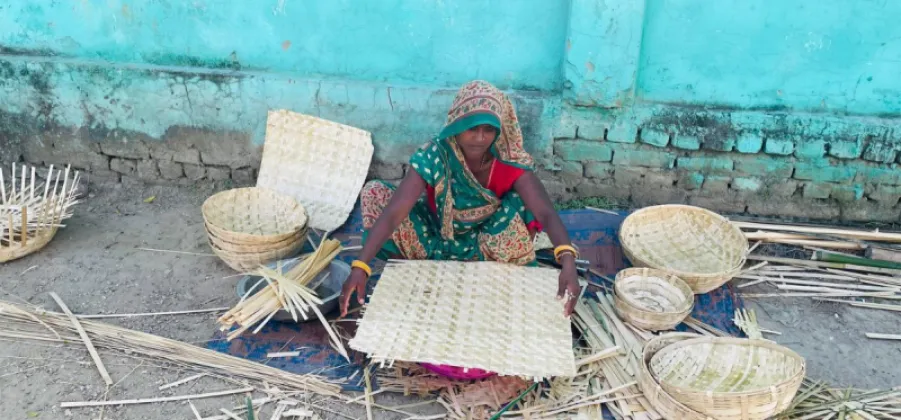
The ancestral bamboo craft that has sustained the Marik (Dom) community in Nepal's Terai-Madhesh region for generations is under serious threat, according to reports from Saptari district. Families who have long earned their living by weaving bamboo into traditional items such as koniya, nanglo, dhakki and changeri, wares that remain essential during weddings and festivals, are finding that the trade barely pays. Despite the hard labour involved, incomes remain low, and the community's age-old profession is now at risk of slipping away, as reported by Nagarik News and Ratopati.
Bamboo Wares Woven into Celebration
In Saptari, in the southern plains of Madhesh Province, the Marik community, also known as the Dom community, has long been identified with one of the Terai's most familiar crafts: turning raw bamboo into finished, functional wares by hand. The items the community produces are part of the everyday and ceremonial vocabulary of the region, and include:
- Koniya
- Nanglo
- Dhakki
- Changeri
These are not decorative keepsakes. They are practical bamboo pieces used during weddings and festivals, which ties the craft directly to the social and cultural life of the Terai. As long as families continue to celebrate marriages and observe festivals in the traditional way, the demand for such items endures, and it is this demand that has anchored the Dom community's livelihood for generations.
Because the occupation is ancestral, the craft has been carried from parents to children across generations. That makes it more than a source of income: it is a marker of identity and a body of knowledge that belongs to the community. The reports describe a profession that has survived on this inheritance, with families continuing to practise the trade that defined their forebears.
Hard Labour, Thin Returns
The central problem, as documented in Saptari, is the gulf between the effort the work demands and the money it brings in. Bamboo craft is punishing manual work: the artisan must handle raw bamboo, split it and weave it into shape, a process that consumes long hours and takes a persistent toll on the body. Yet, as the reports make clear, despite this hard labour the income remains low.
That imbalance strikes at the foundation of any livelihood. When the rewards from a full stretch of labour are not enough to sustain a household, the occupation becomes progressively harder to justify. For the Marik (Dom) community, the consequence is direct: the trade that fed generations is no longer generating the returns needed to keep families committed to it, and the ancestral profession has been pushed into crisis.
The coverage frames the situation as more than a passing hardship. The language used in the reports themselves, describing the community's "professions in crisis", signals a livelihood under sustained pressure rather than a temporary difficulty. Low earnings, combined with the physically demanding nature of the work, have placed the traditional occupation at genuine risk.
An Ancestral Profession at the Crossroads
What is at stake in Saptari is twofold. On one side is a livelihood: the income of families who continue to depend on bamboo craft despite its poor returns. On the other is a cultural inheritance: a craft tradition woven into the weddings and festivals of the Terai, produced by a community whose name has become inseparable from the work.
The reports suggest that if the profession continues to yield so little, its survival as an inherited occupation is in doubt. A craft passed down through generations endures only when the next generation has both the skills and the incentive to carry it forward. When the incentive erodes, as it has when income stays low despite hard labour, the chain of transmission weakens, and with it the future of the tradition itself.
Key Facts at a Glance
- Community: the Marik, also known as the Dom community
- Location: Saptari district, Terai-Madhesh region of southern Nepal
- Craft: handmade bamboo items, including koniya, nanglo, dhakki and changeri
- Use: the wares are used during weddings and festivals
- Challenge: hard labour paired with low income has pushed the ancestral profession into crisis
The question the reports from Nagarik News and Ratopati leave open is how a craft that remains culturally indispensable can be made to provide a dignified living. Until that gap between effort and earnings is closed, the koniya, nanglo, dhakki and changeri that accompany the Terai's weddings and festivals will continue to be made by artisans whose own future in the trade grows more uncertain by the season.