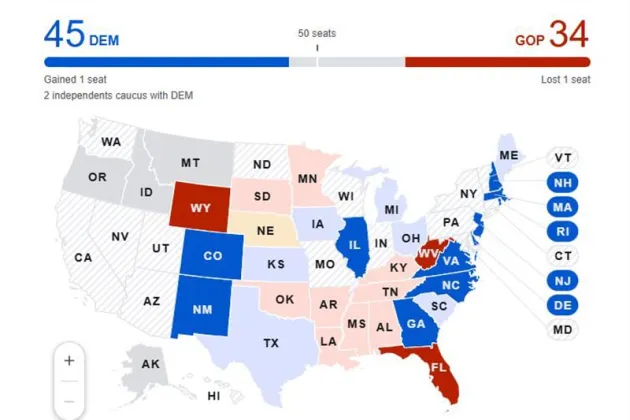
Early results from the United States midterm elections show the Democratic Party leading in both chambers of Congress, dealing a setback to President Donald Trump and his Republican Party, according to preliminary vote counts reported by Nepali media outlets on Wednesday. The trend, if it holds as the counting progresses, would mark a significant shift in the US legislature and change the balance of power in Washington for the remainder of Trump's term in the White House.
The reports, carried by major Nepali news portals, described the numbers as early and preliminary, with vote counting still under way after polling concluded in the United States. Even at this stage, a Democratic lead in both the House of Representatives and the Senate would represent a notable outcome, given that the president's party traditionally enters midterm votes on the defensive.
Democratic Advantage Emerges in Early Counts
Nepali outlets carried the trend throughout the day on Wednesday, citing preliminary tallies that began coming in after polls closed across the United States. According to the reports, Democrats were ahead in both chambers of Congress, the House of Representatives and the Senate, which together make up the federal legislature.
The reporting emphasized that the figures reflected early counts rather than final results. In US elections, counting frequently extends beyond election night as election officials process remaining ballots, and narrow margins can shift as more votes are tabulated. The outlets therefore presented the trend as an early lead for the Democrats and a setback for Trump's Republicans, not a final verdict.
The coverage was published by the following outlets:
All three reports attributed the trend to preliminary vote counts and framed the results as an early, not conclusive, picture of the election outcome.
A Midterm Test for the President's Party
Midterm elections are held at the halfway point of a US president's four-year term, and they place the composition of Congress before the voters. In these elections, all seats in the House of Representatives are contested along with a portion of the Senate, meaning the results determine which party controls the legislature for the second half of the presidential term.
Midterms are widely regarded as a referendum on the sitting president. Historically, the party that occupies the White House has often struggled to hold its ground in these contests, as voters use the opportunity to register their judgment on the administration's performance. The early trend reported on Wednesday, with Democrats leading and Republicans suffering a setback, fits within that familiar pattern of a president's party facing pressure at the two-year mark.
The stakes are considerable because Congress holds substantial power over a president's ability to govern. The legislature writes federal law, approves the budget and conducts oversight of the executive branch. A chamber controlled by the opposition can block legislative proposals, shape spending priorities and scrutinize administration decisions through its committee work. For that reason, shifts in congressional control are treated in the United States as consequential political events with implications well beyond a single election night.
What a Democratic Lead Would Mean for Trump
If the early lead reported on Wednesday is sustained, President Trump would face a Congress in which both chambers were under Democratic control. Control of the House determines which party sets the legislative agenda in that chamber, while control of the Senate carries additional weight because the Senate holds a central role in confirming presidential appointments. A legislature led by the opposition would therefore complicate the administration's efforts to advance its agenda and subject it to heightened congressional scrutiny.
For Trump's Republican Party, the early results amount to a setback after a campaign in which the party, holding the presidency, sought to defend its position in Congress. A loss of ground in both chambers would hand the initiative to the Democrats, who would gain both a platform to challenge the administration and greater influence over what legislation reaches the president's desk.
For the Democratic Party, leading in both houses would mark a significant political achievement in an election cycle that was closely watched as a measure of the country's mood halfway through Trump's term. The reported trend suggests voters were inclined to hand at least part of the federal legislature to the opposition.
Counting Continues, Final Picture Awaited
Attention now turns to whether the early trend holds. The results reported by Nepali media on Wednesday were based on preliminary counts, and the final outcome depends on the completion of tallying in individual races across the country. Until the counting concludes and results are finalized, the Democratic lead in both chambers remains a projected picture rather than a certified result.
For now, the message from the early numbers is clear: the opposition Democrats were ahead in both houses of Congress, and President Trump's Republican Party was facing a setback in the US midterm elections. Observers in the United States and abroad will be watching closely as the final counts determine whether that early shift in the legislature is confirmed.