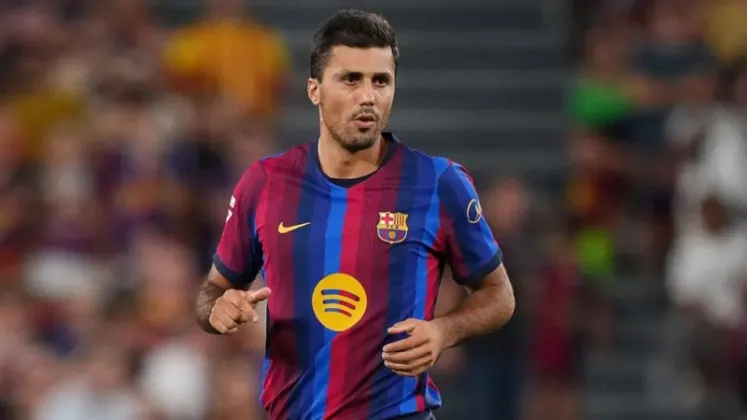
Barcelona have been dealt a significant setback, with the club officially confirming that their main midfielder Rodri Hernandez will be out of action for approximately a month due to injury. The announcement removes any doubt about the seriousness of the situation and immediately raises pressing questions about how the Spanish side will organise its midfield in the weeks ahead. As the team's principal holding midfielder, Rodri has been central to Barcelona's strategic plans, and his absence will force the coaching staff to reshape the side's structure while one of its most influential players works his way back to full fitness. The news, described as a major blow, was reported by Ratopati's English service and its Nepali edition.
A Confirmed Setback for the Catalans
The club has officially confirmed the injury, meaning speculation has given way to a concrete timeline. According to the reports, Rodri will be sidelined for about a month, a period that will keep him out of training with the squad and out of contention for selection during that stretch.
The framing of the story as a "major blow" reflects the midfielder's standing within the squad. Rodri is not a rotation option but the team's main midfielder, the player around whom the rest of the engine room is built. When a club loses that calibre of player, the impact is felt well beyond the individual fixtures he misses; it reshapes training routines, tactical drills and the overall balance of the side.
Why the Timeline Matters
A month on the sidelines typically spans a meaningful portion of a football calendar. Depending on fixture congestion, it can cover several matches along with the training sessions in between, and for a team that has structured its game around a specific midfield anchor, that is long enough to demand genuine solutions rather than short-term patchwork.
The word "about" in the estimate is also significant. Injury timelines are educated projections based on the nature of the problem and how a player responds to treatment. Some athletes return at the early end of such a window, while others need additional time. What is certain, based on the club's confirmation, is that Barcelona must plan for an extended period without their midfield linchpin.
Why the Holding Midfielder Role Is So Hard to Fill
The holding midfielder is often described as the metronome of a team, and Rodri fills that role at the heart of Barcelona's setup. The position demands a rare combination of skills that few players possess:
- Shielding the defence - screening passing lanes, breaking up opposition moves and providing cover when teammates push forward.
- Dictating the tempo - deciding when the game speeds up and when it slows down, often with the first pass out of defence.
- Positional discipline - holding the shape of the team so that more attacking players can take risks elsewhere on the pitch.
- Linking play - serving as the bridge between defence and attack, receiving the ball under pressure and moving it into dangerous areas.
When that player is unavailable, the effects ripple through the entire team. Defenders lose the protection in front of them, attackers may receive poorer service, and the side as a whole can look less controlled both with and without the ball. This is why the reports on Barcelona's situation point to a genuine impact on the club's strategic plans, not merely a change of names on the teamsheet.
A Tactical Puzzle for the Coaching Staff
Replacing a holding midfielder like for like is rarely straightforward, because a squad may simply not contain another specialist in that mould. The usual responses include reshuffling the midfield, asking a more attack-minded player to drop deeper, or adjusting the overall system so that less responsibility falls on a single pivot. Each option carries trade-offs: greater defensive cover can mean less creativity, while a bolder setup can leave the back line more exposed.
There is also a psychological dimension to the loss. Teams grow accustomed to a reference point in midfield, a player who demands the ball when the game turns chaotic and restores order. Rebuilding that sense of control, even with capable deputies, tends to take matches rather than minutes, and opponents are likely to test the area of the pitch that Rodri would normally occupy.
The Road Back
Recovery from an injury of this kind follows a familiar path: initial medical assessment and treatment, rehabilitation to restore strength and mobility, and then a staged return to training before match action resumes. The month-long estimate gives Barcelona's medical staff a framework for that process, but the priority will be a complete recovery rather than a rushed return, since bringing a player back too early increases the risk of complications.
For the player, the coming weeks will be about disciplined rehabilitation. For the club, they will be a test of squad depth and adaptability. Rodri's importance to the team's structure means Barcelona will want him back only when he is fully ready, and the confirmed timeline reflects that cautious, structured approach.
For now, the essentials are clear: Barcelona's main midfielder is out for about a month, the club has officially confirmed it, and the team's strategic plans must be adjusted accordingly. His progress will be closely followed by supporters, with his return to action expected once the recovery window runs its course.