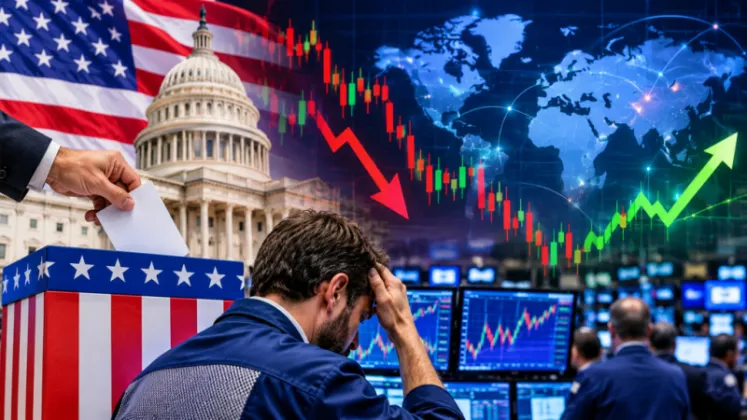
Global technology stocks tumbled this week after the Democratic Party's unexpected success in the United States midterm elections sparked investor fears of tighter regulation of the technology and artificial intelligence industries. US tech shares fell sharply on Thursday, dragging the tech-focused Nasdaq index down by more than 5.5 percent, and markets around the world recorded heavy declines of their own. The shock wave swept through Asian trading floors as well, where Japan's Nikkei 225 and South Korea's Kospi sank by as much as 6 percent in early Wednesday trading before clawing back a portion of their losses, according to reports from Nepal Press and Ratopati.
A Selloff That Crossed Borders
The epicenter of the decline was the United States, where technology shares fell sharply on Thursday. The Nasdaq, the index most closely identified with the technology sector, dropped by more than 5.5 percent, a steep fall for an index of its size and one that translated into substantial losses in market value across the technology industry. Because the Nasdaq is dominated by major technology companies, it is widely treated as a barometer of investor sentiment toward the sector, and its sharp drop signaled a rapid deterioration in confidence among the investors who back America's tech and AI firms.
The decline was not confined to American shores. Global markets also saw heavy declines as traders in other regions absorbed the implications of the election result. In Asia, where trading begins hours before Wall Street opens, the reaction was immediate. Japan's Nikkei 225 and South Korea's Kospi each fell by as much as 6 percent in early trading on Wednesday before recovering somewhat as the session progressed. The initial plunge, followed by a partial rebound, captured the mood of a market grappling with an unexpected political outcome and struggling to price its consequences in real time.
Why the Democratic Victory Spooked AI Investors
At the heart of the selloff lies a straightforward concern: regulation. The Democratic Party's performance in the midterm elections exceeded expectations, and that success has changed how investors calculate the political risk facing technology and artificial intelligence companies. As Ratopati reported, investors in AI and technology firms grew fearful that the new political balance in Washington could bring tighter regulation of their industry.
Such fears carry particular weight in this corner of the market. Companies in the technology and AI fields are often valued on the promise of rapid growth, aggressive product development and the expansive deployment of new tools. Tighter regulatory oversight could complicate that model, potentially raising compliance costs, slowing the rollout of new products and constraining the pace of expansion on which the sector's valuations rest. The mere prospect of a more assertive regulatory environment proved enough to trigger a wave of selling, as investors moved to reduce their exposure to the companies they believe are most vulnerable to a policy shift.
The breadth of the reaction also reflected how deeply technology and AI companies figure in global equity portfolios. When concerns concentrate on that sector, the effects rarely stay contained within it. They pull down technology-heavy benchmarks such as the Nasdaq and drag allied markets across the globe into the red, as the sharp falls in Tokyo and Seoul demonstrated.
Investors Await Clarity on What Comes Next
With the initial shock absorbed, attention has turned to what the election outcome will actually mean for the technology and artificial intelligence industries. That assessment is still in its early stages. Investors are now weighing how the Democrats' strengthened position could shape the regulatory landscape in the United States, and how any resulting policies might affect the growth prospects, cost structures and competitive standing of tech and AI companies.
The partial recovery in Asian markets after Wednesday's early plunge suggested that some investors were willing to buy back into beaten-down shares once the first wave of selling had passed, a sign that the market's judgment on the long-term impact of the election is far from settled. Swings of this kind typically reflect a market searching for a new equilibrium, with prices moving as traders update their assumptions in response to each new piece of information.
For now, the prevailing posture among investors is caution. Until the direction of US technology and AI policy becomes clearer, the sectors that have anchored investor enthusiasm remain exposed to further swings in sentiment. Market participants around the world are expected to watch developments in Washington closely in the days ahead, as the consequences of the Democratic Party's midterm success continue to work their way through the global financial system.