In Kathmandu, the traditional swing known as the ping has returned to the heart of conversation as Nepal marks Dashain, the great festival of Nepalis, with fresh reports indicating that the cherished custom of swinging during the festival is gradually fading. The belief attached to the tradition holds that every reveller should leave the ground at least once during the festival, an idea that has long given the ping a special place in the way the season is celebrated. As this year's festivities are observed and photographed in the capital, cultural commentary is once again turning to what the swing means and why its slow disappearance is being noted.
A Cherished Custom of the Great Festival
Swinging on the traditional ping is among the most cherished customs of Dashain. The practice carries with it a widely held belief that a person must leave the ground at least once during the festival, and it is this belief that has lifted the swing beyond simple recreation and into the realm of observance. In the reports emerging from Kathmandu this Dashain, the ping appears in two lights at once: as a living custom that continues to define the festival, and as a tradition under visible strain.
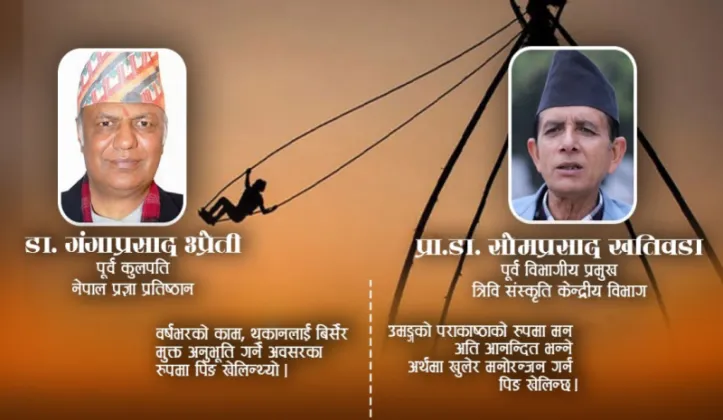
The season's coverage has come through two distinct lenses. Gorkhapatra Online has published an explainer on ping culture, drawing on the views of a former official of the Nepal Academy, while RatoPati has released a photo feature documenting Dashain celebrations. Taken together, the two reports present a festival in which the swing remains a defining image, even as the habit of swinging itself is described as gradually fading.
The Belief That One Must Leave the Ground
At the heart of the ping tradition lies a simple but striking idea: during Dashain, one must leave the ground at least once. The reports frame this belief as central to the custom's endurance, tying the physical act of swinging to the spirit of the festival itself. To take to the ping is, in this understanding, to participate fully in the season.
The reports published this Dashain can be summarised in three points:
- Swinging on the traditional ping is a cherished custom of Dashain, the great festival of Nepalis.
- The belief attached to the tradition holds that a person must leave the ground at least once during the festival.
- Reports from Kathmandu indicate that the tradition is gradually fading.
A Symbol of Joy and Enthusiasm
The explainer published by Gorkhapatra Online cites a former official of the Nepal Academy, who describes ping culture as a symbol of joy and enthusiasm. In this reading, the swing is more than a simple pastime: it embodies the exuberance with which the festival is meant to be celebrated, and it gives physical expression to the festive mood that gathers across the country during Dashain.
The former official's assessment places the ping within the wider cultural fabric of the festival. As the explainer presents it, ping culture belongs to the set of practices that give Dashain its distinctive character, and the description of the swing as a symbol of joy and enthusiasm helps explain why the custom has been so cherished, and why its reported decline in the capital is being remarked upon.
A Tradition Slowly Losing Ground in Kathmandu
Against this cultural backdrop, the reports from Kathmandu carry a clear note of change: the tradition of swinging during Dashain is gradually fading. The observation comes from coverage filed in the capital, where the festival is being celebrated and photographed this season, and where the swing's place in the festivities is being examined alongside the celebrations themselves.
The phrasing of the reports matters. They do not describe the ping as a custom that has vanished; they describe it as gradually fading, a trend rather than an ending. The belief that one must leave the ground at least once during Dashain continues to be articulated, and the ping continues to be treated in cultural commentary as a symbol of joy and enthusiasm. What the Kathmandu reports record is the distance between that enduring ideal and the practice as it stands today, a gap that the coverage presents as a gradual, ongoing shift rather than a sudden disappearance.
Celebrations Captured on Camera
Alongside the written explainer, RatoPati has published a photo feature on Dashain celebrations, documenting the festivities as they are being observed in the capital. The gallery offers a visual record of the festival at a moment when one of its older customs is reported to be fading, adding a documentary layer to the conversation around the ping and the traditions that accompany it.
For readers following the festival through these reports, the combination of photography and cultural explanation captures Dashain as it stands: a great national festival still rich with celebration, and still carried by customs whose meanings are being spelled out even as their practice thins in the capital.
Dashain remains the great festival of Nepalis, and the ping remains one of its most recognisable customs. The belief that one must leave the ground at least once during the festival gives the swing a significance that reaches beyond play, while the explainer's description of ping culture as a symbol of joy and enthusiasm underlines its cultural weight. The reports from Kathmandu, noting that the tradition is gradually fading, capture a festival in transition: the ping endures as a cherished emblem of Dashain, even as the practice of swinging, by the accounts filed from the capital, is on the decline.