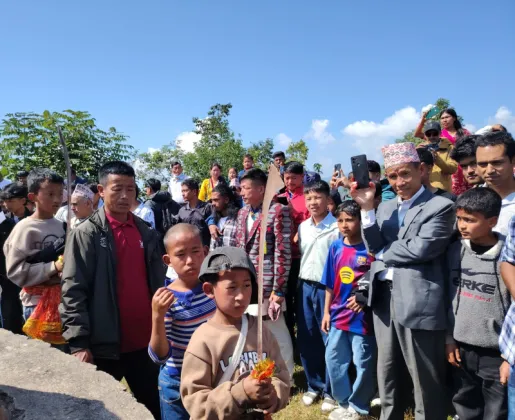
As the Dashain festival reached Navami, its ninth day, families across Limbuwan in eastern Nepal carried out a tradition handed down through generations: bringing out the nishan, ritual standards bearing old weapons, worshipping them ritually and, in some places, dancing with them until the maulo, the sacred thread of Dashain, is cut. The custom, documented in Tehrathum and surrounding areas, was described in reports by Pradesh Khabar and OnlineKhabar as a practice that carries the history of the Limbu community, binding the country's largest festival to the faith and memory of its eastern hills.
The Nishan Come Out on Navami
Navami, the ninth day of the fifteen-day Dashain festival, holds a particular weight in Nepal's ritual calendar. In many parts of the country, the day is associated with the ritual worship of weapons and implements, and in Limbuwan that association takes a form of its own. Here, the nishan, standards that bear old weapons, are brought out and displayed, an act that local reporting identifies as the focal point of the day in the villages where the custom survives.
According to the accounts published by Pradesh Khabar and OnlineKhabar, the Navami observance in Limbuwan centres on three linked elements:
- The nishan, bearing old weapons, are brought out on the festival's ninth day.
- The standards are worshipped ritually, in keeping with the religious faith that surrounds them.
- In some places, the maulo is cut while the nishan dance continues.
The phrase "generations-old" recurs in local reporting, and for good reason. The nishan are objects of continuity, brought out year after year as part of an inheritance that the community recognises as its own, rather than festival items assembled anew each season.
Worship, Dance and the Cutting of the Maulo
The maulo is the sacred thread tied during Dashain as a mark of blessing, and its cutting is among the most distinctive notes of the Limbuwan Navami. In some places of the region, the observance does not end with quiet worship. The nishan is danced, and the maulo is cut in the course of the dance itself, joining ritual, movement and the display of weapons in a single public act.
Local reporting presents this as more than spectacle. The worship of the nishan is rooted in religious faith, and the dance that follows in some villages carries that faith into the open, before neighbours and family. The cutting of the maulo within the dance ties the custom to the wider rituals of Dashain, in which the thread is a familiar presence, while keeping the manner of its cutting distinctively local.
The pairing of old weapons with dance and worship gives the day its particular character, one that local media have found worth documenting precisely because it survives in some places rather than everywhere, kept alive where families and villages have held on to it.
Tehrathum and the Surrounding Limbuwan Hills
The reports documenting the custom place it in Tehrathum and the areas around it, part of the eastern hill belt known as Limbuwan, the homeland of the Limbu community. The geography matters. Limbuwan's Dashain is not a single uniform observance. The tradition continues across the region, but features such as the cutting of the maulo during the dance appear "in some places", a phrase that recurs in the reporting and points to a living, locally varied custom rather than a scripted rite.
The coverage treats the practice as news precisely because it is present tense. The nishan come out each Navami, are worshipped, and in the places where the dance is held, the maulo is cut. In that sense, the reports record not a memory of a custom but a custom in motion, renewed with each festival cycle.
A Custom That Carries History
Both accounts describe the tradition in the same terms: it carries the history of the Limbu community. That phrasing situates the festival within a longer story. Dashain is observed across Nepal, but in Limbuwan its Navami becomes the occasion on which the community's past is made visible, in standards bearing old weapons, in rites of worship and in a dance that belongs to the region.
The documentation by Pradesh Khabar and OnlineKhabar adds to a wider record of how Nepal's communities mark the festival differently across its hills and plains. For Limbuwan, the Navami nishan tradition sits alongside the festival's national customs, at once part of Dashain and unmistakably of the east.
The tradition's survival is the quiet centre of the story. Reported as continuing rather than revived, the practice suggests transmission: households keeping the nishan, bringing them out on Navami, worshipping them and dancing in the places where the maulo is cut. As long as that cycle holds, Limbuwan's Dashain will keep a ritual that is at once an act of faith and an heirloom of history, displayed on the festival's ninth day and carried through the rest of the year.