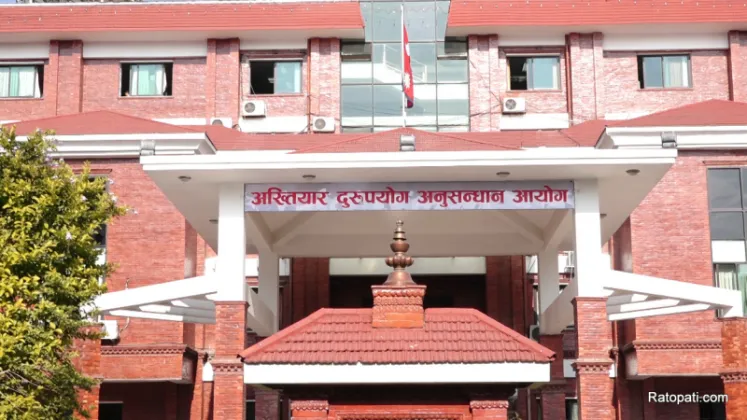
The Commission for the Investigation of Abuse of Authority (CIAA) has filed a corruption case at the Special Court in Kathmandu against five people, including former chief administrative officers of Likhu Rural Municipality in Okhaldhunga district, accusing them of embezzling Rs 3,167,200 in social security allowances. The constitutional anti-corruption body moved the court on Friday, acting on a complaint that had flagged irregularities in the distribution of the allowance in ward 9 of the rural municipality, as reported by Rato Pati, Nepal Press and Nepal Lead.
The allegations against five individuals
The case centres on the alleged embezzlement of social security allowance funds meant for residents of ward 9 of Likhu Rural Municipality. According to the CIAA, the money involved amounts to Rs 3,167,200, or roughly Rs 3.1 million, and the irregularities span two consecutive fiscal years, 2075/76 and 2076/77, which correspond to 2018/19 and 2019/20.
Among the five accused are former chief administrative officers of the rural municipality. The chief administrative officer is the senior-most civil servant posted at a local level, responsible for day-to-day administration, financial management and the delivery of services and benefits, including social security allowances. Their presence among the accused underlines the position of trust such officials occupy in the allowance distribution chain.
The key points of the case filed at the Special Court are as follows:
- Five accused: The case has been filed against five people in total.
- Former officials implicated: Those named include former chief administrative officers of Likhu Rural Municipality.
- Amount involved: Rs 3,167,200 in social security allowance funds.
- Location: Ward 9 of Likhu Rural Municipality, in Okhaldhunga district.
- Period: Fiscal years 2075/76 and 2076/77.
From complaint to prosecution
The case did not begin with the CIAA's own surveillance but with a complaint. Authorities received information alleging irregularities in the way social security allowances were being distributed in ward 9 of the rural municipality, prompting the commission to open an investigation into the matter.
The CIAA, the apex constitutional body tasked with combating corruption and abuse of authority, investigated the complaint before deciding that the matter warranted prosecution. With the filing at the Special Court in Kathmandu on Friday, the case has now moved from the investigation stage to the judicial stage.
The Special Court is the designated venue for hearing corruption and abuse of authority cases in Nepal. In filing the case, the CIAA acts in the role of prosecutor, and the court will now determine whether the accused are guilty as charged.
Why social security allowance cases matter
The social security allowance is one of Nepal's most significant direct-transfer programmes, channelling monthly cash support to senior citizens, single women, persons with disabilities and other eligible groups. Local governments such as rural municipalities and municipalities are responsible for distributing the allowance to beneficiaries in their areas, which makes local officials central to whether the money actually reaches the intended recipients.
Because the programme is aimed at some of the most vulnerable members of society, including elderly citizens who often depend on the allowance as a primary source of income, any leakage in its distribution has consequences that go beyond the financial loss recorded in official files. An embezzlement of more than Rs 3.1 million across two fiscal years in a single ward illustrates how irregularities at the local level can accumulate, ward by ward, across the country.
Okhaldhunga, a hilly district in Koshi Province, is among the many localities where the state relies on rural municipality offices to deliver such benefits to scattered settlements. The filing of the case against former senior officials of Likhu Rural Municipality is likely to renew attention on the oversight of allowance distribution in hilly and remote local governments.
What happens next
With the case now filed, the Special Court will take it up for hearing. The five accused will have the opportunity to respond to the charges and present their defence, and the court's eventual verdict will determine both their legal fate and the question of recovering the embezzled amount.
Under Nepal's anti-corruption legal framework, convictions in corruption cases can carry penalties including fines and imprisonment, along with orders for the recovery of misappropriated public funds. The outcome in this case will therefore be watched closely, both by the residents of Likhu Rural Municipality and by officials in local governments across the country who handle similar allowance distributions.
For the CIAA, the case forms part of its broader mandate to pursue corruption wherever public funds are misused, and its decision to act on a complaint demonstrates the role that such complaints play in triggering accountability. For now, the five accused await proceedings at the Special Court, where the details of exactly how Rs 3,167,200 in social security allowances went astray in ward 9 of Likhu Rural Municipality are expected to be examined in full.