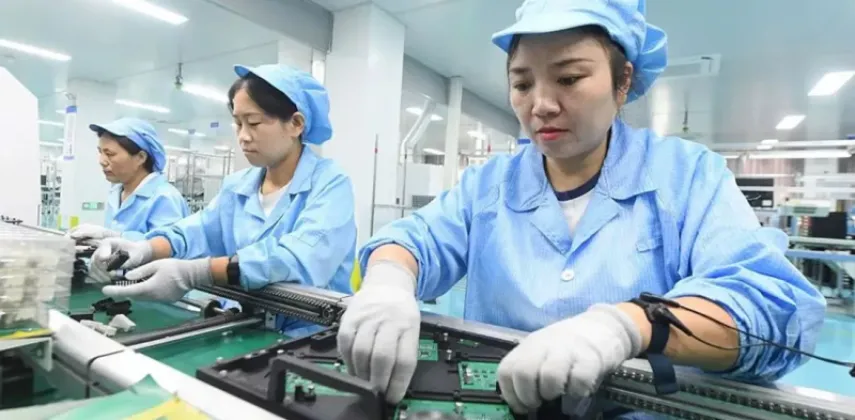
China's economy has shown a clear improvement over the past three months, and the turnaround is being powered largely from abroad. Reports published from Kathmandu say the country's growth has accelerated in recent months on the strength of rising global demand for artificial intelligence (AI)-related technology exports, even as conditions inside China continue to weaken. The result is a strikingly uneven picture: an export sector gaining momentum from the growing worldwide appetite for AI technology, and a domestic economy still held back by weak consumption and a persistent slowdown in real estate.
AI Exports Drive the Recent Acceleration
The reports, published by Nepali news outlet Ratopati in Nepali and carried in an English version as well, describe an economy whose recent improvement owes much to the technology trade. Over the last three months, exports of AI-related technology have increased as demand from overseas rises, and that expansion has been strong enough to lift the economy's overall performance. According to the reports, this export growth has helped offset the two biggest drags on China's economy at present: weak domestic consumption and the continuing real estate slowdown.
The significance of that dynamic is hard to overstate in the framing of the reports. At a time when the domestic engines of growth are sputtering, external demand for AI-linked technology has effectively carried the economy forward. The improvement is real, but it rests on a narrow base: shipments abroad of technology tied to artificial intelligence, rather than a broad-based strengthening of economic activity at home. Both language versions of the report present the rise in AI-related exports as the decisive factor behind the better numbers of the past quarter.
Gains Concentrated in One Sector
That concentration matters for how the improvement should be read. Export growth can raise output, incomes and employment in the sectors that serve foreign buyers, but the reports make clear that the benefits have not translated into a broad strengthening of the domestic economy. Domestic economic conditions remain weak despite the export-led gains, the reports note, underlining the gap between the headline acceleration and the situation on the ground.
Domestic Weakness Persists
The first of the two domestic drags highlighted in the reports is consumption. Domestic spending remains soft even as exports accelerate, which means the recent improvement has been earned externally rather than internally. In an economy where household and business spending at home would ordinarily be expected to drive momentum, the reports describe domestic consumption as a continuing weak point.
The second drag is the property market. The reports point to a slowdown in the real estate sector that has not eased, describing it as one of the key pressures that the AI export boom has had to counterbalance. Alongside weak consumption, the real estate slowdown forms the core of the domestic weakness that persists despite the country's improving export numbers. The pairing of the two drags is important: consumption and real estate together define the domestic picture that the export boom is currently being asked to outweigh.
A Two-Speed Economy
Taken together, the reports sketch a two-speed economy. On one track, AI-related technology exports are rising in step with global demand, and overall growth has accelerated as a result. On the other, the domestic economy, spanning both consumption and real estate, remains in a slowdown. The export gains have been large enough to offset the domestic weakness in the overall figures, but they have not resolved it.
The essential dynamics described in the reports can be summarized as follows:
- What is improving: the overall performance of China's economy, which has accelerated over the past three months.
- What is driving the improvement: rising global demand for AI-related technology exports.
- What is holding the economy back: weak domestic consumption and a slowdown in the real estate sector.
- The key tension: export growth is currently offsetting domestic weakness rather than being accompanied by it.
What to Watch Next
The reports were published from Kathmandu, with the Nepali original and its English counterpart delivering the same core message captured in the headline: China's economic growth is accelerating as AI technology exports increase, but the domestic economy is weakening.
What the reports leave open is whether the export engine can continue to carry the load on its own. The improvement of the past three months is tied to external demand for AI-related technology, and the reports' framing makes clear that the domestic side of the economy is not yet contributing the same momentum. Until consumption strengthens and the real estate sector stabilizes, the gap between export strength and domestic weakness, as the Kathmandu-published reports describe it, will remain the central tension in China's economic story.